







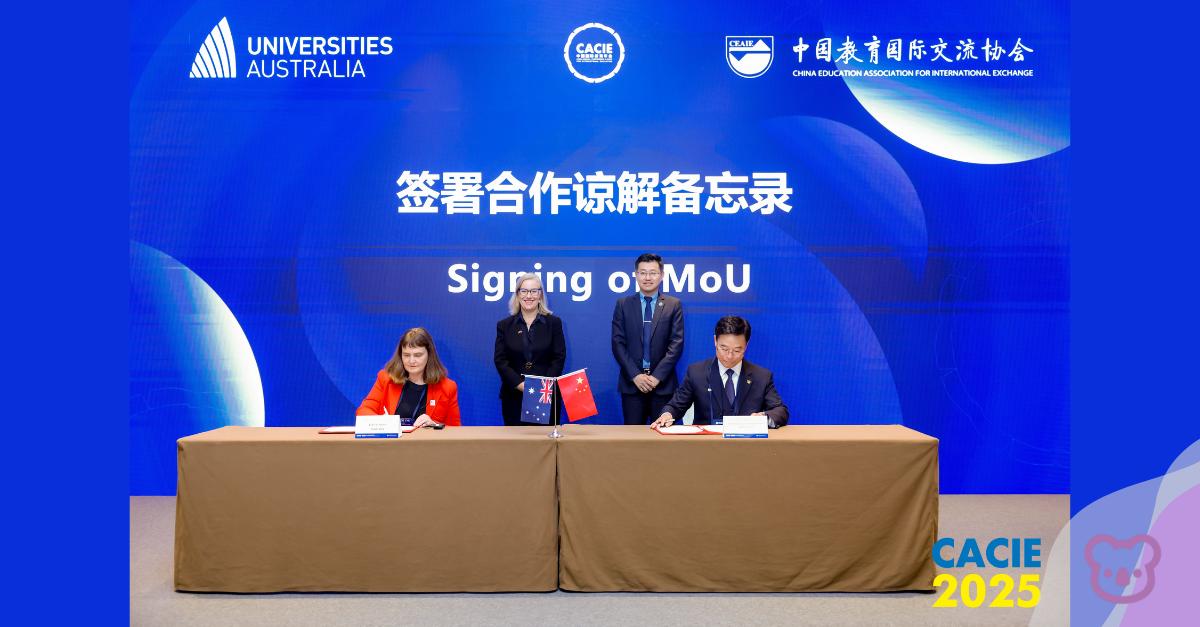
Australia and China have reaffirmed their century-long partnership in education, signing a renewed Memorandum of Understanding (MoU) between Universities Australia (UA) and the China Education Association for International Exchange (CEAIE) during a visit to Beijing this week.
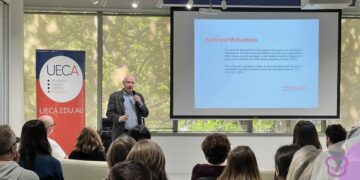
The signing coincided with the inaugural Australia–China University Leaders Dialogue and the 2025 China Annual Conference and Expo for International Education, where Universities Australia Chair Professor Carolyn Evans delivered a keynote address titled “Innovation and partnership: the next chapter in the Australia–China education relationship.”
The renewed MoU – first signed in 1999 – represents UA’s longest-standing international partnership, underscoring the enduring role of education in strengthening bilateral ties and driving knowledge exchange between the two nations.
Under the agreement, both sectors will focus on:
- Encouraging the flow of students through exchanges and internships;
- Expanding joint research in national priority areas such as climate resilience, health, and technology; and
- Building innovation ecosystems that link universities, start-ups, and industry to foster creativity and entrepreneurship.
Professor Evans said the renewal symbolised not only continuity but a shared vision for the future.
“Australia and China understand the importance of education, and this has helped bring our countries closer together for over a century,” she said. “Our collaboration has supported the exchange of knowledge, people, and ideas that have benefited both nations — and I look forward to this work continuing for our mutual benefit.”
In her keynote, Professor Evans reflected on the 100-year history of educational exchange between Australia and China — from the first Chinese students who studied in Australia in the 1920s to the tens of thousands who now form a vital part of the academic and cultural landscape.
She spoke about how education has long served as the most stable bridge between the two countries, outlasting political and economic fluctuations.
“Through even the most complex periods of our relationship, universities have continued to connect people, create knowledge, and nurture understanding,” she said. “Our institutions have become places where young people from both nations learn not only about their chosen fields, but about each other — and that is what builds lasting trust.”
Professor Evans emphasised that innovation is the currency of progress, and that partnerships between Australian and Chinese universities are already delivering tangible benefits in key research fields.
She highlighted several joint initiatives, including:
- The University of Sydney and Peking University, collaborating on sustainable food systems and climate adaptation;
- Monash University and Southeast University, partnering through a joint institute focused on advanced materials and smart cities; and
- Flinders University and Nankai University, whose Australia–China Research Centre for Personal Health Technologies is advancing medical science and biotechnology.
“Innovation doesn’t happen in isolation,” she said. “It thrives when researchers, educators, governments, and industries come together to share ideas and solve problems that matter — from energy security to public health.”
UA Chief Executive Luke Sheehy said the visit and renewed MoU demonstrate Australia’s continued commitment to responsible global engagement. “Through respectful and collaborative partnerships, we can continue to learn from one another and build a more prosperous, connected, and sustainable future,” he said.
As both nations enter the next chapter of their education relationship, the renewed agreement highlights a clear message: education remains the strongest and most enduring bridge between Australia and China — one that connects people, powers innovation, and builds mutual understanding across generations.
The Koala congratulates Universities Australia and the China Education Association for International Exchange (CEAIE) on renewing the long-standing MOU.