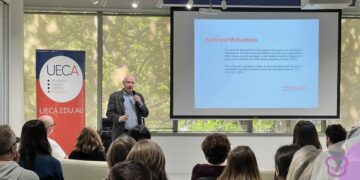









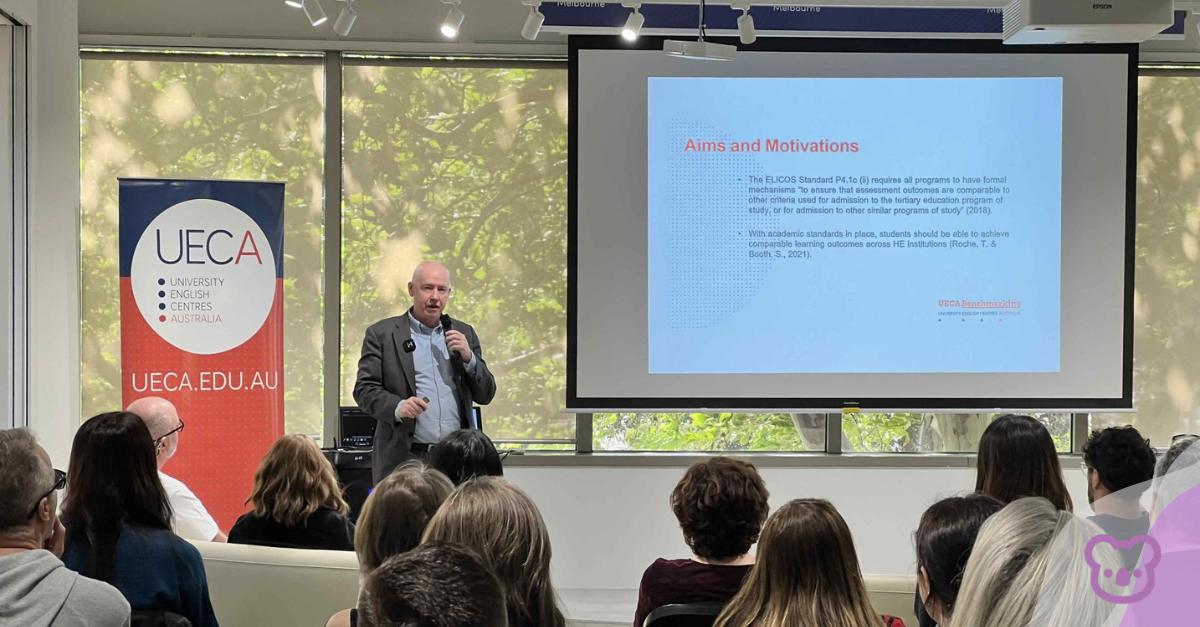
The latest iteration of the University English Centres Australia (UECA) External Referencing through Benchmarking project has been launched, marking a new chapter in an initiative which underpins quality assurance in English language pathways.
UECA is well known for its professional development program and its network facilitation, but is also committed to research which informs the work of University based English language centres and stimulates quality improvements. The benchmarking initiative is an important feature of that aspect of UECA’s work.
UECA members offer Direct Entry (DE) English programs which develop both English and other tertiary study skills which support student success in Australian higher education. These courses are the gateway to higher education for thousands of international students in Australia each year. It is therefore vitally important to provide evidence that students admitted via these pathways are well prepared for university study and satisfy the criteria used for admission to the tertiary education course of study or for admission to other similar courses of study.
Benchmarking across UECA members is intended to ensure the quality of assessment standards in ELICOS Direct Entry courses. It provides a robust mechanism to demonstrate assurance of learning and comparability of outcomes. By verifying the alignment of assessment practices and standards with external reference points such as the Common European Framework of Reference, institutions can validate the exit standards of their DE cohorts. The process also supports compliance with the ELICOS Standards (2018), which require providers to monitor, review and externally reference assessment outcomes. Equally significant is the collaborative dimension of the work. Participating universities not only review and calibrate assessment samples across providers, but also share good practice, reflect on innovations, and contribute to sector-wide recommendations.
The first benchmarking exercise was conducted in 2018/19. It focused primarily on written assessments, student work samples, and cross-institutional moderation as well as review of assessment policies, processes, and outcomes . Through the combination of peer review and external referencing, member institutions gained confidence that their DE students were achieving learning outcomes consistent with sector-wide expectations. The activity and resulting report from Round One also provided regulators with clear evidence of compliance with ELICOS Standard P4 requirements. The results demonstrated the robustness of DE assessment practices and also reassured stakeholders that entry standards into higher education were being consistently upheld. With this latest initiative, UECA aims to extend this work to further inspire confidence among regulators, institutions, and students alike.
The new UECA benchmarking, beginning in October 2025 and extending through 2026, builds on this foundation but also recognises the transformative impact of Generative AI. For the first time, benchmarking will explicitly examine how institutions are adapting assessment design, delivery, and moderation to maintain validity, reliability, and fairness in the face of AI-assisted writing tools.
Timelines Ahead
The renewed project will roll out in clear stages: refining scope and processes was undertaken from July to October 2025; the reviewing of assessment policies and processes between November 2025 and March 2026; benchmarking Direct Entry units and assessments from April to July 2026; reflection and consolidation in August and September 2026; and a final review with outcomes and recommendations between October and December 2026. Each participating institution will receive a consolidated report of findings and recommendations, strengthening internal quality assurance while adding to a national body of knowledge. These timelines provide institutions with a structured pathway to engage deeply, embed improvements, and contribute to a stronger, more coherent national framework for Direct Entry programs.
Johanna Motteram has recently been appointed to manage the project. Johanna brings extensive expertise in English language assessment and project management, a PhD which investigated language test constructs, and an MA in Applied Linguistics. She has led large-scale assessment development projects for the British Council, currently serves on the NEAS Quality Endorsement Committee, and was a member of the ALTAANZ committee from 2013 to 2023. Her appointment underscores UECA’s commitment to excellence in benchmarking and collaborative best practice across the sector.
Simon Winetroube, UECA President said, “The first benchmarking project was enormously successful and highly regarded, not just for the outcomes of the research but also for the learning and development which the process fostered. Since then, our members have been asking us to repeat it. Now is the right timing to do that, but with additions and refinements to reflect the ever-changing context. Together with our work on tracer studies, this also provides evidence of the success of our University ELICOS DE programs in preparing our students for their future education.”
Aparna Jacob has worked in international education since 2008, beginning as a teacher before moving into academic leadership across private and university sectors in Sydney. A former English Australia board member for over eight years, she is now Director of Studies at UNSW College, where she leads Academic English programs and champions the evolving role of international education in shaping global futures.
Ben Doran is the Manager, Pathway Programs at Swinburne University of Technology. With over 20 years of experience in the international education sector, he has held a range of leadership and managerial roles in relation to ELICOS, Foundation Programs and Academic Learning Support. Ben has a keen interest in the role played by pathway programs in preparing international students for future success, with his current position focused on curriculum management and quality assurance for Swinburne pathway courses delivered both onshore in Australia and offshore across a range of locations. Ben holds a Master of Applied Linguistics (TESOL) from Macquarie University and is a committee member for University English Centres Australia.