





The Koala News
  • News
    • All
    • Compliance
    • Ed-Tech
    • Market Update
    • Opinion
    • Policy
    • Profile
    • Sponsored Content
    • Student Mobility
    • Student Recruitment
    • Student Support
    • TNE
    • World
    Melanoma Breakthrough and Free Tax Clinic Among 2025 Shaping Australia Awards Winners

    Melanoma Breakthrough and Free Tax Clinic Among 2025 Shaping Australia Awards Winners

    Notre Dame Explains Nursing Enrolment Pause

    Notre Dame Explains Nursing Enrolment Pause

    Education as a Tool of Statecraft

    Education as a Tool of Statecraft

    TEQSA publication: AI assessment reform for the age of artificial intelligence

    Why Universities Shouldn’t Expect AI to Run Student Support

    Uni further tightens admissions settings to reduce visa risk

    University of Newcastle First to Sign as UniReady Global Brings AI to Admissions Verification

    NOM minus one – news from the frontline in Canada

    NOM minus one – news from the frontline in Canada

    Sector in Flux: Recent webinar stocktakes where the sector stands today, and where it may be heading

    Sector in Flux: Recent webinar stocktakes where the sector stands today, and where it may be heading

    International education largely sidelined at ATEC hearing

    International education largely sidelined at ATEC hearing

    More vibes, less validity? The feel-good fictions of marketing labels that quietly strangle strategy

    More vibes, less validity? The feel-good fictions of marketing labels that quietly strangle strategy

    CELPIP Test Now Accepted for Australian Migration Visas

    CELPIP Test Now Accepted for Australian Migration Visas

    Trending Tags

    • Austrade
    • English
    • Student Data
    • Awards
    • Schools
  • About
  • Contributors
  • Advertise
  • Jobs
  • Events
  • Subscribe
  • Archive
  • Shop
  • Contact
No Result
View All Result
The Koala News
  • News
    • All
    • Compliance
    • Ed-Tech
    • Market Update
    • Opinion
    • Policy
    • Profile
    • Sponsored Content
    • Student Mobility
    • Student Recruitment
    • Student Support
    • TNE
    • World
    Melanoma Breakthrough and Free Tax Clinic Among 2025 Shaping Australia Awards Winners

    Melanoma Breakthrough and Free Tax Clinic Among 2025 Shaping Australia Awards Winners

    Notre Dame Explains Nursing Enrolment Pause

    Notre Dame Explains Nursing Enrolment Pause

    Education as a Tool of Statecraft

    Education as a Tool of Statecraft

    TEQSA publication: AI assessment reform for the age of artificial intelligence

    Why Universities Shouldn’t Expect AI to Run Student Support

    Uni further tightens admissions settings to reduce visa risk

    University of Newcastle First to Sign as UniReady Global Brings AI to Admissions Verification

    NOM minus one – news from the frontline in Canada

    NOM minus one – news from the frontline in Canada

    Sector in Flux: Recent webinar stocktakes where the sector stands today, and where it may be heading

    Sector in Flux: Recent webinar stocktakes where the sector stands today, and where it may be heading

    International education largely sidelined at ATEC hearing

    International education largely sidelined at ATEC hearing

    More vibes, less validity? The feel-good fictions of marketing labels that quietly strangle strategy

    More vibes, less validity? The feel-good fictions of marketing labels that quietly strangle strategy

    CELPIP Test Now Accepted for Australian Migration Visas

    CELPIP Test Now Accepted for Australian Migration Visas

    Trending Tags

    • Austrade
    • English
    • Student Data
    • Awards
    • Schools
  • About
  • Contributors
  • Advertise
  • Jobs
  • Events
  • Subscribe
  • Archive
  • Shop
  • Contact
No Result
View All Result
The Koala News
No Result
View All Result
Home News Market Update

Education as a Tool of Statecraft

Tracy HarrisbyTracy Harris
February 25, 2026
in Market Update, Policy
Education as a Tool of Statecraft
Share on LinkedinShare on TwitterShare on FacebookShare via Email

A new options paper argues that Australia should see education not simply as a domestic policy portfolio or an export industry, but as a central instrument of statecraft.

“Education providers contribute to foreign policy goals, shaping positive outcomes at individual, community and country-wide levels. Their work is arguably one of the best tools Australia has at its disposal to support the development of its neighbours and amplify Australia’s global reach,” the paper argues.

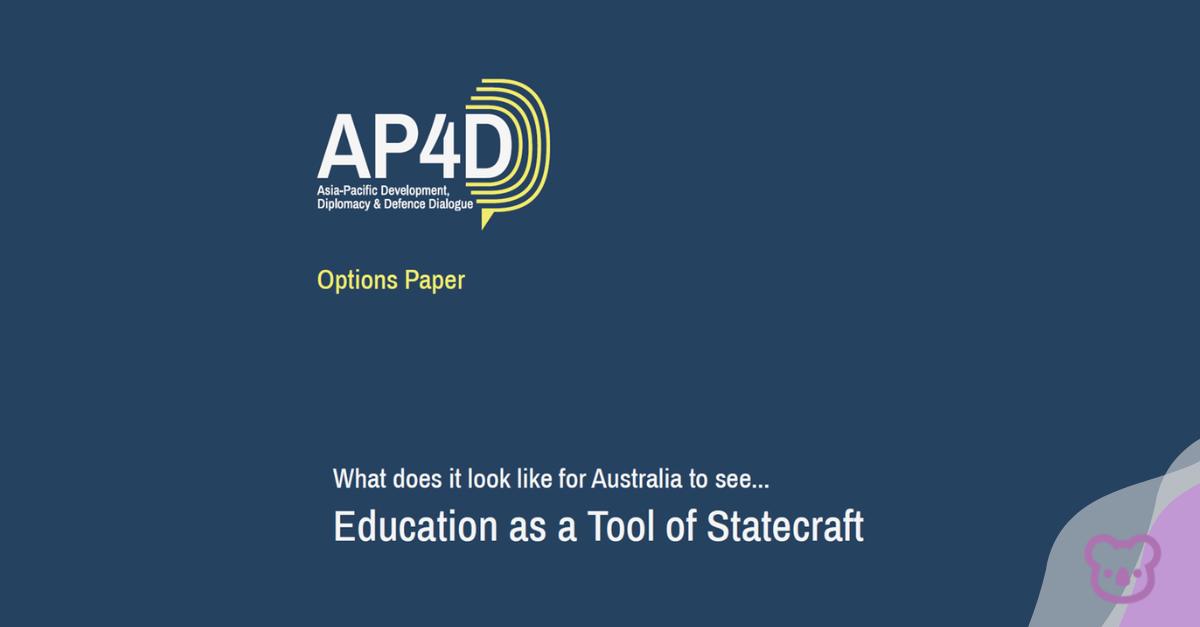
The paper, What does it look like for Australia to see Education as a Tool of Statecraft, was released by AP4D (Asia-Pacific Development, Diplomacy & Defence Dialogue) last week, following consultations with 105 education experts and practitioners from Australia and across the region.

In a pre-recorded message during the webinar launch, Assistant Minister for International Education Julian Hill echoed the paper’s central theme, describing international education as “an instrument of Australia’s statecraft”.

Hill said the sector now strengthens global ties through both institutional and people-to-people linkages and acts as “both a key enabler of the traditional domains of statecraft – foreign affairs, defence, trade and aid, international development – but also a pillar in its own right, part now of Brand Australia.”

However, he suggested that the broader value of the sector is not widely understood.

“The public understanding of the sector and the focus of policy has been predominantly on the economic contribution, be it GDP, jobs, or university revenue. That remains important,” Hill said.

“But looking at the geopolitical circumstances around us, we need to more directly value our international education and skills sector as a national asset, important for building and maintaining enduring relationships with our partners.”

A fragile asset

The consultations behind the paper identified concerns about reputational risk, policy volatility and financial vulnerability. Participants noted that international students are described in policy documents as contributing to Australia’s soft power and regional engagement, while also being referenced in domestic debates about housing and cost-of-living pressures. The paper observes that any significant reduction in international enrolments would have financial implications for universities and could affect Australia’s reputation as a global education leader.

The paper identifies education’s contribution to statecraft across three domains:

  • International development: international development, institutional strengthening, societal impact
  • Diplomacy and trade: economic prosperity, soft power, generational connections, relationships
  • Defence and security: conflict prevention, regional stability and resilience, sovereign capability

A tool for development

The paper positions education as a longstanding and central pillar of Australia’s development program. It highlights the role of scholarships, transnational education, research collaboration and institutional partnerships in supporting capacity-building across the Indo-Pacific.

A tool for diplomacy and trade

Education is described as both an economic contributor and a diplomatic asset. While the sector remains Australia’s largest services export, the paper emphasises its role in building enduring people-to-people links.

A tool for defence and security

The paper outlines education’s contribution to sovereign capability through workforce development, research and innovation. Beyond workforce development, the paper argues that education contributes to regional stability by strengthening institutions, fostering economic opportunity and supporting peaceful societies.

Education as a tool of statecraft

The paper reports broad agreement among those consulted that education should be recognised as a central pillar of Australia’s statecraft. Participants described education as contributing not only to sovereign capability and economic prosperity, but also to diplomacy, development and regional security.

While many examples of education-led engagement are already underway across universities, schools and vocational institutions, consultees observed that these efforts are often fragmented. There was support for a more coherent national approach, clearer articulation of responsibilities and stronger coordination between government and the education sector to maximise education’s strategic impact.

Opportunities

The paper argues that Australia holds a clear comparative advantage in education, with a disproportionately high number of globally ranked universities relative to its size. It also points to growing demand for international education in Southeast Asia, driven by demographic trends and expanding middle classes.

Australia’s proximity to the region, established reputation and extensive alumni networks are identified as strategic strengths. The paper suggests that, with coherent policy settings, education represents a significant opportunity for Australia to strengthen its regional influence.

Looking ahead

In setting out its vision, the paper recognises human capital as Australia’s primary asset and calls for the education sector to be afforded greater status in building sovereign capability and strengthening Australia’s global position. It calls for stronger regional literacy and language learning embedded across curricula.

Education’s full potential as a tool of statecraft, the paper argues, will be realised through a coherent whole-of-nation approach, underpinned by trust, predictable policy settings and closer collaboration between government and the sector.

The options paper can be downloaded here.

Tags: Statecraft
Previous Post

Why Universities Shouldn’t Expect AI to Run Student Support

Next Post

Notre Dame Explains Nursing Enrolment Pause

Tracy Harris

Tracy Harris

Tracy Harris is currently interim Chief Executive Officer of the Australian Guild of Education, bringing more than three decades of leadership experience across the international education sector, spanning universities, pathway providers, the federal government and the not-for-profit sector. She is also Principal of Tracy Harris Solutions, a consultancy through which she undertakes independent work and sector commentary. While Tracy Harris Solutions remains active, particularly for her sector commentary, her consultancy work is currently operating at reduced capacity during her tenure as interim CEO. Previously, Tracy led Swinburne College as General Manager and Dean and was Executive Director, Global Development and Performance at RMIT University. She has also held senior roles in the public sector, including with the Australian Trade and Investment Commission (Austrade), involving overseas representation, and within the former Australian Education International (AEI). Tracy also serves on a number of boards across the education sector, including the International Education Association of Australia (IEAA). All views expressed in Tracy’s writing are her own and do not represent the views of any organisation with which she is associated.

Next Post
Notre Dame Explains Nursing Enrolment Pause

Notre Dame Explains Nursing Enrolment Pause

What Now? What Next? What Now? What Next? What Now? What Next?
Cambridge Cambridge Cambridge
iDAT Logo iDAT Logo iDAT Logo
The Koala News

The Koala is intelligent, it can be cheeky, it aims to be informative and is uniquely Australian though proudly global.

It unashamedly promotes best practice in International Education. It loves seeing students succeed via vibrant offerings and a supporting mix of policy, recruitment and support settings.

Follow the Koala

Browse by Category

Subscribe: Have the Koala Delivered to your Inbox

  • About
  • Terms of Use
  • Privacy Policy
  • Contact

© 2023 The Koala News

No Result
View All Result
  • News
  • About
  • Contributors
  • Advertise
  • Jobs
  • Events
  • Subscribe
  • Archive
  • Shop
  • Contact

© 2023 The Koala News