







The international education sector is under increased scrutiny. Negative headlines, political commentary and public debate often highlight our sector’s challenges: integrity issues, fraud and exploitation, growth at the cost of quality, housing pressures and at times outright racism. At best, international education is seen as a lucrative export bolstering the economy and, at worst, students are portrayed as cash cows sustaining underfunded universities or lining the pockets of commercial operators.
Sometimes these stories reflect real problems. More often, they reflect how poorly we organise, communicate and articulate our purpose. Too often, our response has been reactionary: talk, debate and then slide back into ‘business as usual’ until the next media or political crisis.
We can’t continue to dodge bullets. We must earn the trust and buy-in of everyday Australians, industry, government and students. That means redefining the purpose of international education in today’s Australia – not simply as an export industry, but as a national undertaking tied to our future prosperity, identity and place in the world. We need to be open to doing things differently, not just polishing our talk.
Jobs and Skills Australia’s International Students Pathways and Outcomes Study positions international education as a workforce strategy, making it clear that international graduates are essential to meeting Australia’s skills needs over the medium to long term. International students and graduates already help Australia build capability, strengthen our economy and they can have a far greater role in securing our future prosperity.
Beyond workforce contributions, international education is a pillar of soft power. Julian Hill MP, Assistant Minister for International Education, speaks passionately about cultural exchange, friendships and the role of education in statecraft.
The three pillars of workforce capability, soft power and educational impact are solid foundations to build from. They offer a renewed purpose for our work and a credible platform for rebuilding social licence and national confidence in the role of international education.
Importantly, international education is for Australian students too. Mobility experiences, diverse classrooms and an internationalised curriculum build intercultural skills, open minds and friendships across borders – helping Australian students gain capabilities and perspectives they need to thrive in today’s interconnected world.
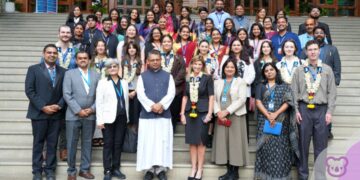
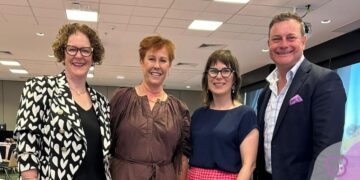
This session at AIEC was a space to reflect on the role of international education in an era of nationalistic interest, geopolitical uncertainty, climate crisis, migration pressures and harsh economic realities like the high cost of living and an ageing population. It was an opportunity to define how our sector can act with purpose, collaborate effectively and contribute meaningfully to Australia’s future.
Together, we examined the challenges and potential solutions for the road ahead, framed around four themes: national future, media and myths, political power and everyday Australians.
National future
Australia’s prosperity in the next decade depends on productivity and capability, not just capital. International education can help fill workforce gaps, strengthen regional economies and prepare Australians and international students to thrive in a globalised world.
The question is not whether international education contributes, but what it could look like if international education was part of our national strategy, not just a revenue line.
Media and myths
Negative perceptions persist. Misconceptions about migration, students “taking jobs” and overstretched communities dominate headlines, eroding trust. These myths are amplified when we fail to articulate our sector’s true purpose.
Political power
International education is often treated as a political football, tied to debates about housing, migration and broader university funding. Students themselves have no direct voice.
The Canberra conference discussion focused on how the sector can change this. Strategic engagement is essential at all levels of politics and government: understanding stakeholders, aligning with their priorities and ensuring the sector’s voice is present and influential before decisions are made.
Everyday Australians
To gain broad support, we must connect international education to what matters most in daily life: good jobs, safe communities and a fair go for families. International graduates are often seen as taking opportunities from Australians, but in reality, they fill labour gaps and are part of our communities.
Educated in Australia, international students understand our values and enter the workforce ready to contribute. Boosting the workforce in healthcare, aged care, hospitality, engineering, IT, infrastructure and other critical sectors international students create more security, more jobs and opportunities for everyone.
What next?
The AIEC discussion left no doubt: failure is not an option. The sector must rejuvenate with purpose, courage and collaboration. A range of tangible actions were discussed in Canberra, under the umbrellas of these four areas:
- a coordinated media and advocacy effort
- an industry engagement strategy
- a focused government relations plan
- a community impact strategy
This is about more than a campaign, it’s about building bridges and demonstrating that international education is part of our national story and future – in a way that resonates with broader Australia.
This mission needs all of us. Together, we can transform the narrative, strengthen our nation and ensure international education is recognised not just as an export, but as a strategic national priority for today’s Australia.
We know the clock is ticking and it’s time to move from discussion to action. On the back of the conference session, we plan to come together, combine our shared knowledge and invite input to create what could be used as a mini plan towards combating the negative social license of our sector in Australia.
If you would like to support this effort or be involved in some way, we encourage you to reach out. We will explore opportunities to contribute as the next steps take shape in the new year.
Elissa Newall, Senior Partner, Edified, Tracy Harris, Principal, Tracy Harris Solutions, Melissa Banks, Senior Partner, The Lygon Group, Dirk Mulder, Founder and CEO, The Koala News