










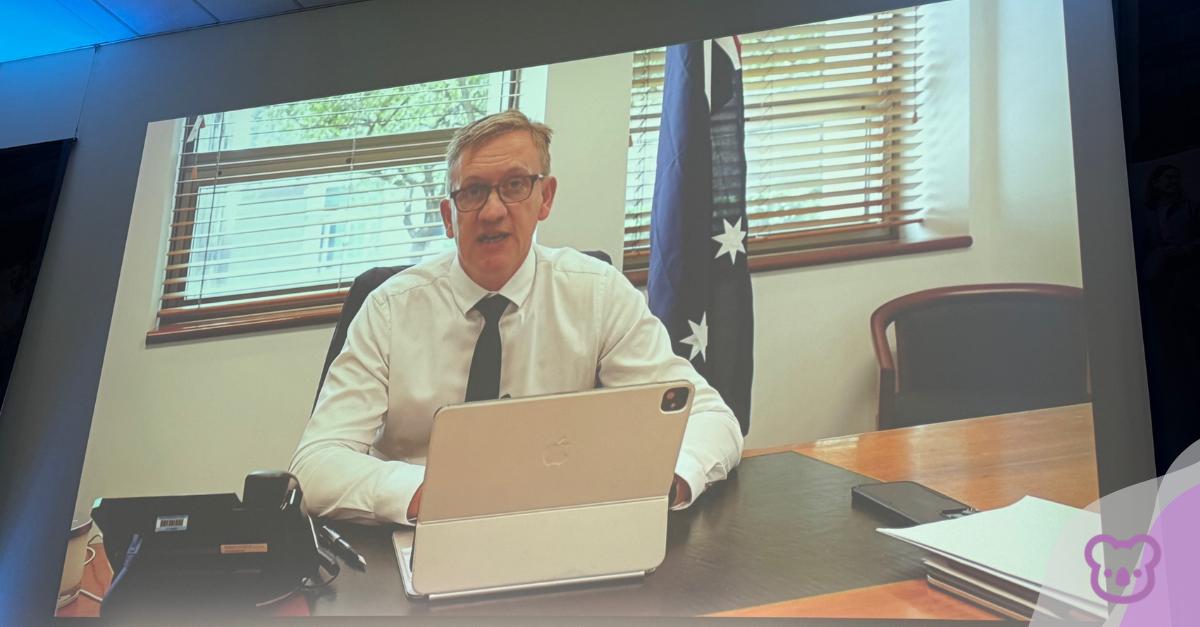
Assistant Minister for International Education Julian Hill acknowledged recent slowdowns in student visa processing from some regions in an address at the International Education Association of Australia (IEAA) National Symposium last Friday, but was unapologetic, making it clear that integrity would remain the government’s priority in 2026. “We’re not taking the risk of letting in non-genuine students,” he said.
Appearing in a pre-recorded message, Hill addressed criticism of the government’s out-of-cycle changes in evidence levels for student visa applicants from several South Asian countries earlier this year. He said the decision followed intensive departmental sampling, which revealed spikes in fraud indicators including concerns around English proficiency, identity and financial documentation.
Hill said some earlier country-level settings had been “weaponised” in certain markets by disreputable agents and intermediaries, who were telling prospective students they could apply without proper English language or financial evidence. As a result, a significant number of non-genuine applications were already sitting in the pipeline before the changes were made.
He acknowledged that processing had slowed in affected countries, explaining that the Department is now returning to applicants to request additional documentation as that residual caseload is worked through.
Hill also indicated that the government would intervene quickly if risk indicators spike, saying that “if anyone thought that this government [was] going to sit around and watch the movie unfold again, with popcorn, as…the previous government did for too long, then they’d have rocks in their heads”.
The clarification comes amid sector criticism that the changes were triggered by the Assistant Minister’s visit to the region at the end of 2025, something Hill rejected, reiterating that the decision was based on the sampling results. He also noted a significant decrease in the grant rates across a number of South Asian countries in recent months.
Hill further emphasised that evidence levels, Ministerial Direction 115 and the National Planning Level do not determine visa outcomes, which are ultimately made by decision-makers based on the evidence before them.
“Egregious end of provider evidence levels”
In a significant part of his speech, Hill explicitly referenced Section 97 of the ESOS Act, the provision that gives the Immigration Minister power to suspend providers from recruiting international students. He flagged that the government is looking into providers with extremely high evidence levels, or what he called the “more egregious end of provider evidence levels” and associated concerns with “systemic misuse of the migration system”.
“Certain providers should not be surprised to receive letters of concern in the near future,” he warned.
English language
Work is underway in the Department of Education to examine English language integrity issues in the Indian and Chinese markets, given their scale. Hill noted that in parts of India, visa interviews and follow-up documentation had revealed instances where applicants’ English proficiency did not align with their applications.
In relation to China, he confirmed that more intensive sampling and a “deep dive” into the caseload, particularly students entering Group of Eight universities, is underway, following community concerns about English standards. Hill said early results are encouraging, with no evidence of systemic fraud or misrepresentation through the streamlined visa pathway and interview samples indicate good proficiency. The review will continue until a statistically valid sample size is reached to ensure “community confidence”.
Onshore student transfers
When speaking about recent changes to the National Code of Practice for Providers of Education and Training to Overseas Students 2018 preventing the payment of agent commissions for students transferring providers from onshore, Hill flagged that this remains an area of concern for the government. He called out concerns about some universities experiencing 20-30 per cent transfer flows in the first six months of study, and said that the government would be considering what other responses might be necessary to better manage these flows.
Student Voice
Hill also referenced a student roundtable he convened last November, describing overwhelmingly positive feedback about Australia’s quality and reputation.
Students nonetheless raised concerns about financial pressure, isolation and post-study employment. Hill said further roundtables are planned for 2026 to inform the work of the International Education Council, complementing insights from Student Experience Survey data.
Transnational Education
Hill spoke extensively about transnational education, drawing on recent visits to India and Sri Lanka. He also framed TNE in the context of it being a natural consequence of a more managed onshore system and a growing strategic priority for the government. In referencing the growing footprint of Australian providers engaged in TNE, he emphasised that offshore delivery must meet the same standards as onshore provision.
“If one provider…does stupid stuff in a market and is not supervised properly, then that can smear all of us and drag everyone down,” Hill said.
International Education and Skills Strategic Framework
Readers may recall that in 2024 the government released a draft International Education and Skills Strategic Framework and invited sector feedback. With the failure of the ESOS Amendment Bill and the lead-up to the 2025 election, the draft was parked but an updated version will be released later in 2026.
According to Hill, the Framework will “outline priorities and address what kind of growth we want to see in international education in the next few years and decade”.
Hill concluded by reiterating that the government would continue to argue for a sustainable sector, while prioritising quality and integrity to maintain what he described as the sector’s social licence with Australians.
International education, he said, is “a really important aspect of Australian statecraft, not just in the export sector”.