







The Department of Education has released a series of fact sheets to support providers following the passage of the Education Legislation Amendment Bill (Integrity and Other Measures) Bill 2025 which amends the Education Services for Overseas Students Act 2000. The five fact sheets cover education agents and agent commissions, ‘Fit and proper provider’ requirements, provider registration requirements and processing, course cancellation powers and internal review processes.
Education agents and agent commissions
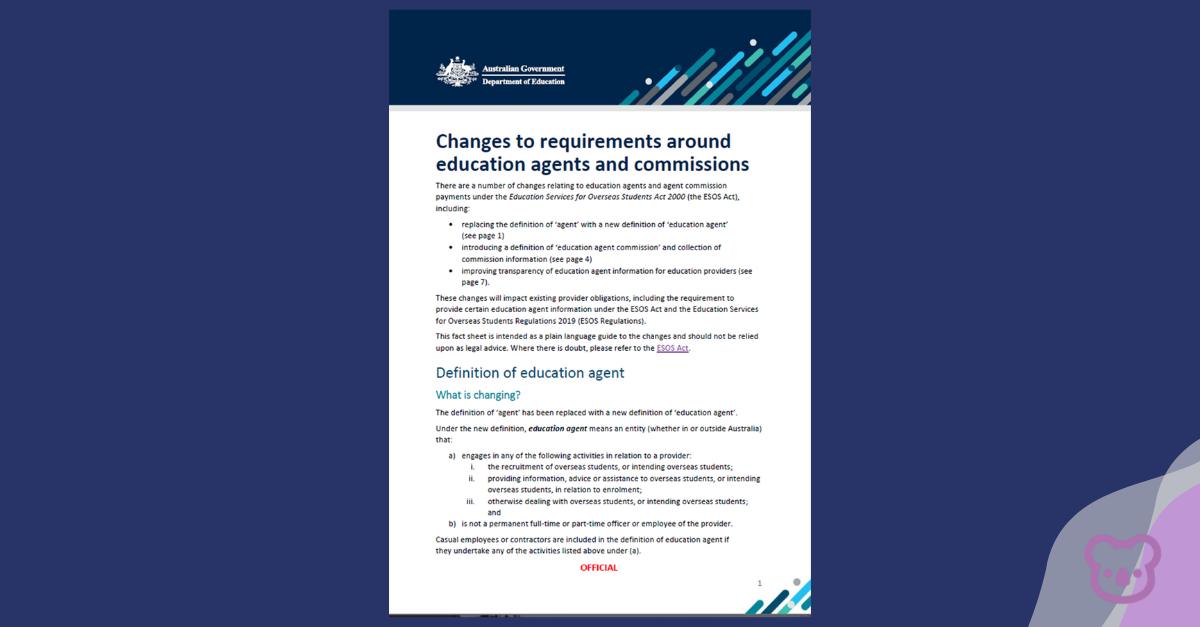
The new definition of education agent was the issue raised most frequently in the submissions to the Senate Committee inquiry into the 2025 Bill. The sector was concerned that the definition is too broad, and the fact sheet will do little to assuage these concerns.
While permanent full-time and part-time employees of a provider are exempt from the definition, casual employees and contractors who undertake activities defined in the fact sheet will fall under the definition of an education agent. While the FAQs determine that short-term hires are not intended to be classified as an education agent, it goes on to say only if they are temporarily filling the role of a permanent employee. Examples that come to mind for this author that could meet the definition include casuals hired during peak periods that are deployed to collect tuition fees or update PRISMS.
On the face of it, a senior staff member on contract (ie International Deputy Vice-Chancellors) who meets an individual prospective student and their parents at an overseas event and goes on to advise the student about the merits of their university and courses, encouraging them to apply, would meet the definition of education agent. But the fact sheet says that senior staff on long-term contracts with a provider may meet the definition of a permanent employee, and refers providers to the Fair Work Ombudsman for definitions of different types of employees.
Providers are told to consider the legislation and supporting material to determine if an individual would be classed as an education agent, leaving every individual provider with the task of determining which of its employees could count as an education agent.
Why does this matter? As a start, education agents must be listed on a provider’s website and details reported in PRISMS. And while the fact sheet does not include ‘salaries’ in the examples of what counts as an education agent commission, this will be another consideration for providers in determining what information needs to be collected and reported.
Another concern for the sector was who would be able to see education agent commission data. The fact sheet says that “where appropriate and necessary to comply with legislative obligations, this information will be deidentified for privacy and commercial in confidence reasons. This information will not be available to education agents or the public”.
This author predicts these changes to the ESOS Act are likely to be the most fraught for education providers to get their heads around!
‘Fit and proper provider’ requirements
Cross-ownership and control arrangements between providers and education agents will be a consideration for ESOS agencies when determining whether a provider is ‘fit and proper’ to be CRICOS-registered.
The fact sheet clarifies what action needs to be taken by a registered provider with ownership of an education agent, ie notify the ESOS agency within 10 business days of the change. Existing arrangements before the commencement of the Bill do not need to be reported.
It also notes that universities with shares in IDP do not need to be reported as these are exiting arrangements and not controlling interests.
Finally, it is important to note that just because there is ownership or control, this is not an individual ground for determining whether a provider is not fit and proper.
Course cancellation powers
The Government agreed to amendments in the Senate to this aspect of the Bill, following concerns about unfettered powers given to the Minister. The fact sheet clarifies that the Minister must consult with the relevant regulator, the Secretary of the Department of Education and any other persons or entities specified in a legislative instrument made by the Minister, prior to making a legislative instrument to cancel courses.
Of note in the fact sheet FAQs: What is meant by courses that ‘raise public interest concerns’?
Courses that raise public interest concerns, for the purposes of this measure, include courses that are evidently exploitative or that have serious integrity issues. For example, courses that are regularly used by students to subvert immigration and education systems may be considered by the Minister as raising public interest concerns.
Provider registration requirements and processing
Last minute amendments in the Senate to the 2025 Bill added all registered higher education providers as well as TAFEs to the exemption of the requirement for new providers to deliver to domestic students for 2 years prior to being eligible for CRICOS registration. The fact sheet reflects this and includes the other exemption categories. The fact sheet provides clarification about who is an overseas student, what is a consecutive study period and so on.
This fact sheet also covers instruments to suspend applications for registration or suspend processing of applications and automatic cancellation of registration following non-delivery of courses to overseas students, with useful FAQs.
Internal review processes
The final fact sheet is a short explanation of the changes to internal review processes allowing a stay of the enforcement of the decision while a review is underway.
All Fact Sheets are available here.