








The Koala has been perched in the high branches of the international education sector for a long time and sometimes the view can be, frankly, heart-wrenching.
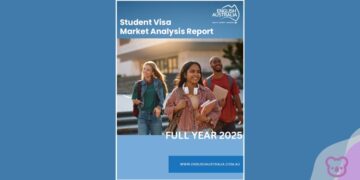
Most in the international education world are aware that the English language teaching sector in Australia has had a particularly rough time of it of late. However, the newly released report from English Australia, the Student Visa Data Report for the Full Year 2025, reads almost like a post-mortem of a world-class Aussie industry being systematically dismantled, its institutions closing doors after decades of success, and thousands out of work.
The report provides in-depth analysis of the recently released Department of Home Affairs data on student and temporary visa numbers – applications, grants, and grant rates. In an environment often clouded by “misunderstood and misinterpreted” data, English Australia’s CEO, Ian Aird, has a rare ability to translate complex data into clear, real-world impacts and insights.
And those impacts are sobering to say the least. Having been through a “veritable rollercoaster ride” since COVID, 2025 saw the independent ELICOS sector with the lowest student visa grants, lowest grant rates and lowest application numbers on record for the second year in a row.
That’s 20 years of investment and growth wiped out. In fact, 2025 saw 25% fewer Independent ELICOS visas applications granted than 2005.
And you’d forgive ELICOS for feeling targeted by government. The report shows shocking disparity between sectors when it comes to grant rates. For instance, Chinese nationals applying for a student visa to study at university were granted their visa 95% of the time – 3% down from the 2019 grant rate of 98%. However, if they apply for a visa to study ELICOS, Chinese nationals are only granted a visa a staggering 29% of the time – down from 73% in 2019.
With those odds, you can understand why applications for independent ELICOS fell to a 20-year low in 2025. That’s a 39% fall compared to 2024 an eye-watering 47% fall compared to the pre-COVID figure of 2019.
So, what’s driven the sector “off the cliff”?
English Australia’s report is blunt. The student visa application fee hikes of 2024 and 2025 along with falling visa grant rates have quite simply made Australia unattractive to ELICOS students. These students have plenty of alternatives to Australia — and they are choosing them.
The report drills down into the data to isolate the impact of the 2024 and 2025 visa fee increases and shows that their effect was “clear and severe.”
On 1 July 2024, the government increased the non-refundable student visa application fee from $710 to $1,600. Independent ELICOS visa applications fell immediately. There were more than 5,000 applications in June of 2024. This fell to 2,900 applications in July. In total, H2 of 2024 saw 38% fewer applications for student visas for Independent ELICOS study than in H1 of the same year.
Then, in 2025, the government put the student visa application fee up by another 25% to $2,000. Immediately ELICOS applications fell further. There were 3,576 applications in June. This fell to just 1,365 for July. In total, H2 of 2025 saw 25% fewer applications than H1 of 2025.
In conversation with Aird, he made clear why this visa fee has impacted ELICOS but not higher education, pointing out that for the average university student, the $2,000 visa fee increases their course cost by just 3% to 4%. However, for the average ELICOS student, it represents an additional 30% to 40% of their course cost. It’s simply disproportionate.
Aird also notes that the university applicants will pay the money because they get a three-to-five-year visa and they get it 95% of the time. Meanwhile, an ELICOS applicant is asked to pay the same amount to get a six-month visa with a 25% chance of getting nothing but a visa refusal letter. One in five simply lose their $2,000 and their hopes and dreams of studying English in Australia.
At what cost all this?
The English Australia report also offers a “sobering estimate” of the human cost, positing that the loss of students has meant a loss of between 5,000 and over 9,500 full-time equivalent (FTE) jobs. The report notes that we are seeing a “growing number of great providers close their doors altogether or simply cease to deliver ELICOS”. Sadly, the Koala can confirm, this includes university ELICOS colleges, one with over 40 years’ history in the sector, as well as TAFEs and multiple private colleges.
Of course, the damage extends beyond standalone English enrolments. For starters, ELICOS has long been a key pathway to higher education, equipping students, not just with English language proficiency, but also with the skills and knowledge that has seen them consistently outperform many international student cohorts who don’t go through onshore ELICOS before starting an Australian degree program.
ELICOS students are also well known for the fact that many come for a good time, not a long time. That means they make an outsized economic contribution to Australia’s hospitality, tourism and retail sectors. No more it seems to the lament of many tourism and hospitality operators.
So, where to from here?
The one-size-fits-all $2,000 student visa application fee clearly needs to be adjusted. And urgently.
Last year, English Australia, ITECA, and IEAA signed a joint letter to the federal government proposing that the fee should be significantly reduced for non-award students applying for a stay of less than 12 months. That includes ELICOS, school exchange programs, and study abroad. Some suggested the fee be reduced to $1,000 for this cohort. Others suggested a sliding scale depending on the length of stay.
What’s clear to the Koala is that the sector needs more than just a change in policy. It needs a restoration of trust.
English Australia members can access the report here.