






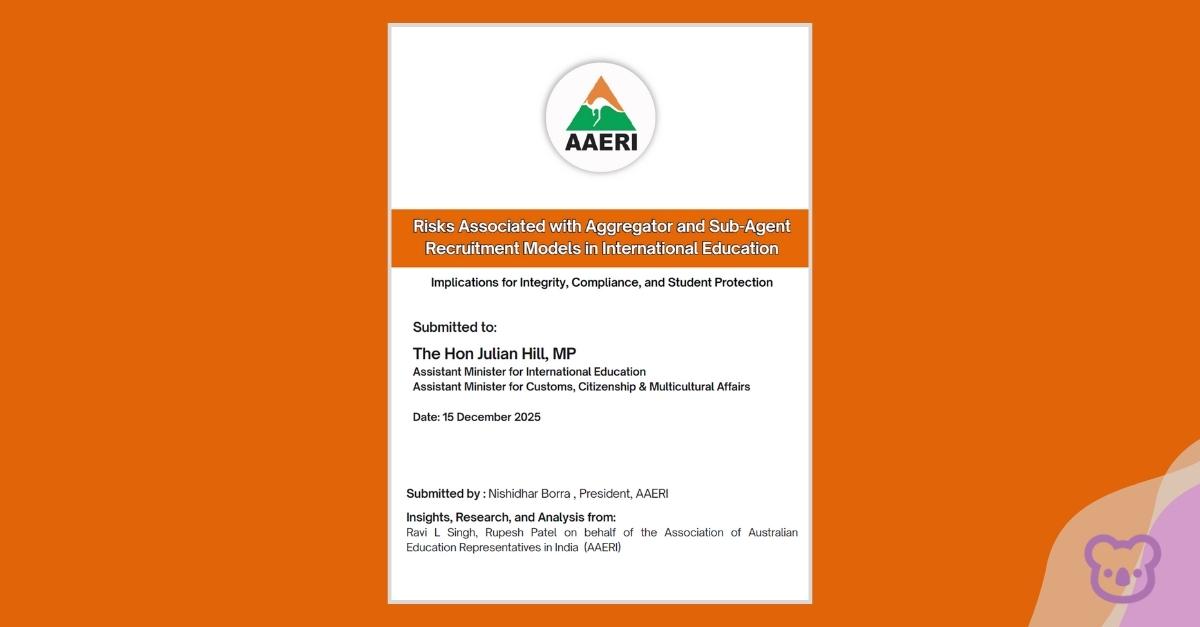
A detailed submission warning of growing integrity and compliance risks in international student recruitment has been published, placing renewed scrutiny on the use of aggregator and sub-agent models at a time of heightened regulatory pressure on key source markets
The document, prepared by the Association of Australian Education Representatives in India (AAERI) and submitted to Assistant Minister for International Education Julian Hill, raises concerns about the expanding role of aggregator-based recruitment and the increasing use of large, largely invisible sub-agent networks in markets such as India and South Asia. It argues that these models are undermining transparency, weakening accountability and exposing both students and education providers to escalating risk under Australia’s ESOS framework.
The submission, while presented to the Minister late last year, is even more important since India has been downgraded to Assessment Level 3, reflecting government concerns about visa integrity, non-genuine applications, and systemic risk within the student recruitment pipeline. The timing of the submission adds further weight to sector debates about whether current recruitment practices are aligned with the government’s stated integrity objectives.
According to AAERI, aggregator models differ fundamentally from traditional agent relationships. While education providers typically appoint agents through due diligence, training and direct contractual agreements, aggregators operate as intermediaries that engage hundreds or thousands of sub-agents who often have no direct relationship with the institution. The submission argues that many of these sub-agents are undisclosed, insufficiently trained and effectively unmonitored, despite recruiting students in an institution’s name
The document suggests this creates a structural conflict with Standard 4 of the National Code and Section 21A of the ESOS Act, which places responsibility on providers for all agents acting directly or indirectly on their behalf. While recent ESOS amendments require providers to publicly list all education agents and sub-agents, AAERI warns this requirement may be operationally unworkable under aggregator arrangements, where institutions may not know who is recruiting for them or where those individuals are operating.
Rather than strengthening transparency, the submission argues, the requirement risks creating confusion for students and exposing providers to compliance failures they cannot realistically control. It describes this as a systemic issue rather than a technical compliance gap, pointing to what it characterises as a breakdown in the accountability chain that ESOS was designed to establish.
The submission also raises concerns about the commercial incentives underpinning aggregator models, describing them as volume-driven systems that prioritise application numbers over student suitability and long-term outcomes. According to AAERI, rapid onboarding of sub-agents with minimal vetting increases the risk of misleading advice, undisclosed fees and aggressive recruitment practices. The document further warns that such incentives can encourage the enrolment of non-genuine students, particularly in a market already subject to elevated risk settings
Visa integrity features prominently in the submission, which links aggregator-based recruitment to a rise in fraudulent documentation, manipulated English test results and questionable financial evidence. It references recent Department of Home Affairs integrity alerts highlighting increased levels of fraud in student visa applications from India, arguing that diffuse sub-agent networks make it easier for such practices to proliferate undetected.
The document also highlights concerns around misrepresentation at education fairs and agent events, where sub-agents may present themselves as authorised university representatives, potentially misleading students about institutional endorsement and oversight. AAERI argues that such practices further erode trust and transparency at a time when Australia’s international education brand is under close scrutiny.
International precedent is also cited, with Canada referenced as a cautionary example of the risks associated with heavy reliance on aggregator recruitment. The submission points to reputational damage, large-scale enrolment of non-genuine students and subsequent policy interventions as outcomes Australia should seek to avoid.
While acknowledging recent government reforms, including tighter Genuine Student assessments, higher financial requirements and enhanced monitoring powers for regulators, AAERI argues that these measures do not fully address the structural risks posed by aggregator models. It notes that while offshore agents cannot be directly regulated by Australian authorities, institutions themselves are regulated and retain control over the recruitment models they choose to adopt.
The submission ultimately calls for a shift back towards direct, quality-focused agent relationships, where recruiters are known, contracted, trained and accountable. It argues that such models are more consistent with the intent of the ESOS framework and better aligned with student protection, visa integrity and long-term sector sustainability
With India now assessed as a higher-risk market and integrity firmly at the centre of government policy, the publication is likely to add momentum to ongoing discussions about how Australian institutions manage offshore recruitment, and whether current practices can withstand increasing regulatory and reputational pressure.
The submission, which has commercial-in-confidence material redacted, can be seen and downloaded here.