





The Koala News
  • News
    • All
    • Compliance
    • Ed-Tech
    • Market Update
    • Opinion
    • Policy
    • Profile
    • Sponsored Content
    • Student Mobility
    • Student Recruitment
    • Student Support
    • TNE
    • World
    ANZUK Expands UK Footprint with Apple A Day Acquisition

    ANZUK Expands UK Footprint with Apple A Day Acquisition

    AIS Singapore Appointment Reflects Australia’s Global Education Reach

    AIS Singapore Appointment Reflects Australia’s Global Education Reach

    The Power—and Pitfalls—of Regulation in Modern Markets

    A Highly Skilled and Adaptable Workforce Delivers Outcomes

    The Five Stages of Grief, in ESOS

    The Five Stages of Grief, in ESOS

    Home Affairs Confirms Computer-Assisted Processing Used in Student Visa System

    When proof is not enough: financial capacity under the spotlight

    New interim commissioners appointed to steer Australia’s tertiary reform agenda

    What submissions say about ATEC and international education

    Trending Tags

    • Austrade
    • English
    • Student Data
    • Awards
    • Schools
  • About
  • Contributors
  • Advertise
  • Jobs
  • Events
  • Subscribe
  • Archive
  • Shop
  • Contact
No Result
View All Result
The Koala News
  • News
    • All
    • Compliance
    • Ed-Tech
    • Market Update
    • Opinion
    • Policy
    • Profile
    • Sponsored Content
    • Student Mobility
    • Student Recruitment
    • Student Support
    • TNE
    • World
    ANZUK Expands UK Footprint with Apple A Day Acquisition

    ANZUK Expands UK Footprint with Apple A Day Acquisition

    AIS Singapore Appointment Reflects Australia’s Global Education Reach

    AIS Singapore Appointment Reflects Australia’s Global Education Reach

    The Power—and Pitfalls—of Regulation in Modern Markets

    A Highly Skilled and Adaptable Workforce Delivers Outcomes

    The Five Stages of Grief, in ESOS

    The Five Stages of Grief, in ESOS

    Home Affairs Confirms Computer-Assisted Processing Used in Student Visa System

    When proof is not enough: financial capacity under the spotlight

    New interim commissioners appointed to steer Australia’s tertiary reform agenda

    What submissions say about ATEC and international education

    Trending Tags

    • Austrade
    • English
    • Student Data
    • Awards
    • Schools
  • About
  • Contributors
  • Advertise
  • Jobs
  • Events
  • Subscribe
  • Archive
  • Shop
  • Contact
No Result
View All Result
The Koala News
No Result
View All Result
Home News Compliance

Government Clarifies Onshore Transfer Commission Ban with Fact Sheet

Dirk MulderbyDirk Mulder
January 21, 2026
in Compliance, Market Update
Government Clarifies Onshore Transfer Commission Ban with Fact Sheet
Share on LinkedinShare on TwitterShare on FacebookShare via Email

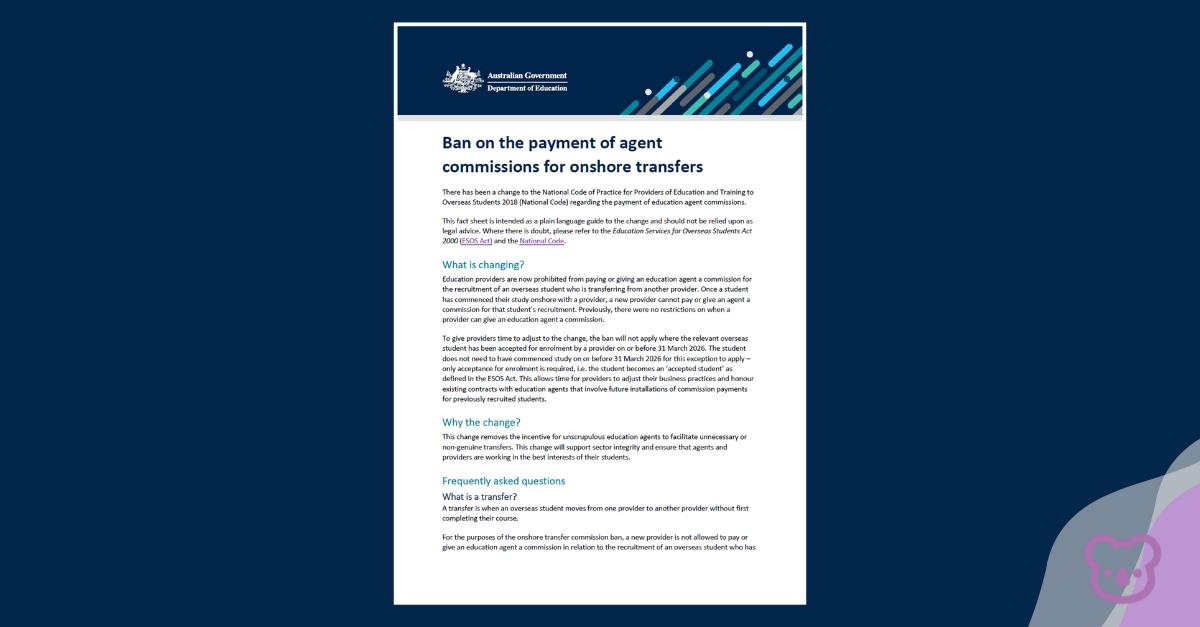
The Australian Government has released a fact sheet outlining how the recently published changes to the National Code of Practice for Providers of Education and Training to Overseas Students will operate in practice, providing further clarity for providers, agents and students.

The update follows amendments to the National Code designed to curb what the government has described as “onshore poaching”, removing financial incentives for unnecessary or non-genuine student transfers between education providers. As reported by Tracy Harris via The Koala News yesterday, the changes form part of a broader integrity agenda under the ESOS framework, aimed at ensuring student decision-making remains in their best interests.

Under the revised rules, education providers are now prohibited from paying, or offering to pay, education agent commissions for the recruitment of an overseas student who has already commenced study onshore with another provider. Once a student has begun their course in Australia, a receiving provider can no longer financially reward an agent for facilitating that transfer.

Importantly, the government has built in a transition period to allow providers time to adjust their business models and honour existing contractual arrangements. The commission ban will not apply where a transferring overseas student is accepted for enrolment by their new provider on or before 31 March 2026. The student does not need to have commenced study by that date; acceptance alone is sufficient to fall within the exemption, as defined under the ESOS Act.

According to the fact sheet, the change is intended to remove incentives for agents to encourage students to switch providers unnecessarily, while reinforcing the expectation that agents and providers act ethically and transparently. The government says the reform will support sector integrity and help maintain confidence in Australia’s international education system.

The fact sheet also provides practical clarification on what constitutes a “transfer”. A transfer occurs when an overseas student moves from one provider to another without completing their course. This includes situations where a student withdraws, has their enrolment cancelled, or moves between courses in a package after having already commenced study. In all such cases, the receiving provider is prohibited from paying agent commissions for recruitment

However, the government has drawn clear distinctions between transfers and legitimate academic progression. A movement to further study after completion of a principal course does not constitute a transfer, meaning providers may continue to pay agent commissions even if a student completes one course and later enrols in a new qualification with a different provider. Similarly, progression through an approved package of courses listed on a student’s Confirmation of Enrolment remains unaffected, provided the courses and providers align with the original visa grant.

The fact sheet also details the understanding of what counts as an “agent commission” which was overhauled as part of the ESOS changes last year. The definition extends beyond direct payments to include non-monetary benefits such as bonuses, service fees, gifts, discounted services and other incentives. These provisions apply not only to traditional agent arrangements but also to casual or fixed-term contractors performing agent-like recruitment activities, reinforcing the government’s intent to close loopholes across the sector.

Crucially, the changes do not restrict a student’s right to transfer providers under Standard 7 of the National Code, nor do they prevent students from seeking advice or assistance from education agents. Students may still engage agents directly, including through fee-for-service arrangements, but agents will no longer be able to receive commissions from the receiving provider for onshore transfers.

For providers, the fact sheet underscores the need to review recruitment practices, agent contracts and internal compliance processes ahead of the March 2026 deadline. For the government, the update signals a clear expectation that financial incentives via education agents should not shape student mobility decisions within Australia.

As the sector continues to adapt to a rapidly evolving regulatory environment, the clarification offers welcome guidance.

The fact sheet can be seen here.

Standard 4 of the National Code has also been updated and can be seen here.

Tags: ESOSNational Code
Previous Post

New interim commissioners appointed to steer Australia’s tertiary reform agenda

Next Post

National Student Ombudsman seeking Education Advisory Group members

Dirk Mulder

Dirk Mulder

Dirk Mulder is the founder of the Koala and Principal of MulderPR, a strategy and marketing communications consultancy specialising in international education. Dirk has had extensive experience in International Education and Service Management, holding Directorships at the University of South Australia, Curtin University and Murdoch University as well the Lead for International Student Initiative across the Asia Pacific region at Allianz Partners. He has been member of the boards of Perth Education City (now Study Perth) and Education Adelaide, he has chaired the Universities of Perth International Directors Forum and has been a past board member of the Hawkesbury Alumni Chapter, his alma mater. His views are widely published and quoted across the media and has been seen in Campus Morning Mail, the Australian Financial Review and ABC television and online. Acknowledgement/disclosure: Dirk holds shares in and outside of the education sector including in IDP Education.

Next Post
National Student Ombudsman seeking Education Advisory Group members

National Student Ombudsman seeking Education Advisory Group members

What Now? What Next? What Now? What Next? What Now? What Next?
Cambridge Cambridge Cambridge
iDAT Logo iDAT Logo iDAT Logo
The Koala News

The Koala is intelligent, it can be cheeky, it aims to be informative and is uniquely Australian though proudly global.

It unashamedly promotes best practice in International Education. It loves seeing students succeed via vibrant offerings and a supporting mix of policy, recruitment and support settings.

Follow the Koala

Browse by Category

Subscribe: Have the Koala Delivered to your Inbox

  • About
  • Terms of Use
  • Privacy Policy
  • Contact

© 2023 The Koala News

No Result
View All Result
  • News
  • About
  • Contributors
  • Advertise
  • Jobs
  • Events
  • Subscribe
  • Archive
  • Shop
  • Contact

© 2023 The Koala News