










In retrospect, the Australian “cockroaches” were right.
I should have listened.
As a small business owner working in international education, I have traditionally been a conservative voter. Politics was something I generally kept private. My approach was simple: work with whoever was in government and advocate for the interests of the sector.
My children had a different view.
When they were younger, and some were just graduating and finding themselves unemployed, political debates around the dinner table would regularly turn into arguments about migration, opportunity and the future of Australia. They would question my political leanings and, on more than one occasion, suggest I was backing a political position that did not necessarily reflect the interests of their generation.
Recently, young protesters in India adopted the label “cockroaches” after it was used by the country’s Chief Justice in a very different context. Rather than being insulted, Gen Z turned the insult into a badge of identity and protest.
Perhaps there is something to the metaphor.
My own household “cockroaches” would argue that the Liberal-National Coalition was happy to seek the votes of migrants, but far less interested in creating political space for migrants who had arrived, built businesses, contributed to the economy and made Australia their home.
I would argue back.
I believed the Coalition understood the value of skilled migration. I believed it understood the contribution of international education. And I believed that, whatever the political rhetoric of the day, there was a broad bipartisan understanding that Australia needed migrants and international students.
I may have been wrong.
A race to the bottom
Australia has spent much of the past few years having an increasingly difficult conversation about migration.
There are legitimate questions to be asked about migration levels, housing, infrastructure, population growth and the sustainability of the international education sector.
But legitimate questions can quickly become something else when political parties compete to produce the toughest sounding answer.
Pauline Hanson’s One Nation has been particularly effective at pushing an aggressively anti-migration narrative. For much of the time, I assumed that whatever influence One Nation might have, it would remain outside government.
That assumption now looks considerably less comfortable.
With the Coalition facing the prospect of struggling to secure a majority, the political incentives are changing. Positions that might once have been considered the territory of the political fringe can become increasingly attractive when parties are competing for preferences, votes and political relevance.
And that creates the possibility of a race to the bottom on migration.
The Coalition’s proposal to abolish Temporary Graduate visas is a case in point.
The policy would effectively bring an end to the current subclass 485 Temporary Graduate visa arrangements, removing a pathway that allows international graduates to gain Australian work experience after completing their studies.
There are certainly arguments for reforming the graduate visa system. But some of the arguments now being deployed against it deserve closer examination.
When the Coalition liked graduate visas
The Coalition’s criticism of temporary graduate visas sits awkwardly alongside its own history.
When the Australia-India Economic Cooperation and Trade Agreement was being negotiated under the Morrison Government, the Coalition agreed to provide Indian graduates with additional time on temporary graduate visas.
India’s Minister of Commerce and Industry, Piyush Goyal, subsequently acknowledged the commitment in correspondence with then Trade Minister Dan Tehan.
The agreement was eventually signed and implemented by the succeeding Labor Government.
That history matters.
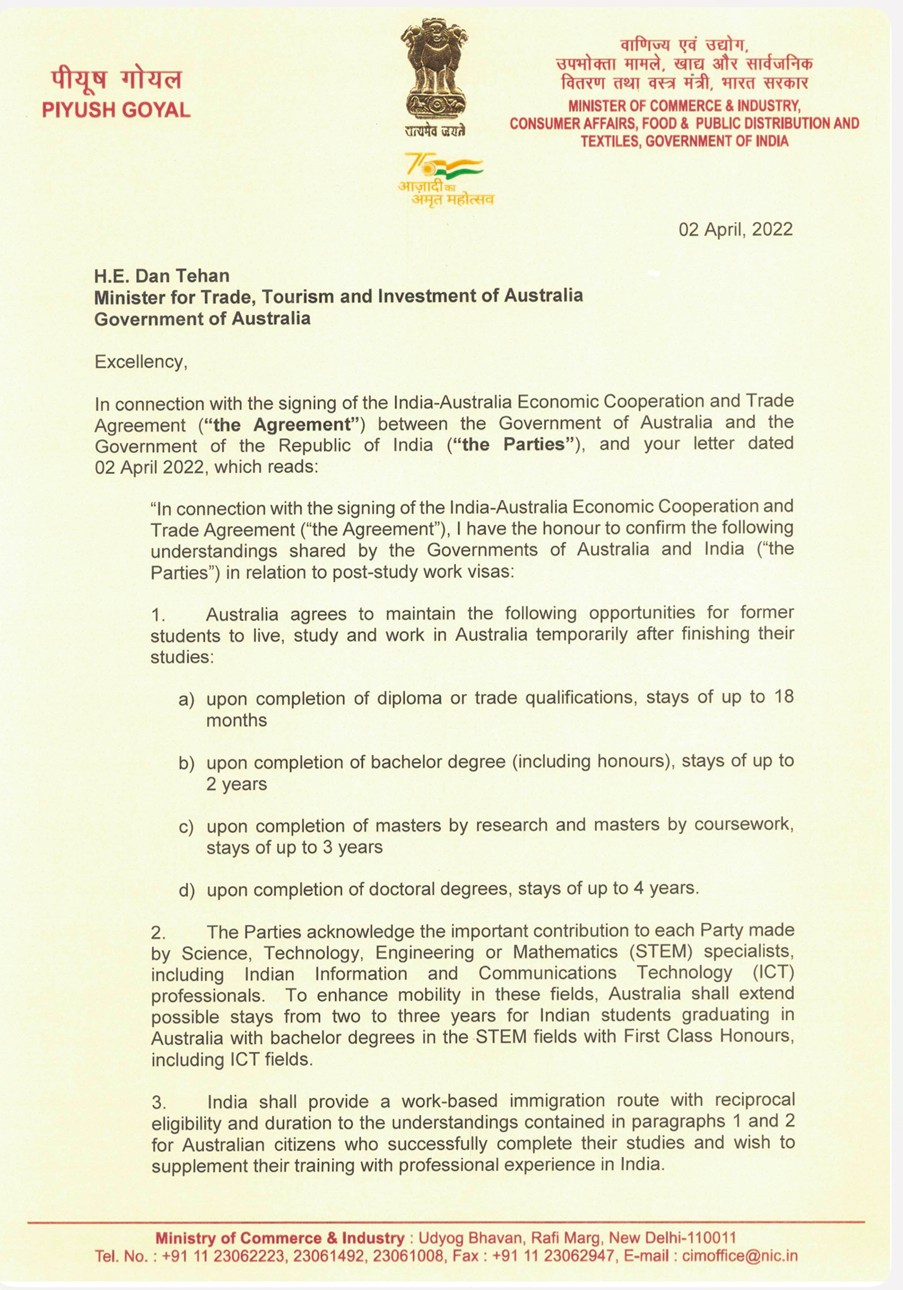
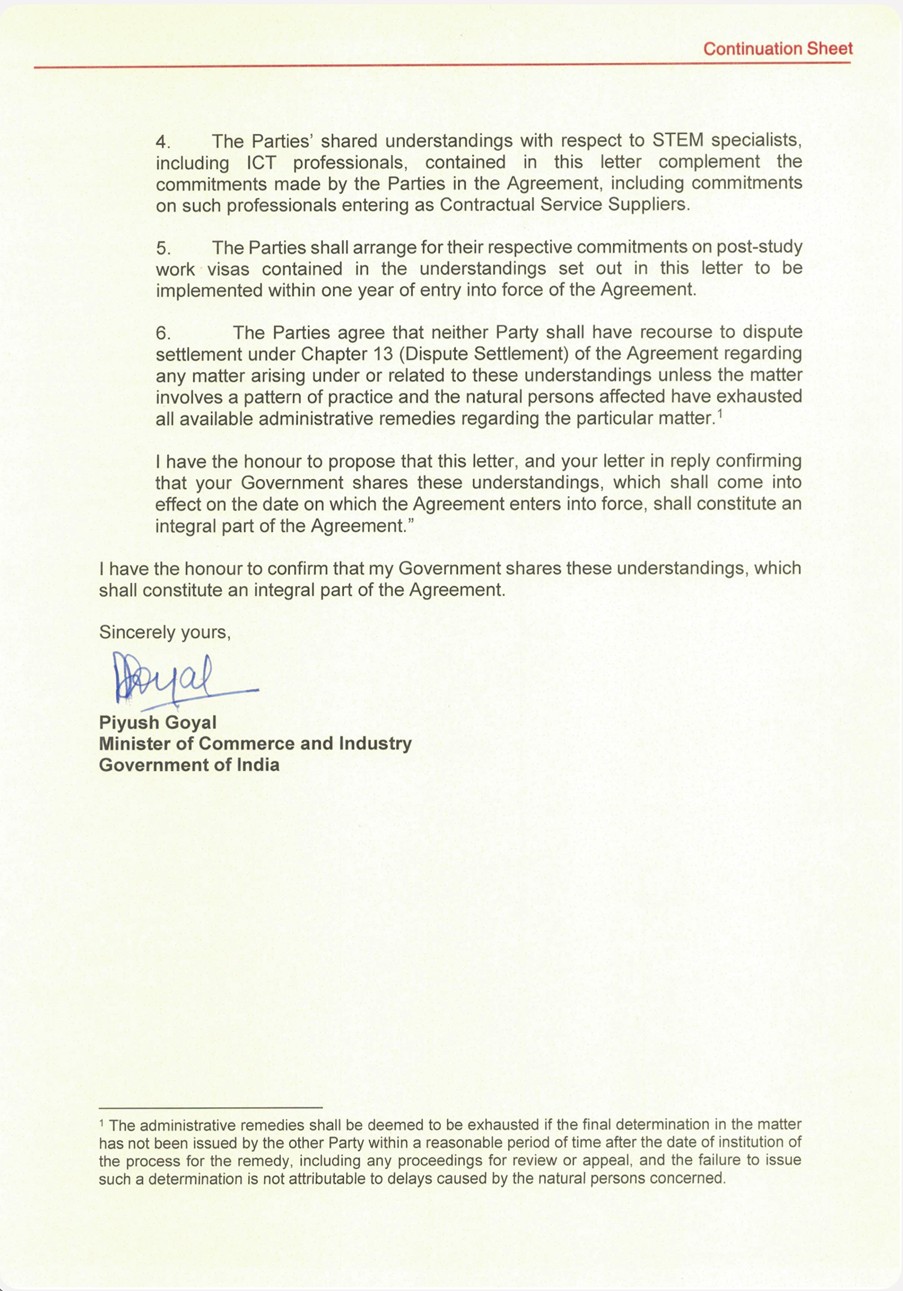
It demonstrates that temporary graduate work rights were not simply a Labor invention designed to turn international students into migrants. The Coalition itself recognised that providing graduates with additional time to work in Australia could form part of a broader economic and trade relationship.
Political positions can change. Governments are entitled to change policy.
But voters are also entitled to ask why something considered valuable in one political context is suddenly being presented as fundamentally flawed in another.
The student visa was never just about study
There is another contradiction worth considering.
The Coalition is increasingly critical of international students seeking work pathways after completing their studies. The argument is that students should come to Australia for a world-class education, rather than seeing education as a back door into migration.
That sounds reasonable on the surface.
But Australia’s international education system has never operated in such a neat binary.
International students have always considered education, employment, career opportunities and future prospects when deciding where to study. Australia knows this because governments and education institutions have actively promoted those opportunities.
And during the Coalition’s time in government, international students were also encouraged to participate more extensively in the Australian workforce.
The temporary relaxation of student work restrictions during the pandemic allowed international students to work more hours, including full-time. The policy was intended to address workforce shortages, but it also reinforced an association between the student visa and the right to work.
It is therefore difficult to now suggest that the idea of international students working in Australia is something created by the current Labor Government.
The reality is considerably more complicated.
Perhaps my children were right
Looking back, I was probably too comfortable in my assumptions.
I assumed that a Coalition government would naturally support skilled migration and international education because both had traditionally been important to Australia’s economy.
I assumed that the economic contribution of international students would protect the sector from the worst excesses of political rhetoric.
And I assumed that sensible policy would ultimately win out.
My children were less convinced.
They saw something I didn’t.
They understood that political parties respond to political incentives. They understood that migrants and international students can become convenient political targets. And they understood that when migration becomes politically toxic, the policy debate can move a long way before the economic arguments catch up.
Perhaps the “cockroaches” were right all along.
And perhaps it is time for me to embrace another definition of the word.
Cockroaches are resilient. They survive. They adapt.
They keep going when circumstances change.
That may be exactly what Australia’s international education sector now needs to do.
But resilience should not mean remaining silent.
If Australia is going to change the way it approaches international education, migration and graduate employment, then we should have an honest conversation about why.
Not one driven by slogans.
Not one driven by fear.
And certainly not one driven by the political assumption that international students, migrants and graduates are convenient targets whenever the electoral environment becomes difficult.
Maybe my children were right.
Maybe I should have voted better.
At the very least, I should have listened to the cockroaches.
Ravi Lochan Singh is the founder of Global Reach, which recently celebrated 35 years in international education and partners with Australian universities. A long-standing advocate for industry self-regulation, Ravi has served multiple terms as head of AAERI and remains an elected executive committee member.
A widely followed commentator, particularly on international education and South Asia, he has been recognised with the Australian Alumni of the Year Award, a Lifetime Impact PIEoneer Award and inclusion in The PIE’s Top 50 Voices in International Education.
Ravi is currently standing for election to the IEAA Board.