


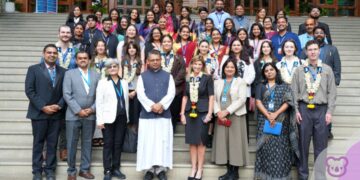




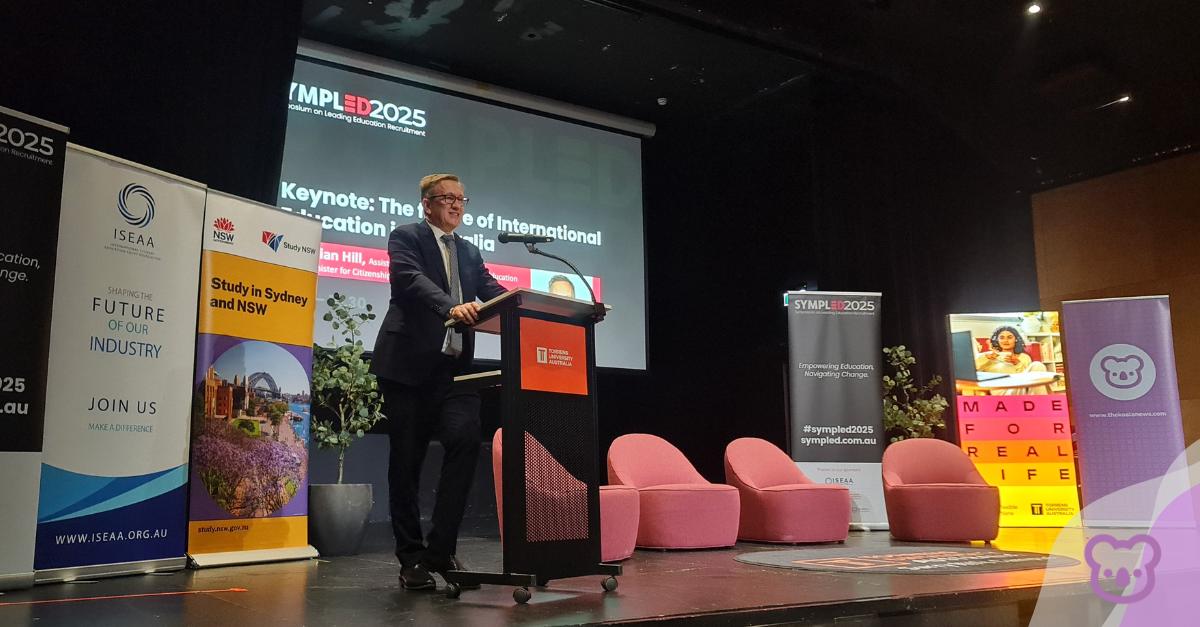
SYMPLED 2025 held at Torrens University in Sydney brought together policymakers, educators, agents, and advocates to confront the challenges and opportunities facing Australia’s international education sector. With reform on the horizon and integrity under scrutiny, the conference delivered a powerful mix of data, debate, and calls to action.
It was clear that we all want a sustainable sector, supported by fair and transparent policy, developed in consultation with key people.
As educators, we are connected to country and students, Study NSW
Toshi Kawaguchi from Study NSW reaffirmed Study NSW’s support for SYMPLED and its role in backing international student initiatives across the state. “It’s wonderful to see this gathering,” he said, “a chance to give back to international students who contribute so much to our community.” Referencing the latest Study NSW report, Toshi emphasised the importance of quality, integrity, and long-term engagement.
Change is inevitable but let’s be transparent, Dirk Mulder
Dirk Mulder, CEO of The Koala News, framed the day with a sobering overview of the sector’s shifting landscape. “We’re in a moment of real change,” he said, pointing to sharp reductions in student intake and policy volatility. Universities and TAFEs now face deep uncertainty, affecting revenue, staffing, and research. Rapid policy shifts are harming student welfare and Australia’s reputation, and the sector needs a more predictable, transparent approach.
He laid out a series of practical recommendations to guide reform:
- Transparent, evidence-based allocation rules
- Targeted measures over blunt caps
- Investment in student accommodation and mental health
- Protection of VET and regional pathways
- Preservation of qualification portability
- Multi-year planning frameworks tied to measurable outcomes
The message is clear: reform must be strategic, transparent, and student-centred: anything less risks undermining the sector’s long-term viability.
Government’s focus, Hon Julian Hill MP
The Hon Julian Hill MP, Assistant Minister for International Education, delivered a wide-ranging address that balanced optimism with realism. He described international education as a national success story – Australia’s fourth-largest export sector yet still underappreciated. Beyond economics, Hill emphasised the soft power of education: the millions of students who take a piece of Australia back with them, shaping global relationships.
Hill acknowledged the post-COVID surge in student numbers and the need to manage growth responsibly. “You may have to prune the tree to save the tree,” he said, referencing unsustainable spikes in low-value qualifications. He outlined upcoming reforms, including new integrity laws, tighter agent oversight, and expectations for universities to invest in student housing.
He also addressed the role of education agents, recognising their importance while warning of systemic issues: “Some continue to operate against students’ best interests and engage in overt criminal behaviour.” Hill reaffirmed Australia’s stability in a chaotic global market and previewed the transition to the Australian Tertiary Education Commission in 2027.
We heard that the integrity measures in the lapsed ESOS Amendment Bill would resurface and that will include the banning of onshore agent commissions specifically for student transfers.
The minister accepted that the impact has been unevenly felt and continues to consider adjustments to policy setting particularly to support the English and study abroad sectors.
Who is a genuine student?
Led by Michal Sestak and Melanie Macfarlane, this panel explored the increasingly fraught process of proving “genuineness” in student visa applications. With appeals to the Administrative Review Tribunal jumping from 2,400 in 2023 to over 40,000 in 2025, panellists questioned whether the current system truly reflects student realities.
Speakers highlighted contradictions in policy – students must justify both their life back home and their future in Australia, often through dozens of documents, however “life isn’t written in regulation.” Concerns were raised about vague criteria, inconsistent training, and the reputational risk of rising refusals. The call was clear there was a need for a more nuanced understanding of student diversity.
ELICOS crisis – Ian Aird, English Australia
Ian Aird, CEO of English Australia, issued a passionate call to action for the ELICOS sector, describing it as the canary in the coalmine. With student numbers at 2006 levels and grant rates at record lows, Aird warned of thousands of job losses and collapsing businesses. “Do we honestly think students are chancing it at $2000 a visa?” he asked. “They’re genuine.”
He emphasised ELICOS’s role in diversity and academic success – two-thirds of students go on to higher education or VET, with better retention and wellbeing outcomes. The decline isn’t just about lost enrolments; it’s about lost multicultural classrooms, lost tourism, and lost economic contribution.
Where is international student representation?
A panel featuring Kim Yang, Weihong Liang, Nabin Gautam and Utku Can explored the collapse of international student representative bodies. With rising costs and limited support, students are struggling with housing, unpaid placements, and access to services. The panel called for long-term engagement and a shift in mindset: international education must be seen as a community, not just a business.
Agent verification and financial reform
Rod Hearps from ICEF introduced new technologies to improve agent compliance, including Train Your Agent and Agency Status. With providers facing growing burdens – screening agents, complying with anti-trafficking laws – the need for robust tools is urgent.
John Crutchley, Founder, Mist also unveiled a Proof of Funds Account, an ASIC-regulated trust fund designed specifically for international students. It aims to streamline visa processes and reduce unfair financial expectations, offering a practical solution to a persistent challenge.
Integrity in action – Carmen Basilicata, ED Integrity, ASQA and Melinda Hatton, Director Tuition Protection Service
Carmen Basilicata and Melinda Hatton delivered a sobering session on the rise of non-genuine providers and bad-faith operators. With over 23,000 qualifications voided due to college closures, the sector faces serious threats – from fraudulent issuance and phoenixing to criminal infiltration.
“Systemic problem requires a systematic solution.” It was recognised that these unethical and sometimes unlawful actions are resulting from a small minority but undermine the integrity of the sector and are being addressed.
Hatton, Director of the Tuition Protection Service, emphasised the importance of provider accountability and student support. VET qualifications, she reminded attendees, are more than certificates – they’re pathways to real careers. The TPS continues to work with providers to uphold obligations and protect students.
Education agent symposium and industry merger
The day concluded with a lively symposium featuring Rod Hearps, Ravi Singh, Mark Lucas, Bhupal Sitoula, and Jennifer Yuan. The session offered open Q&A and reflections on the day’s themes, culminating in the announcement of a major industry merger: ISEAA and ECAA will unite to form a single, stronger voice for education agents.
There is a need for all of us to focus on what do we want to get out of international education – to become clearer so that we meet these challenges. This is a time of uncertainty – what students want, the future of jobs and skills – but out of chaos, comes opportunity!
Rob McGowan is Vice President Future Students & Growth, Torrens University Australia