


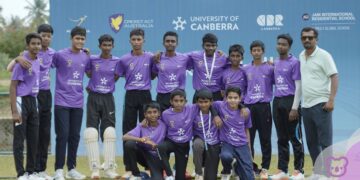









International education begins at home and school, stimulating learners’ curiosity and engaging young people across the region.
A decade ago, the target for global citizenship education (GCED) set under the United Nations Sustainable Development Goal (SDG) 4.7 was “to ensure all learners acquire knowledge and skills needed to promote sustainable development.” Since then, our education ecosystem has pondered how to bring this to life, reflecting on the complex and diverse local and global contexts faced by students, teachers and schools.
Now a new global citizenship education (GCED) framework will enable countries across the Asia-Pacific to monitor progress toward SDG 4.7.
The framework grew through a collaboration between the Asia Pacific Centre for International Understanding (APCEIU) under the auspices of UNESCO, and the Global Education Monitoring (GEM) Centre; an outstanding partnership between the Australian Council for Educational Research (ACER) and DFAT.
Providing tools and resources to deliver and evaluate global citizenship education throughout the Asia-Pacific, it also supports and builds on the goals and objectives of the Southeast Asia Primary Learning Metrics’ (SEA-PLM) global citizenship assessment framework.
While the scope of countries engaged across the project is broad, it’s worth noting the Invested: Australia’s Southeast Asia Economic Strategy to 2040 focusses on the role education plays in Australia’s ASEAN economic engagement. So, this robust contribution and commitment to leadership is ongoing work that will uplift global citizenship education alongside our regional partners.
There is increasing global recognition of the need to nurture and engage critical learners. Delivering global citizenship education is becoming entrenched as a critical pillar of curricula, policy and practice. Research conducted to build the framework showed teachers describe GCED with varying degrees of complexity, so a deeper understanding and quality measure of impact will assist in refining and accelerating the pedagogy around global citizenship education.
The research also uncovered that high-quality GCED activities are holistic, involving a range of stakeholders, including policymakers, school administrators, teachers, parents, carers, and students. So, best practice in GCED assessment and quality evaluation enables participation in the co-design by all stakeholders – including industry, community and government – to influence outcomes.
The work will continue to showcase progress towards a shared GCED language and build evidence of what works in GCED to inform program design for administrators, schools and teachers and capture student knowledge, values and behaviours. You can read the full phase 1 report on ‘Monitoring teacher and school readiness to enact global citizenship in the Asia-Pacific region’ here.
Read the policy brief here.
Read the summary report here.
This is an impactful Australian investment in the Asia-Pacific region. The next phase of the study aims to refine the GCED quality framework and develop a readiness toolkit for schools and the government to bring GCED to life. With 2024 marking the 50th year of Australian dialogue relations with ASEAN, this education project is a stellar example of commitment to developing shared understanding through people-to-people relationships within ASEAN‑Australia engagement.
You can track the next phase’s progress via the ACER research repository here.