









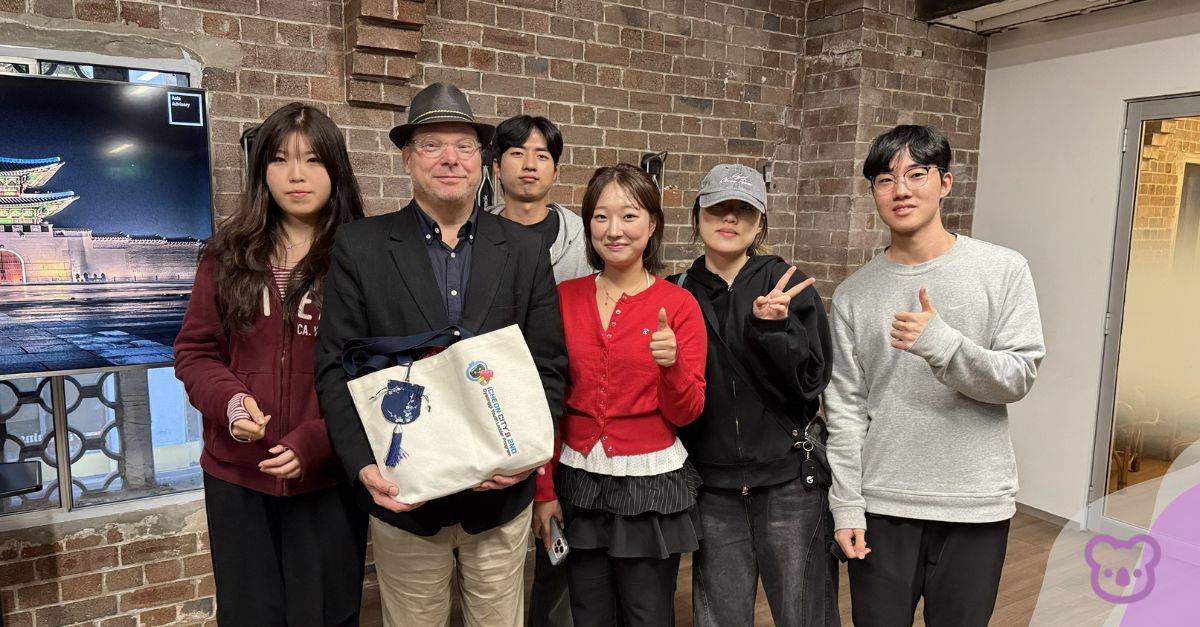
Fourteen young adults from Korea recently took part in a Professional Insights session in Sydney, exploring the changing world of marketing, artificial intelligence and doing business across cultures.
Led by Professor Seohyun Bae from Pyeongtaek University, and joined by Mr Kim Yun Ho, Leadership Coach, the group heard from Adam O’Neill, Managing Director of Asia Advisory, and Professor Chris Baumann from Macquarie University.
The session was part of a series of professional insight activities giving the students opportunities to explore Australian businesses, meet industry leaders and discover ideas they may not encounter in Korea.
Adam O’Neill opened with insights from his 20-year career in advertising and marketing, working with global brands including Tourism Australia, LG, Rolex and Red Bull. He shared stories from his time in Seoul and across Asia, including major campaigns and his experience helping Western companies establish a presence in Korea.
One key lesson was the importance of trust and relationships in international business. Adam explained that while business in Western markets can often begin through professional relationships, in Korea and other parts of Asia, establishing personal rapport and trust can be an important step before meaningful business opportunities develop.
The student, Sunho Song then turned the question around: “If this is what it takes to bring Western brands to Asia, what does it take to bring Asian brands to the West?”
This sparked discussion about understanding local customers and adapting products to different markets. Cosmetics provided a simple example: tanning products are popular in many Western markets, while skin-brightening products are more sought after across Asia. The discussion also raised a bigger question: Are consumers always looking for something different from what they already have?
Adam also explored how AI is democratising storytelling and transforming creative industries. Drawing on the Omni International film festival held in Shanghai, he showed how AI-generated films are becoming increasingly sophisticated, including their ability to elicit powerful human emotions.
As AI continues to develop, the distinction between human-created and AI-created work is becoming harder to identify. For the students, this highlighted AI’s double-edged nature: it may disrupt professional roles, but it also gives people powerful new tools to create almost anything they can imagine.
Professor Chris Baumann then introduced the concept of “Necro-Branding” and the evolution of marketing and media. From traditional advertising to product placement in movies, the boundaries between entertainment and marketing have progressively blurred.
Chris explored how the commercial power of celebrity can continue long after a person’s death, with icons such as Elvis Presley still attracting visitors to Graceland and generating value decades later (merchandising, movies, royalties).
New technology creates even more complex questions. If a person’s image, voice or likeness can be recreated using AI after their death, who controls their legacy? Should people be able to determine how their identity is used after they die?
One participant took the discussion further, asking: if humans can have a legacy through “Necro-Barketing”, could AI eventually have a legacy too?
The questions demonstrated the curiosity and critical thinking of the group, turning the session into a genuine exchange of ideas rather than simply a presentation.
For young people preparing for an increasingly global and technology-driven world, professional insight experiences provide an opportunity to hear directly from experienced business and academic leaders, ask questions and connect classroom learning with real-world experiences.
For the Korean participants, the session offered fresh perspectives on global business, cultural understanding, creativity and the future of AI, while building valuable people-to-people connections between Korea and Australia.
Programs like these, supported by partners such as OZiHOUSE Group, give international students and young leaders the chance to meet Australian businesses, academics and professionals firsthand. These experiences broaden their thinking and can stay with them long after they return home.
Daniel Yuen is Head of Operations and Growth at OZiHouse.












