











The turbulent policy environment of the last 12 months wasn’t enough to deter some education providers from seeking registration to deliver courses to international students, according to the latest annual reports of the two key regulators.
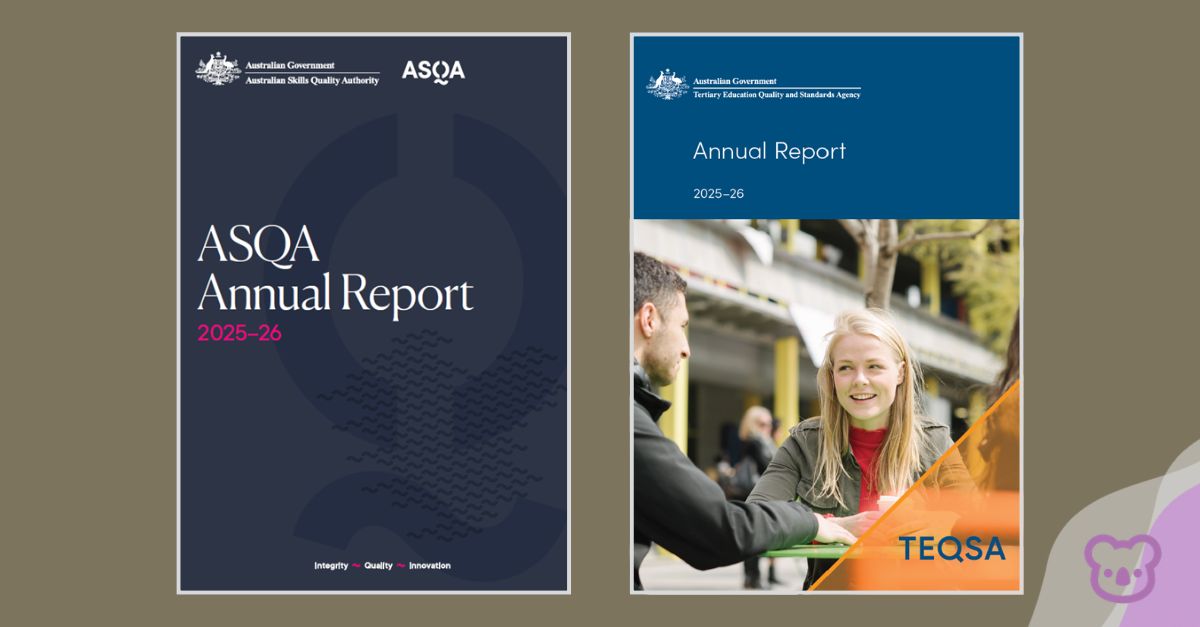
While the Tertiary Education Quality and Standards Agency (TEQSA) and the Australian Skills Quality Authority (ASQA) march to the beat of their own drums, making direct comparisons difficult, their latest annual reports provide some interesting insights into what they got up to in 2025–26.
Who got in?
TEQSA received 11 initial Commonwealth Register of Institutions and Courses for Overseas Students (CRICOS) applications, 32 CRICOS renewal applications and 1,046 applications to vary CRICOS registration in 2025-26.
At 30 June 2026, there were 697 Registered Training Organisations that were also registered on CRICOS to deliver vocational education and training (VET). Another 286 were registered to deliver both VET and English Language as an Intensive Course of Study (ELICOS), and 83 were ELICOS-only providers.
During 2025-26, ASQA approved 50 new providers to deliver to domestic and international students (with two applications per provider, one for provider registration and one for CRICOS registration).
This was despite the downward trend in student visa approvals in the VET sector, with offshore VET visa grants falling by 74.6% between 2022–23 and 2024–25, and despite the enactment of the Education Legislation Amendment (Integrity and Other Measures) Bill 2025 (the Bill) in December 2025 which requires providers to have registered as an RTO and delivered training for at least two years before applying for CRICOS registration.
In addition to the 50 new providers ASQA also approved 12 existing providers to deliver to international students and 5 providers to deliver English-language training only.
These applications were received prior to the government’s decision to suspend new applications to ASQA for registration on CRICOS and adding new courses to existing registrations for 12 months from 19 May 2026. ASQA reports having received the equivalent of four months’ worth of applications for change of scope in the few hours on 18 May prior to the new decision taking effect.
TEQSA also reports having completed a range of assessments but doesn’t report on the outcomes: 12 for initial CRICOS registration, 23 for renewal of CRICOS registration and 1,025 for changes to CRICOS registration.
Who got out?
ASQA rejected 27 CRICOS registration applications in 2025–26, while 12 CRICOS registrations expired. Five providers allowed their CRICOS registration to expire but retained their VET registration. ASQA made decisions to cancel registration or reject renewal involving 60 providers, although those decisions were across its regulated sector, not necessarily CRICOS providers.
TEQSA does not provide an equivalent breakdown of CRICOS registration expiries or cancellations.
What caught the regulators’ attention?
Both regulators referred to the amendments to the Education Services for Overseas Students Act 2000 (ESOS Act) at the end of 2025, with ASQA stating that the reforms have “strengthened our ability to identify and mitigate integrity risks within the international education sector”.
Governance and international education integrity were priorities for TEQSA in 2025-26 and it reports being concerned about ongoing risks from exploitation of the student visa system by non-genuine applications and weaknesses in overseeing ‘unscrupulous’ education agents. Attention was given to student capacity increase applications where elevated regulatory risk was present. It also focused on the effectiveness of governance as it related to admissions, recruitment and meeting financial obligations to international students.
‘International education marketing, recruitment and delivery’ was one of six risk priorities identified by ASQA in its regulatory assessment and monitoring activities. It undertook 300 assessments involving providers delivering to international students, but it doesn’t identify how many resulted in non-compliance. Around 42 per cent of its serious matters under investigation at year-end involved providers delivering to overseas students.
And where did they go (the regulators, that is)?
Both regulators were active internationally during the year, with India featuring in the engagement activities of both agencies. TEQSA reported engagement with regulatory and quality assurance agencies in China, India, the Philippines and Vietnam, as well as continued participation in the Global Academic Integrity Network (GAIN). Supporting transnational education activity including monitoring opportunities and risks was a key priority for TEQSA’s international engagement.
ASQA Chief Executive Officer Saxon Rice reported working directly with counterparts in India, Singapore and Cambodia, meeting regulators, government agencies, industry leaders and training organisations.
“Throughout the year, ASQA deepened its engagement with international counterparts, recognising that protecting and strengthening the reputation of Australian VET increasingly requires collaboration beyond our borders,” stated Rice in her introduction to the report.
Both regulators have now released their corporate plans for 2026–27, with international education integrity remaining firmly on the agenda.
For TEQSA, a further development to watch will be the government’s proposed changes to its governing legislation, which have already prompted concerns from some sector bodies about the potential expansion of its powers.










