













Australia can no longer rely on its traditional appeal as a study destination amid stronger competition for international students, policy uncertainty and growing cost sensitivity, according to a new report from QS Quacquarelli Symonds.
The 2026 report, Student mobility and motivation: Australia, also identifies rising visa fees and tighter visa approval conditions as challenges for prospective students.
The report combines QS Global Student Flows forecasts and International Student Survey insights to identify where future demand is likely to come from and where perception gaps exist, as well as how students use information sources during their decision journey. The 2026 International Student Survey drew on responses from more than 42,000 prospective international students across 191 locations.
Key findings
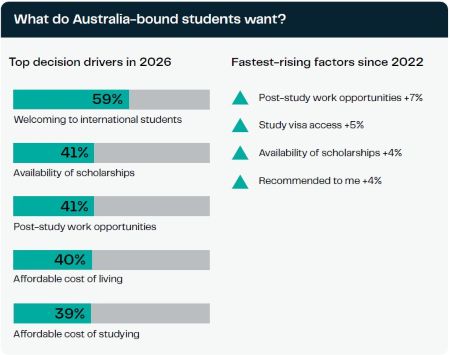
The most important factor for Australia-bound students when choosing a study destination in 2026 is whether it is welcoming to international students, followed by availability of scholarships and post-study work opportunities.
Post-study work opportunities have also become increasingly important, rising seven percentage points as a decision factor since 2022, while the importance of study visa access has increased by five percentage points.
Official university websites are still cited as the most influential information sources (75%) followed by general online search (57%) and social media channels (47%). The influence of independent agencies, consultants and education agents has also grown, increasing from 22% in 2022 to 32% in 2026.
The report also found that half of prospective students are considering five or more universities, with 10% considering more than ten, highlighting the increasingly competitive recruitment environment.
Business and management and engineering and technology have remained the top two subject interest areas since 2022, although there has been some movement in the third most ranked subject with subjects allied to medicine overtaking computing for the first time in 2026. The report highlights that providers need to ensure their messaging is connecting course choice to employability, industry links, practice experience and post-study outcomes.
On international perceptions of Australia, good quality of life, environmentally friendly and good work opportunities are the top three factors highlighted in the report. At the same time, expensive is also noted by 35 per cent of respondents, and only 18 per cent perceive it as affordable.
The findings suggest that while Australia’s appeal as a study destination remains strong, prospective students are placing increasing importance on affordability, visa access and post-study opportunities. For Australian institutions, the challenge is not simply attracting prospective students, but convincing them that Australia remains a worthwhile investment in an increasingly competitive international education market.
The report is available here.











