










The Koala News caught up with IESG Co-Founder, Ailsa Lamont, to check out how the Climate Action Barometer is going, a year since the first pilot was launched.
The Climate Action Barometer (CAB) is a rolling comparative study that measures and compares climate action policies, practices, emissions and remediations across international education institutions. The CAB was launched in July 2023 and is an initiative of the International Education Sustainability Group (IESG), a social enterprise founded by Ailsa Lamont, Emily Callaghan and Will Archer.
Interest in climate action and sustainability in the international education sector appears to be really growing. Why is that?
There are few reasons why I think the international education sector having agency around climate action is becoming more readily acknowledged and accepted. One is people generally are becoming more concerned about climate change and are seeing more of its effects, with few parts of the world not having felt its impact in some way.
I think the other is that this issue has received increasing profile because of organisations like IESG and the Climate Action Network for International Educators (CANIE); through the development of the CANIE Accord; and through the recent recognition of CANIE and the Accord by QS in their sustainability rankings (see TKN’s report).
Also, students around the world are increasingly considering their education institution’s commitment to sustainability before making their choice of where to study. A Times Higher Education study found that 82 per cent of prospective international students say sustainability is an important factor in decision-making; and in a QS Survey, 43 per cent of students looking at studying in Australian and New Zealand said that they were actively researching universities environmental sustainability strategy and efforts.
There’s broader recognition and understanding. It is something that students care about, that the university sector has to do something about, and where we have actions that we can take.
I saw on some of your material “1.5°c, the KPI that really counts”. Tell us more about that.
This is basically the rule we live by.
When we think about the purpose of international education, it’s not just about helping people get a job. It’s about creating global citizens who can improve the world and who have international horizons and skills. That’s what is needed to tackle the climate crisis. We need people who can think globally.
I also think global citizenship without climate literacy or sustainability literacy is hollow. When you look at the issues that the world faces, if you don’t tackle the rising temperatures, global warming, you’re not going to be able to tackle any of those other problems, because climate change acts as a threat multiplier.
For example, if you’re in a middle or low-income country country and you have extreme weather events, your resources and funds get diverted into just dealing with that problem. This means they get taken away from education, from health, from achieving the other sustainable development goals.
Tackling climate change should be part of an institution’s core mission, and part of their core offer to students. In my view, nobody should be leaving university or any higher education provider without a working knowledge of what the causes and effects are of climate change and what they personally can do about it throughout their career.
Now let’s turn to the Climate Action Barometer. Can you tell us what is it?
The CAB is a global benchmark, tracking and comparing climate action policies, practices and emissions across international education. It has two parts:
- CAB Survey Tool
- ClimateEye™ instrument which calculates travel emissions from international staff and student mobility
How does it work?
We’ve designed the CAB in a way that it makes it accessible and readily adoptable by an institution. It shows them where they are now, how they compare to others and gives them support to implement change.
Data is collected online from the institutions that are participating, in the form of a questionnaire survey, with over 110 measures of benchmarked data, tracked and compared over time. Participating institutions receive a report with a tailored set of recommendations. Individual institution data isn’t shared publicly but we do anonymise information so that we can share comparative data.
And we don’t just do their analysis and give them a benchmark report, we also give them practical tools and recommendations, backed up with good practice exchange sessions. We choose critical topics that come through from the results and then we run sessions where people share what they’re doing, how they managed to do it and what the impact has been. For example, we’ve run sessions on improving climate literacy, sustainable travel policy, and promoting sustainability themed planning abroad. Our experience is that they have been very collaborative and practical.
Tell me about working across international and sustainability teams
That has been another interesting part of the journey. We work with the international team and the sustainability team at most of our partners, and very often we’re the ones that are bringing them together. They might never have had any communication or connection previously.
Most sustainability teams have been focusing on reducing the emissions from the built environment and from energy usage over the last several years (Scopes 1 & 2), and in many cases, they’ve now got that under control. This means they’re turning their attention to indirect emissions in their supply chain (Scope 3), and what that means is that international has to be a a big part of the conversation.
If an institution has set ambitious climate and sustainability targets, there’s no way they can achieve them without bringing in international. But sustainability teams generally don’t know how to bridge that gap, and that’s where we come in.
Is the CAB limited to universities?
No, it’s open to any institution that is involved in international education.
What do you hope participating institutions will do with the results they receive?
We want to help them make better decisions about the actions they take that impact the climate. We want them to learn from, and share, the great examples that are out there. That’s one of the reasons we run the good practice exchange sessions.
It’s also important that they not only commit to climate action but can provide evidence of how that commitment translates to action.
What’s the idea behind it being a rolling comparative study? Most people would be more familiar with the once-a-year survey concept.
The main reason for it being rolling is that because it’s climate action, we don’t have time to wait. We don’t want someone to miss out and have to wait another year to participate, especially because actions are cumulative; someone is appointed to work on climate action, and they get involved in the institution’s climate sustainability committee, and then they start building it into their plan and it goes on from there.
The second reason is that we’re constantly expanding. We’ve currently got most of the data from our participating institutions in this current wave. Then we’ll have a cut-off point.. At the same time as we are doing this, we are expanding to North America, so we will be adding them into the next group.
On the comparative aspect, we’ve found that the positive impact of a comparative process for climate action is that it multiplies across regions. Comparative insights grow, as great practice examples are shared between more participants. And the body of data grows, to the benefit of each participating institution.
Tell us about some of the results from the pilot?
There were nine founding members that participated in the pilot: Charles Darwin University, Curtin University, University of Auckland, The University of Newcastle, The University of Sydney, University of Tasmania, Western Sydney University, Flinders University and Navitas.
Some of the headline findings were:
- Sustainability and climate action are core to the strategy and positioning of 8 out of the 9 institutions in the pilot
- In most cases, CAB institutions’ International Strategy is not closely linked to their Sustainability Strategy
- No Founders Group members have developed sustainability or climate action strategies specific to international operations
- Eight institutions anticipate that climate change will have a significant impact on their international operations in the next 3-5 years
How many institutions have now signed up to participate in the CAB and where are they from?
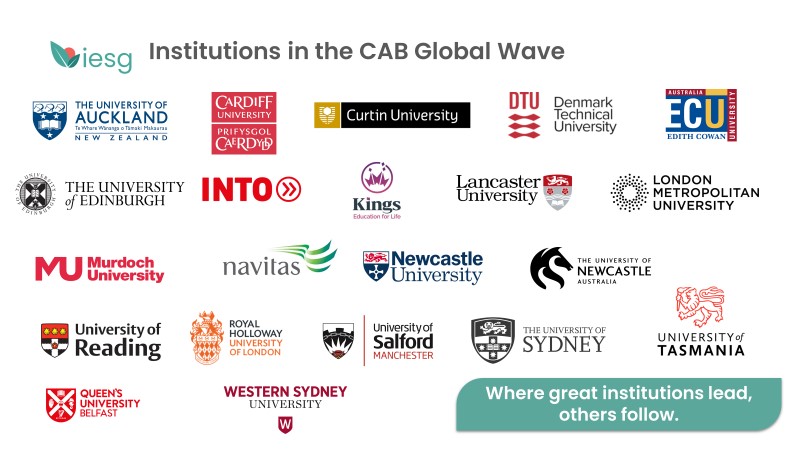
We have more than 20 institutions from 7 different countries, and we’re looking forward to adding to that with our North America group soon.
What’s next for the evolution of the CAB?
We’ve already introduced a streamlined version of the CAB for education abroad and one for just transnational education. We’re in the process of developing one for language schools.
And as I already mentioned we’re launching our North America Founders group soon.
How can institutions get involved?
There is still an opportunity for institutions to get involved in the next wave. You can contact us through our website: https://www.iesg.eco/climate-action-barometer