
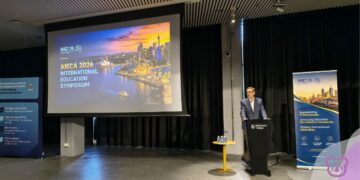










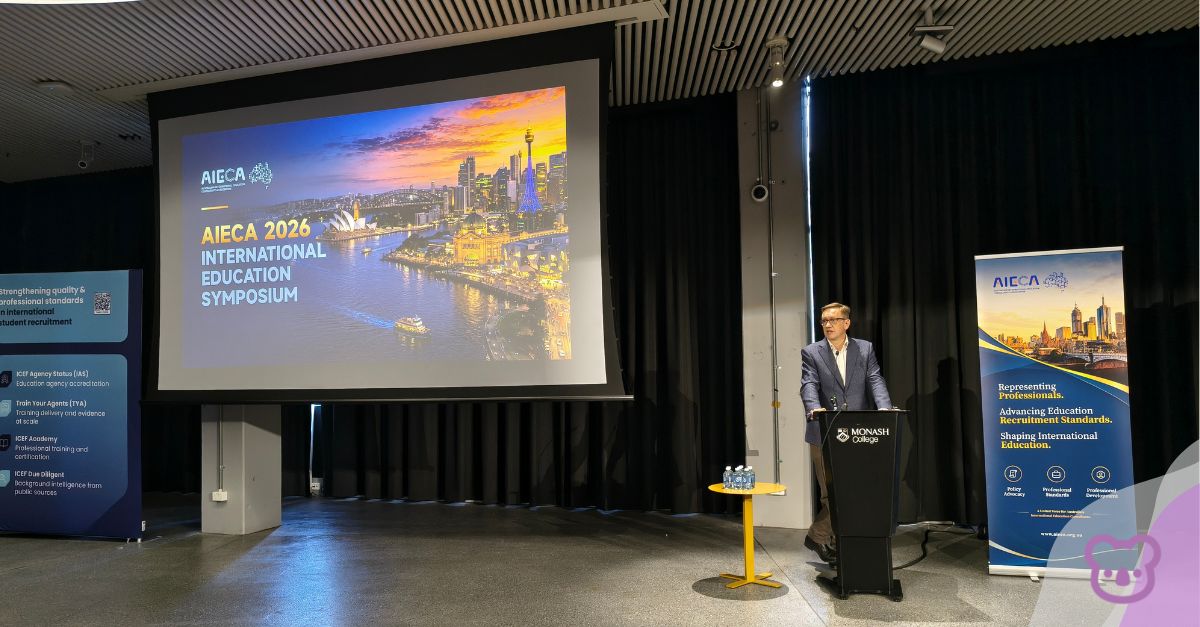
Australia’s international education sector is being asked to navigate changing student visa settings, shifting migration policy and growing pressure on recruitment, with industry leaders using AIECA SYMPLEDX in Melbourne to examine what comes next.
The symposium, organised by the Australian International Education Consultants Association (AIECA), brought together education agents, universities, schools, English language providers, policymakers and migration specialists for a day of discussion on the direction of the sector.
The programme reflected an industry grappling with the consequences of successive policy changes since mid-2023, while trying to restore confidence among students, families and international education partners.
Professor Andrew Norton’s session, Future directions for international student policy, put the question of policy stability firmly on the agenda. The programme noted that successive measures intended to improve integrity and reduce student numbers had created a difficult environment for students, agents and providers, raising the question of whether more stable rules could be restored.
The relationship between international education and migration was another central theme. Migration Institute of Australia CEO Peter van Vliet opened the discussion on the links between education and skilled migration, while Dr Abul Rizvi later examined temporary migration and potential solutions to the pressures surrounding the system.
Together, the sessions highlighted a persistent challenge for the sector: international education operates alongside Australia’s migration settings, but changes to those settings can have consequences well beyond the visa system itself.
Recruitment pressures extend across the sector
The day’s discussions also moved beyond higher education, reflecting the breadth of Australia’s international education ecosystem and the different ways policy changes affect providers.
A panel on transnational education and the future of student recruitment examined how Australian universities are expanding their international presence. Representatives from Monash, Swinburne, Deakin and RMIT discussed developments across China, Qatar, Indonesia and India, and the implications for international partnerships and recruitment.
The discussion reflected the growing importance of offshore delivery and transnational education as universities seek to build their international presence beyond traditional models of students travelling to Australia.
International student recruitment in Australian schools received separate attention, with the programme identifying visa settings and processing, accommodation, guardianship arrangements and changing market conditions as pressures on demand and enrolments.
A further panel brought university admissions leaders and education consultants together to consider how they could work more effectively across the student journey, from application through to enrolment.
The inclusion of these discussions underscored that recruitment challenges are not confined to a single provider category. Schools, universities, agents and other education providers are operating in an environment where policy, affordability, processing and confidence can all influence student decisions.
ELICOS under pressure
The challenges facing English language colleges received particular attention in a session titled ELICOS: from Canary in the Coal Mine to Sacrificial Lamb, presented by English Australia CEO Ian Aird.
The published programme noted that student visa applications for English Language Intensive Courses for Overseas Students (ELICOS) in the 2025–26 financial year were nearly 30 per cent lower than they had been 20 years earlier, while enrolments were also at their lowest level in almost two decades.
It also flagged the potential consequences of October’s announced cuts to onshore applications, including further pressure on ELICOS numbers and possible flow-on effects for vocational education and higher education enrolments.
The session placed the future of the English language sector within the wider debate about the sustainability of international education settings, and the extent to which pressure on one part of the system can affect the others.
Policy updates and the road ahead
International Education Association of Australia CEO Phil Honeywood delivered policy updates and insights alongside the Education Agent Report, before a student visa changes update and question-and-answer session with Matthew Noble, Assistant Secretary for Temporary Visas at the Department of Home Affairs.
The programme concluded with a keynote from Assistant Minister for International Education Julian Hill, who was scheduled to address the future of international education in Australia and take questions from the audience.
The combination of sector perspectives and government participation provided an opportunity to consider the practical implications of policy changes for those working directly with international students and their families.
But the broader challenge remains how Australia balances the integrity of its international education system with the need to provide a clear, predictable and credible environment for students, institutions and international partners.
For education agents in particular, policy uncertainty is not an abstract concern. Changes to visa settings, student eligibility and processing can affect advice, recruitment decisions and relationships with providers, often before the longer-term effects of a policy are understood.
AIECA SYMPLEDX provided a forum for those pressures to be examined across the sector. The next test will be whether the discussion translates into greater clarity, stronger collaboration and a more consistent direction for Australian international education.











