
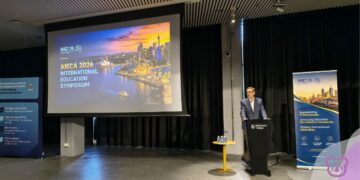












I wish to acknowledge Gary Li Chair of AIECA; Robert Parsonson CEO of AIECA; Melanie Macfarlane, Board Director of AIECA and also NSW/ACT Branch President of the MIA; and Mr Matthew Hilakari MP, Parliamentary Secretary for Education.
Today I wanted to talk about the link between international education and skilled migration and some of the changes that have occurred in migration and international education over the last few years.
I begin with the obvious premise that I believe it is self-evident that both migration and international education have been hugely beneficial to Australia. Australia would not be the economically successful regional middle power that it is today without the economic and social benefits of migration along with the added regional soft-power benefits of international education.
Fee paying international students have also help fund universities and colleges for domestic students. For instance, universities received around 25% of their funding from international student fees in 2019.
International education brings around $55 billion dollars per year to the Australian economy and creates around 250,000 jobs. It is one of our top four export earners along with mining, agriculture and tourism. International Education is a core component of our global economy success story.
To understand where we got to today you need to cast your mind back to 1999 and the early 2000s when John Howard connected international education more directly to skilled migration. This was seen as a win-win for Australia. We would take in more higher education and vocational and technical or VET students internationally, scale up Australia’s international education sector as a major export industry, and keep some of the best and brightest of international students who would stay on as skilled migrants. Then in 2007 the 485 temporary graduate visa was introduced further strengthening the connection between study and post study work.
Then came the Knight Review in 2011 which recommended strengthening our international education system further and strengthening post study work rights. The genuine temporary entrant criteria (now know as the Genuine Student requirement) was also introduced to ensure students knew they were here on a temporary basis and that there were no guarantees of permanency.
The international education system went from strength to strength but then of course came the COVID pandemic which put the brakes on migration and saw net overseas migration plummet.
However, post COVID we quickly saw net overseas migration play catchup and rise to the unprecedented level of 555,000 in September 2023 with much of the increase being driven by delayed student arrivals.
This net overseas migration surge saw the migration debate spring back to life in Australia and of course international students and the international education sector have been the collateral damage in this debate. In effect international education and international students were an easy target.
Today net overseas migration has fallen to 292,000 (at last count) and with the government’s tightened migration policies NOM is well on its way to meet the government’s 225,000 target in a few years.
This will effectively return Australia to the more normal and sustainable migration levels that we experienced before the pandemic.
Anecdotally many temporary visa holders are now talking of returning home when their visas expire given the current more hostile environment. This is not necessarily a good sign for a usually welcoming and multicultural country like Australia, but I suspect this is what some policy makers want.
So, what have been some of the policy changes we have seen from Government over the last while:
- There was of course international student commencements now set at 295,000 in 2026.
- Student visa fees have increased rapidly from $710 in 2023; to $1600 in July 2024; to $2,000 in July 2025; and then $2,500 in July 2026.
- There was also the massive increase in the 485 temporary graduate (work) visa fee in March 2026 from $2,300 to $4,600 and again in July 2026 from $4,600 to $5,750.
- Then we had the restriction on secondary applicants for international students and planned restrictions on secondary applicants for most 485 temporary graduate visa holders which is expected to be implemented soon.
All of these measures have been designed to reduce net overseas migration and also the number of temporary visa holders in Australia, the latter of which has risen significantly from around 2 million in 2020 to just under 3 million more recently.
International students and 485 visa holders, with visa holder numbers at 528,800 and 217,200 respectively, make up around 28% of the 2.8 million temporary visa holders in Australia. If you exclude New Zealanders and tourists they make up around 45% of temporary visa holders.
So, if the Government is going to get net overseas migration down to more sustainable and politically manageable numbers the international education sector is an obvious target.
But as I said earlier net overseas migration or NOM numbers are now returning to normal and the public debate hasn’t really caught up with that.
Now that NOM numbers are returning to normal levels and towards that 200,000 mark it is really time to let the international education sector and international students themselves breathe. In my view, the government should now ease off on any more cuts or restrictions in international education. As my good friend Melanie Macfarlane and AIECA board member says don’t prune the tree so much that you kill it!
I also noticed that the Professionals in Internation Education or PIE group just noted at their international conference in Dublin, Ireland that visa uncertainty was threatening the $1.7 trillion international education industry. I think we can all agree that now is the time for more student visa certainty here in Australia as well.
It is also time to restate the great benefits of migration and international education. We cannot forget the great value of international education to Australia which I discussed earlier. Walk out on the streets of Melbourne today and you will see the wonderful contribution that international students make to our city and all the soft regional power that goes with that.
We also need to dispel myths about international students taking housing given many live in purpose-built student accommodation or smaller city apartments. There is also now strong investment in student housing which is a good thing.
I now wanted to talk about the Temporary Graduate 485 vias which can be linked to skilled migration for international students. This visa allows students to work from 18 months to three years following their graduation depending on their qualification.
Australia now has a very clear policy choice on this issue with the Labor Government supporting the retention of this important visa and the Coalition and One Nation both proposing to abolish the visa except for some specialist pathways in a few instances.
I believe the temporary graduate 485 visa is an important part of the international education and skilled migration architecture in Australia. It allows graduates to gain valuable work experience after their studies in Australia. It acts as an incentive to attract the best and brightest to our shores. It enables graduates to fill areas of skills shortages in industries like early childhood education, IT and health and aged care.
We also know for instance that around a third of international students chose Australia as a study destination because we allow access to a temporary post study visa with work rights.
The 485 temporary graduate visa also keeps open the golden thread for the very best and brightest international students. Here the best and brightest can go from a 500 student visa; to a 485 post graduate visa; to a 482 temporary skilled visa; and then to a 186 permanent employer sponsored visa; and then to citizenship.
While on this journey they are boosting productivity, reducing skills bottlenecks, paying tax, paying visa application charges, and performing skilled jobs for which there are no Australians available. These may be the perfect migrants economically if there is such a thing!
Of course, this golden pathway is only for the best and brightest but is very valuable architecture and Australia is very lucky to retain those who are skilled and smart enough to complete this journey.
So, in conclusion policies to effectively end the 485 temporary graduate visa will further dampen demand for international education in Australia. If we want to damage this $55 billion industry and the 250,000 jobs that go with it and curb the effective subsidisation of Australian students through international student fees; then this is one good way of doing that.
Back to the temporary vs permanent skilled migration issue, I just wanted to make a very basic point which I think is important. It may seem slightly contradictory to my comments just then about the golden thread for the best and brightest but none the less it is still important.
The majority of international students will eventually have to go home following completion of their 500 or 485 visa. Many students never intended to stay beyond those initial temporary visas anyway. But unfortunately for those that do want to stay the maths of a permanent skilled program of just 132,000 places per year does not support them all staying here on a permanent basis.
The education industry, migration agents and migration lawyers need to be honest with their clients chasing permanent residence about this basic fact. They must clearly and unambiguously explain the generally temporary nature of the subclass 500 and 485 visas.
Yes, permanent residence is achievable through transition to skilled migration and the pathway is there, but this is only for the exceptionally talented students, only for the best and brightest who have skills that are in demand, and it is by no means guaranteed.
Both our international education and our migration industries need to be genuine and honest with international students about this basic fact that permanency or PR is not guaranteed. Our industry depends on a strong ethical foundation to flourish and to keep our social licence, our good relationship with government, and general public support for migration. So please give honest and realistic advice.
I want to end my speech with one simple truth about the current temporary migration debate. Most temporary visa holders like 485 visa holders only stay in Australia if there is paid work available to do. They have no welfare rights so if the labour market were to soften most would go home. The system has this self-correcting mechanism built into it which people seem to forget.
So, the simple truth in the current debates about migration in Australia is the reason we have so many temporary migrans here is that there are jobs aplenty. There are not enough Australian born people to fill all of these jobs due to our ageing population and low birth rates.
Yes, we need to manage migration and social cohesion, but we cannot make cuts so drastic that they would undermine our broader economic success and restrict our labour market. And we cannot forget that the 48 hours per fortnight that international students can work is actually a critical component of this framework.
Any plans to drastically further cut temporary migrant numbers, other than the more reasonable reductions already underway, needs labour market and economic modelling to analyse the impact of such cuts and explain how they would not impact basic services and prices for Australians. It is the view of many economists, including Saul Eslake just yesterday, that cuts that are too deep to temporary migration would damage our economy to the tune of billions of dollars.
In closing international students and international education are a critical part of Australia’s economic and social success and an integral and key part of our migration program and we must never lose sight of this.
Thank you for the opportunity to speak today and I look forward to learning more during the rest of the symposium.
Peter van Vliet was appointed as CEO of the MIA in 2024. Prior to this, Peter has worked as a senior executive in the Commonwealth and Victorian governments, including for the then Department of Immigration and Citizenship. He has also led several non-government organisations and has had some experience practising as a registered migration agent. Peter has a Master of Arts from Monash University, a Graduate Diploma in Corporate Governance from the Governance Institute of Australia, and a Graduate Diploma in Migration Law from Victoria University. Peter also serves on the board of Settlement Services International.












