










International student mobility is becoming an increasingly competitive global contest, and the traditional English-speaking destinations are finding themselves on the wrong side of the scoreboard.
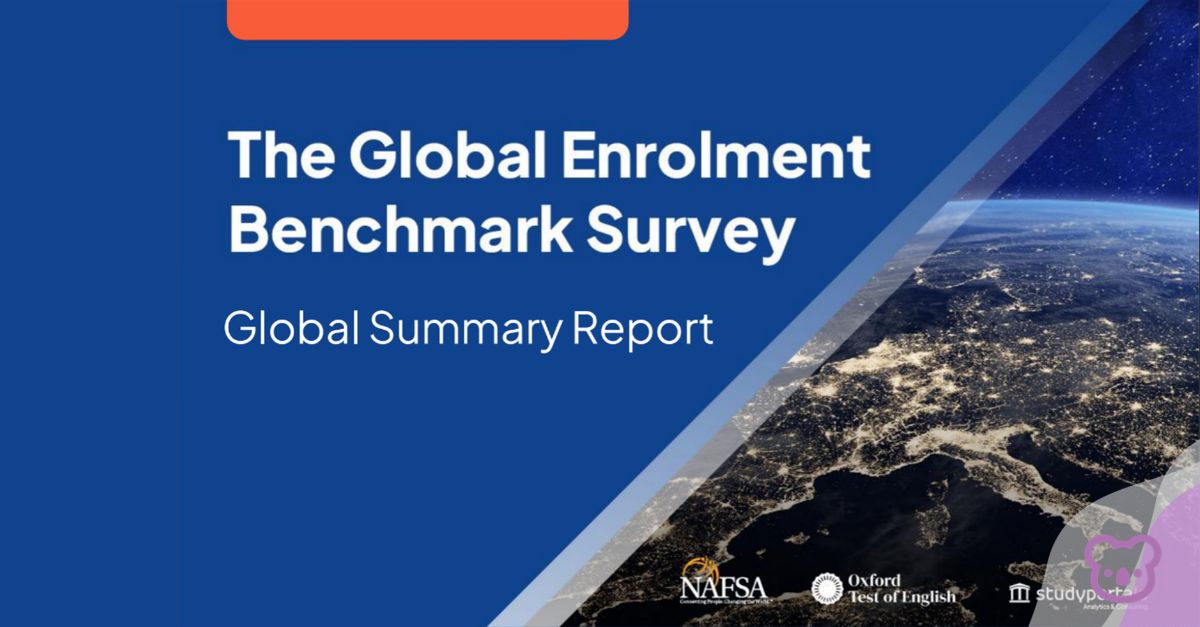
New findings from the Global Enrolment Benchmark Survey, released by Studyportals in partnership with NAFSA: Association of International Educators and Oxford Test of English, suggest that restrictive government policies, visa difficulties and affordability are pushing international students towards alternative destinations in Asia and Continental Europe.
The survey collected responses from 437 universities across 63 countries on new international enrolments between August and October 2026. Its findings reveal a growing divide between the established international education destinations and the rest of the world.
Across the four major English-speaking destinations of Australia, Canada, the UK and the US, 62% of institutions reported declining postgraduate enrolments, compared with just 27% of institutions elsewhere.
At undergraduate level, the contrast was also significant, with 46% of Big Four institutions reporting lower enrolments compared with 26% elsewhere.
It is a finding that should prompt some uncomfortable questions for the traditional destination markets. For decades, the US, UK, Canada and Australia have enjoyed considerable advantages in attracting international students. But reputation, established education systems and English-language delivery are no longer necessarily enough to maintain that competitive position.
The UK and US feel the pressure
The UK appears to be experiencing the sharpest downturn, particularly in postgraduate education.
Almost four in five UK institutions (79%) reported lower postgraduate enrolments in the August to October intake, up from 50% a year earlier. The average decline was 19%.
Visa refusals, credibility interviews and changing immigration requirements were among the concerns raised by participating institutions.
The US is also continuing to struggle. Some 59% of American institutions reported declining postgraduate enrolments, with an average fall of 13%. It marks a third difficult autumn in succession.
One US institution warned that proposed changes to Duration of Status and Optional Practical Training (OPT) rules could further reduce demand. Another reported that proposed fees associated with OPT, STEM OPT and H-1B visas were cooling interest in studying in the country, particularly among prospective postgraduate students.
These findings reinforce a familiar theme in international education. Students are not simply choosing a university. They are making decisions about where they want to live, work and potentially build a future.
When governments change the perceived value of that proposition, the consequences can extend well beyond the visa application itself.
Asia and Europe gain ground
While the traditional destinations are dealing with declining numbers, institutions in Asia and Continental Europe are reporting a different experience.
Almost six in ten Asian institutions (59%) recorded higher postgraduate enrolments, with average growth of 7%. At undergraduate level, 40% reported growth.
Continental Europe also recorded positive results, with undergraduate enrolments increasing by an average of 4% and postgraduate enrolments by 2%.
The contrast is particularly interesting because it suggests international students are not necessarily abandoning international education. Rather, they are increasingly looking at different destinations.
This is an important distinction. The global appetite for an international education experience may remain strong, but the countries and institutions benefiting from that demand are changing.
As Studyportals CEO and Co-Founder Edwin van Rest observed, the shift is particularly evident in postgraduate programmes, which play an important role in attracting the international talent countries need to remain competitive.
The question for established destinations is whether they recognise that international students have alternatives, and whether their policy settings reflect that reality.
Government policy remains the biggest obstacle
The survey leaves little doubt about what institutions believe is driving the changes.
Some 73% of participating universities identified restrictive government policies and visa issues as a significant obstacle to international recruitment. When asked what had the biggest negative influence on enrolments, approximately seven in ten respondents identified visas or government policy.
The report identifies two distinct problems.
The first occurs after students have already been admitted. Visa appointment shortages, extended vetting processes and slower permit decisions are causing students to miss course commencement dates. Some defer, others arrive late, while some simply abandon their plans.
The second problem occurs much earlier in the recruitment process. Changes to post-study work rights, proposed visa fees and increasingly restrictive immigration settings are influencing destination choices before students even submit an application.
In other words, governments are potentially undermining recruitment before universities have had a chance to compete for the student.
NAFSA CEO Dr Fanta Aw said the findings reinforced the importance of national policy in decisions about where international students study, conduct research and begin their careers.
It is an observation that should not be particularly surprising. What is perhaps more surprising is how often governments appear to underestimate the competitive consequences of their decisions.
There are also other pressures. Almost half of institutions (46%) identified affordability and the cost of living as a significant issue, while concerns about suitable accommodation increased from 14% in the previous survey to 21%.
The international student proposition is becoming more complicated. Governments can make it harder to obtain a visa, universities can increase tuition fees and accommodation can become increasingly difficult to secure. At some point, students will simply look elsewhere.
Canada shows signs of stabilising
There is some more encouraging news for Canada, which appears to be emerging from two years of significant enrolment declines.
Canadian institutions reported average falls of just 4% at undergraduate level and 3% at postgraduate level. More than half reported postgraduate enrolments remaining unchanged.
The outlook is also relatively positive, with 71% of Canadian respondents expecting higher enrolments in the next intake.
However, this optimism needs to be viewed against the considerable ground Canada has lost following reductions in study permits and changes to post-study work eligibility and visa transferability.
Stabilisation is welcome, but it is not the same as recovery.
Diversification becomes the priority
The survey also provides an indication of how institutions intend to respond to the changing market.
Diversification into new international markets was the most commonly identified strategy for the next 12 months, with 43% of institutions saying it was very likely. That figure rises to 63% among UK institutions.
Budget cuts were the second most common anticipated response, increasing from 26% in the previous survey to 30%.
The focus on diversification is understandable. When traditional markets become more difficult to access, universities need to find new sources of demand.
But the findings also suggest that institutional activity still matters.
Among institutions identifying positive influences on enrolments, 73% credited something their own institution had done. Recruitment activity, staffing and international travel were the most frequently mentioned, followed by strategic marketing, programme quality, personalised applicant communication and scholarships.
There is a useful reminder here that universities are not entirely powerless in an increasingly difficult policy environment. How they recruit, communicate and position their offerings can still make a difference.
And what about Australia?
For Australian institutions, the report offers a broader warning rather than a definitive assessment of domestic performance.
Only four Australian institutions participated in the survey, meaning the report does not provide a separate Australian regional breakdown. Australia is included in the Big Four comparison, but it would be unwise to draw firm conclusions about the direction or scale of Australian enrolments from such a small sample.
Nevertheless, the broader findings are difficult to ignore.
Australia is competing in a market where students have more choices, alternative destinations are becoming increasingly attractive and government policy is playing a major role in shaping destination decisions.
The fact that universities elsewhere are reporting growth while institutions across the Big Four are more frequently reporting declines should be enough to warrant attention.
The report is based on institutional responses rather than official student headcounts, and its authors caution that regional sample sizes vary and that the results should be considered alongside government statistics and other market research. Even so, the directional trends are worth watching.
The message from Studyportals Co-Founder Edwin van Rest is straightforward: welcoming international students is an investment in a country’s future competitiveness.
It is a message that applies equally to Australia.
International education is a global market, not a guaranteed pipeline of students who will continue to choose the same destinations simply because they have done so in the past.
Students have options. Governments have choices. And universities are increasingly finding that the consequences of those choices are showing up in their enrolment numbers.