










Affordability is increasingly trumping proximity to campus in the purpose-built student accommodation (PBSA) market, with students showing a greater willingness to travel further in exchange for more manageable rents.
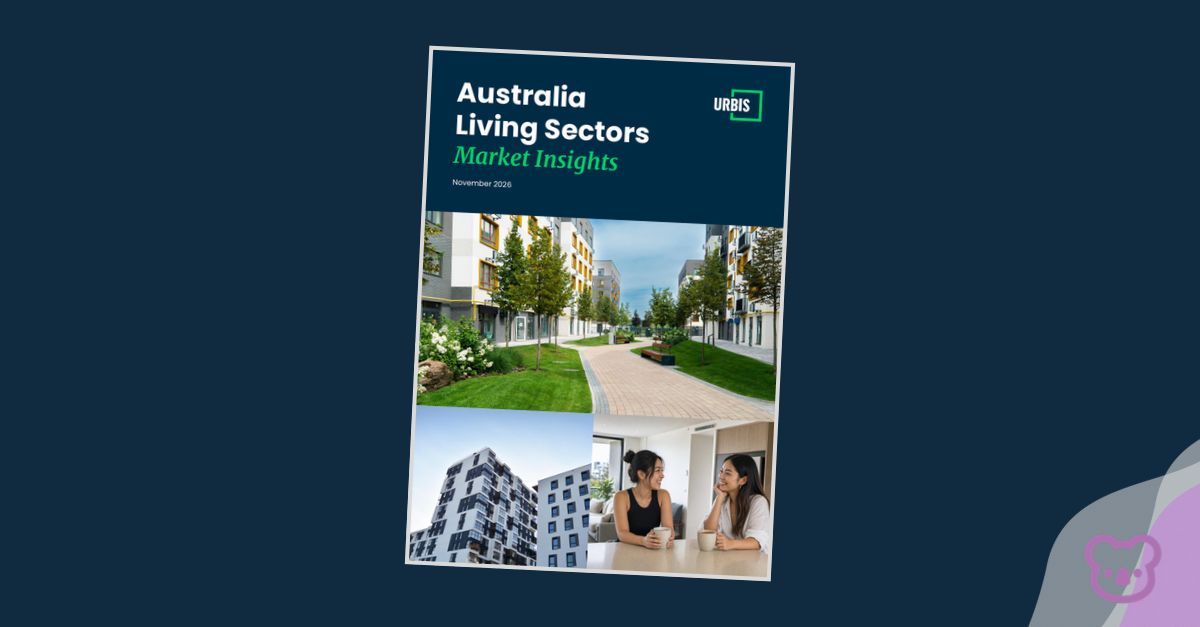
That is one of the central findings of property consultancy Urbis’ November Living Sectors Market Insights report, which points to a sector that has almost doubled in size over the past decade but is now facing growing pressure to ensure accommodation remains accessible and affordable for students.
The numbers tell part of the story. Average weekly rents in private PBSA facilities have increased across every Australian capital over the past two years, with Perth recording the sharpest growth at 7.3%, followed by Sydney at 4%, Brisbane at 3%, Melbourne at 2.4% and Adelaide at 1.4%.
Sydney remains the most expensive market, with average weekly rents of $705, while Adelaide is the most affordable at $400. Perth sits at $480, although its recent rental growth suggests affordability pressures are becoming increasingly pronounced.
For students already navigating higher living costs, the decision about where to live is becoming less about securing a room within walking distance of university and more about finding a workable combination of price, transport, safety and lifestyle.
Urbis Partner Clinton Ostwald said students were increasingly prepared to look beyond their immediate university precinct if public transport offered convenient access to campus.
The shift is also being influenced by changing patterns of university participation. With online learning reducing the amount of time some students spend on campus, the traditional assumption that students need to live as close as possible to their university is becoming less straightforward.
But there is a catch. Living further away only makes sense if the transport connections work, and if the savings in rent are not swallowed up by travel costs and additional time spent commuting.
A market growing, but not necessarily becoming more accessible
The scale of Australia’s PBSA market has changed considerably. Urbis estimates national supply has reached approximately 139,000 beds in 2026, almost double the 2014 figure of around 70,000.
Private investment has been the principal driver of that expansion, accounting for 73% of new supply since 2014, rising to 89% when university joint ventures are included.
Despite the growth, the report identifies around 7.3 full-time, on-campus university students for every existing PBSA bed nationally. While that ratio has declined over time, occupancy remains strong and the report suggests there is still room for additional supply in selected markets.
A further 18,000 beds are currently under construction nationally, although rising construction costs, financing constraints and planning challenges are making new projects increasingly difficult to deliver.
There is an important distinction here between market demand and student affordability. A strong investment market, high occupancy and rising rents might be encouraging signals for developers and investors, but they do not necessarily translate into better accommodation options for students.
Indeed, the report’s findings suggest the sector is increasingly having to reconcile two different expectations: investors need projects that deliver viable returns, while students need somewhere affordable to live.
The challenge is not simply to build more beds. It is to build the right beds, in the right locations, at prices that reflect what students can reasonably pay.
Two accommodation models are emerging
One of the more interesting findings in the Urbis report is the growing difference between privately operated PBSA and university-affiliated accommodation.
Private operators are increasingly favouring self-contained living, with studios and one-bedroom apartments accounting for around 80% of projects in the development pipeline.
The attraction is understandable. Students seeking greater independence and privacy are increasingly drawn to self-contained accommodation, while studios also offer developers stronger rental returns per square metre. Urbis estimates studio apartments command rents per square metre around 41% higher than four-bedroom apartments.
Private providers are also competing through lifestyle amenities, with gyms, cinemas, rooftop terraces and other facilities increasingly part of the product offering.
University and joint venture accommodation, by comparison, remains more heavily weighted towards shared living arrangements, including five-plus-bedroom apartments and college-style accommodation.
This model allows universities to accommodate more students and offer comparatively affordable options while supporting the social connections and sense of community associated with student living.
The distinction is significant. It suggests the market is not simply expanding to provide more of the same accommodation. Different providers are developing different products for different student expectations and price points.
However, there is a question about how far the private market can continue moving towards premium, self-contained accommodation while affordability becomes an increasingly important consideration.
A gym and cinema room might help differentiate a property, but they are unlikely to be the deciding factor for a student struggling to meet weekly rent.
There is a balance to be struck between providing an attractive living experience and ensuring that the additional facilities do not simply add to the cost of accommodation.
Universities are getting back into the accommodation business
Another notable development is the growing willingness of universities to take a more direct role in delivering student accommodation.
Historically, universities have increasingly relied on partnerships with private investors, developers and specialist operators to expand supply while limiting their own capital commitments and sharing development risk.
Urbis identifies a shift towards greater direct university investment, with five of the six university-related projects currently under construction being delivered without a joint venture partner.
The report points to several significant developments, including the University of Queensland’s 1,018-bed Walcott Street project, the University of Newcastle’s Muloobinba House and the University of Western Australia’s 844-bed Nedlands development.
There are several reasons for the change. Universities are under pressure to support housing affordability, maintain their competitiveness in attracting and retaining students and, increasingly, respond to government expectations around accommodation provision and international student enrolment allocations.
Accommodation is becoming more closely connected to the broader student recruitment and experience proposition. Universities cannot necessarily leave the housing question entirely to the private market and assume students will find somewhere suitable.
The growing direct investment also raises questions about the future relationship between universities and private PBSA operators. Rather than relying exclusively on partnerships, institutions may increasingly see accommodation as an asset worth developing and managing themselves.
Beyond the university precinct
The report also highlights the growing integration of PBSA into mixed-use developments and the potential to repurpose existing commercial buildings.
Projects such as the Waterloo Metro Quarter in Sydney and the proposed Gurrowa Place development in Melbourne demonstrate how student accommodation can become part of larger urban renewal projects, alongside residential housing, retail, commercial space and public amenities.
The former office conversion model is also gaining attention, particularly in established CBDs where older commercial buildings may offer convenient access to universities, public transport and employment.
There are obvious attractions, including the potential to reuse existing structures, reduce demolition waste and bring accommodation to market more quickly. However, Urbis cautions that not every office building is suitable, with floorplate configurations, natural light, building services and compliance requirements all affecting feasibility.
These developments reinforce the changing role of student accommodation. PBSA is increasingly being viewed not just as a place for students to sleep, but as part of the broader housing, economic and urban planning equation.
The next challenge is affordability
Urbis expects demand for PBSA to remain strong, supported by international education, continued investor interest and Australia’s relatively low accommodation provision compared with other major student destinations.
However, the report also identifies international student policy, migration settings and construction costs as continuing sources of uncertainty.
The outlook for 2027 is therefore one of sustained investor interest, but with greater scrutiny of local market conditions, affordability and the viability of individual projects.
For the international education sector, there is a broader issue that should not get lost in the investment numbers.
Australia’s ability to attract international students is not determined solely by the quality of its universities or the reputation of its qualifications. The practical experience of living and studying here matters too, and accommodation sits firmly within that equation.
A market can have strong demand, an expanding pipeline and plenty of investor interest while still leaving students struggling to find somewhere suitable to live.
The willingness of students to travel further for cheaper accommodation is a useful signal of where the market is heading. It is also a reminder that proximity, amenities and lifestyle are only part of the equation.
Ultimately, the next phase of Australia’s PBSA market will be judged not just by how many beds are delivered, but by whether those beds offer students genuine value.
More accommodation is certainly needed. But building a bigger market and building a more affordable one are not necessarily the same thing.