



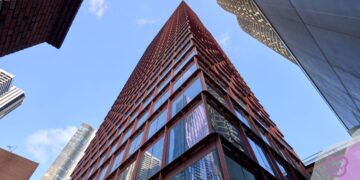






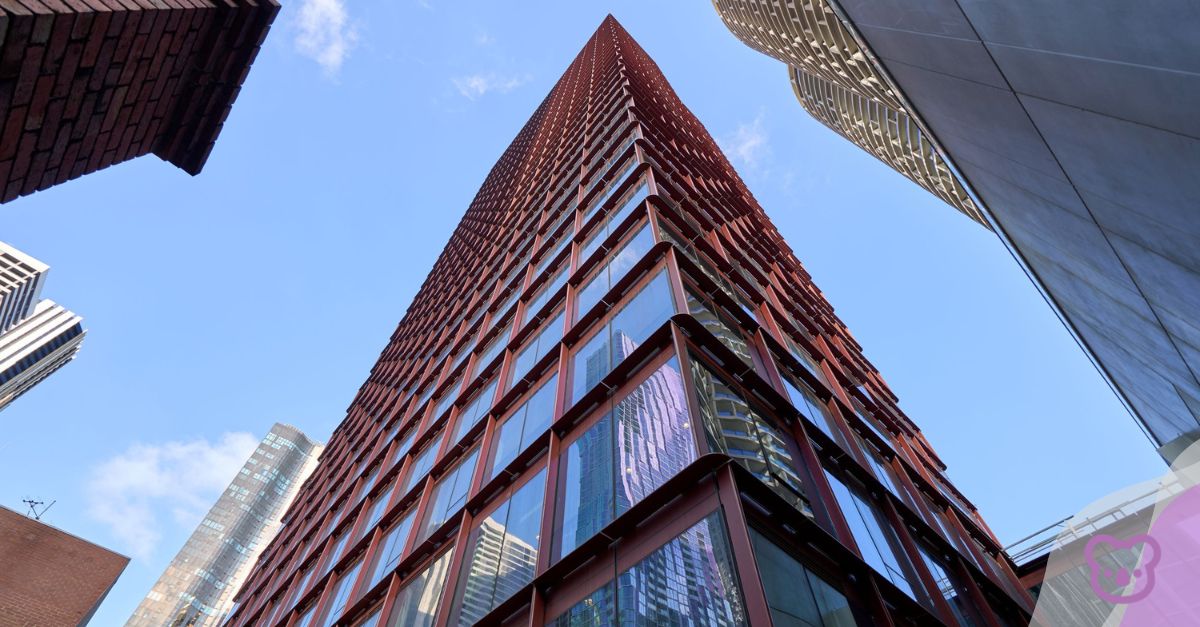
Melbourne’s student accommodation pipeline has taken another significant step forward, with Multiplex completing Journal Student Living’s 40-level Market Way development in the CBD ahead of schedule.
Located at 100 Franklin Street, close to the Queen Victoria Market and within easy reach of Melbourne’s major universities, Market Way delivers 715 rooms and 1,010 student beds across a mix of shared and individual configurations.
The scale of the project is considerable, but it is the combination of new construction and old Melbourne that makes Market Way particularly interesting. The development has retained the four-storey heritage-listed Burbank House, incorporating the historic building into a contemporary student accommodation project rather than simply building around it.
Burbank House now houses the development’s library, kitchen, dining area, study rooms and entry lobby. The building dates back to 1840 and was once home to inventor James Harrison, who lived there for around 40 years from 1850. Harrison established Victorian Ice Works at the property and developed one of the earliest mechanical ice-making machines.
It is a neat piece of Melbourne history sitting underneath a very modern response to one of the city’s more pressing challenges: where international and domestic students are going to live.
Market Way provides more than 3,000 square metres of communal space, including study rooms, a gym, library, music and gaming rooms, a cinema and rooftop terrace. There is also more than 350 square metres of retail space and 172 bicycle spaces, with the development deliberately opting against onsite car parking.
That last point is worth noting. Student accommodation in a CBD environment does not necessarily need to reproduce the infrastructure expectations of conventional residential development. Students are more likely to be walking, cycling or using public transport, particularly when their accommodation is located close to universities and the services of the city.
For Melbourne, the additional 1,010 beds are also another contribution to a student accommodation market that has spent years trying to catch up with demand.
The development comes as universities, governments and accommodation providers increasingly recognise that student housing is not simply a property issue. Availability, affordability and location all influence the broader international education proposition. A student may choose a university because of its academic reputation, but where they can actually live, and what they will pay to do so, can be just as important to the experience of studying in Australia.
Market Way follows Journal Student Living’s first project with Multiplex, the 452-room Campus House in Carlton, which was completed in 2025. Together, the two developments represent more than 1,450 student beds delivered by the partnership.
The project also provides an interesting example of how construction itself is changing as the sector attempts to deliver PBSA at greater scale.
Multiplex says around 250 workers were onsite each day during construction, with prefabrication used extensively to improve efficiency. The project included 983 offsite-fabricated bathroom pods, 300 precast panels with integrated brick façades, prefabricated column boxes with built-in reinforcement, a modular curtain wall façade, GRC planter boxes and pre-assembled rooftop plant.
The contractor says the combination of these techniques with high-rise construction expertise and the complex restoration of Burbank House allowed the project to be delivered ahead of schedule without compromising quality.
That matters because Australia does not simply need more student accommodation. It needs more accommodation delivered at a pace that can respond to student growth, while still producing buildings that work as places to live and study.
There is also a broader lesson in Market Way. The future of PBSA is unlikely to be about beds alone. The strongest developments are increasingly being designed around the full student experience, combining accommodation with study, recreation, social spaces, transport connections and access to the city.
Market Way is, quite literally, building on Melbourne’s past while responding to its future. And with more than 1,000 students set to call the building home, it is another sizeable addition to the infrastructure supporting the city’s international education ambitions.