










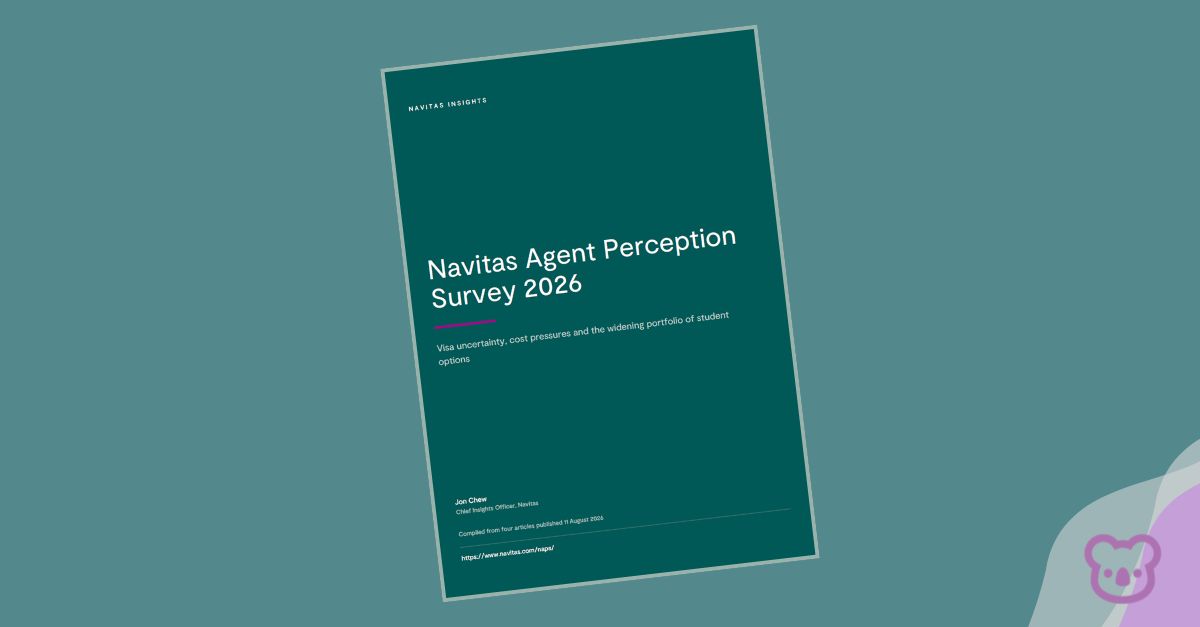
The 2026 Navitas Agent Perception Survey offers a revealing look at where international education is heading. Visa volatility, rising costs, changing student expectations and AI are reshaping how students choose where and how they study overseas. Drawing on thousands of agent responses across key markets, the survey captures a sector in the middle of a significant reset. The Big Four face growing policy and affordability pressures, while students are widening their options to include regional and home country alternatives. At the same time, agents are adapting to a world where AI provides more information, but human advice remains essential. In this four part Koala News series, we unpack what agents are telling us and explore the trends shaping the next chapter of global student mobility.
If visa uncertainty is changing where students look, cost is changing whether they go at all.
The 2026 Navitas Agent Perception Survey makes that pretty clear. Across the major student markets, affordability has become the biggest factor influencing where students choose to study, pushing traditional considerations such as prestige, rankings and even visa access further down the list.
Across Greater China and North Asia, South Asia, South East Asia and Africa, cost of study was the number one factor identified by agents, with 81.8 per cent selecting it as a key driver of destination choice.
That puts cost well ahead of post-study work rights at 60.6 per cent and quality of education at 53.6 per cent.
And when agents talk about cost, they are not just talking about tuition fees.
Families are looking at the whole bill. Tuition, accommodation, food, transport, exchange rates and the prospect of finding work all form part of the calculation. With the cost of living rising in many markets, studying overseas has become a much bigger financial decision.
The question is increasingly not simply, “Where is the best place to study?”
It is, “Where can we afford to study and what are we going to get for the money?”
That is a significant change for an industry that has spent decades selling the benefits of the world’s most prestigious education destinations.
Australia still has some big advantages
Cost may be dominating the conversation, but Australia continues to perform strongly in areas that matter to students.
Post-study work rights remain particularly important in South Asia, South East Asia and Africa, where they are consistently the second most important consideration for students.
Australia is the clear favourite when agents are asked which destination offers the most appealing post-study work opportunities, attracting more than half of responses.
It is even stronger when it comes to opportunities to work while studying, with almost 70 per cent of agents selecting Australia as the most appealing destination.
Those are significant competitive advantages.
But they do not make Australia immune from the affordability problem.
A strong work rights proposition only goes so far if students and their families cannot afford to get through the first few years of study.
Students are building a Plan B
Perhaps the most interesting part of the survey is what students are doing in response.
They are not necessarily abandoning international education. Instead, they are becoming much more strategic about it.
Seventy-seven per cent of agents agree that students are now applying to more countries outside the Big Four. At the same time, 72 per cent say students are increasingly likely to have a backup plan to study in their home country.
That tells us something important about how the market is changing.
The student who once had their heart set on Australia, Canada, the UK or the US may now have several options on the table. There might be a first choice overseas, a cheaper alternative in another country and a local university waiting in the wings.
And there is a very good reason for having that safety net.
Sixty-eight per cent of agents agree that students are now more likely to give up on studying overseas altogether because they cannot afford it.
That is arguably the most important finding in the survey.
Cost is no longer simply an obstacle that students try to overcome. For a growing number of families, it is becoming a reason to abandon the idea altogether.
Home is looking better
Domestic alternatives are also becoming more credible.
Forty-six per cent of agents agree that universities in students’ home countries can now provide an education comparable with studying overseas.
Foreign branch campuses are also strengthening their position. They offer students access to international institutions and qualifications without necessarily requiring them to take on the full cost of living and studying overseas.
Again, affordability is the biggest reason students choose to stay home, accounting for 28.9 per cent of responses. Family commitments and visa difficulties follow.
This does not mean global student mobility is going into reverse.
It means students are becoming smarter about it.
They are comparing more destinations, looking at more institutions and thinking much harder about what they will get from the investment.
Value is becoming the new competitive advantage
For universities and governments, this has some pretty serious implications.
A strong university brand still matters. Rankings still matter. Graduate outcomes matter.
But value is becoming increasingly important.
Destinations that can combine reasonable costs with good quality education, reliable visa processes and genuine opportunities to work are likely to have an advantage.
The old assumption that students will simply find a way to afford the world’s most popular destinations is becoming harder to sustain.
The Big Four still have plenty going for them. But students are no longer shopping with an unlimited budget.
They are comparing.
They are negotiating.
And increasingly, they are asking whether the price of an international education is actually worth paying.
That may prove to be one of the biggest changes facing the global education market in the years ahead.
The Navitas Agent Perception Report 2026 can be seen here.