













Australia’s post-COVID recovery in outbound student mobility appears to have stalled, with cost pressures, staffing constraints, changes to the New Colombo Plan and ongoing geopolitical uncertainty all weighing on participation.
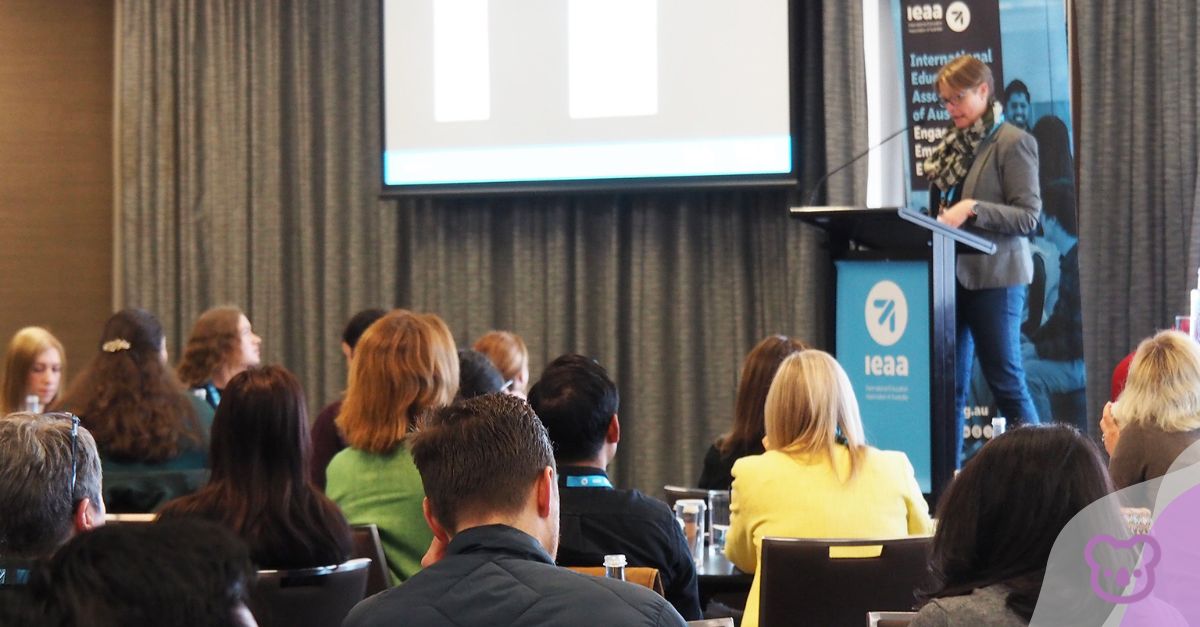
That was one of the clearest messages to emerge from the 2026 IEAA Learning Abroad Forum, held on 13 and 14 August.
The annual event is unusual in the Australian international education calendar. With a little over 150 participants, it brings together many of the people who actually design, manage and promote learning abroad programs across the country.
Twenty-one years after it began, it remains the only national event focused entirely on learning abroad.
This year’s theme, “Lost in Translation”, felt appropriate. The latest benchmark data indicated that the sector’s post-COVID recovery has lost momentum, but there is no single reason.
Changes to the New Colombo Plan have reshaped what is fundable and for whom. Cost-of-living pressures are making overseas study harder to justify for students already under financial strain. Airfares remain painful, while conflict in the Middle East has added both travel disruption and parental anxiety.
Another issue received less attention, but may be just as important.
Many learning abroad teams are still operating with fewer staff than they had before 2020. Fewer staff can mean fewer programs, less promotion, fewer conversations with students and fewer opportunities to turn vague interest into actual participation.
A plateau is perhaps unsurprising when affordability, confidence and institutional capacity are all under pressure at once.
Importantly, the mood of the forum was not gloomy.
Much of the discussion focused instead on how learning abroad needs to evolve. Accessibility and neurodiversity featured strongly, with a clear message that inclusion should not be treated as something added during risk assessment. It has to be designed into the experience from the beginning.
The same practical approach emerged around sustainability and student safety. Nobody pretended there were simple answers to the tension between international education and long-haul travel, or to the increasingly complex risk environment universities are managing.
But the discussion I found most interesting was around outcomes.
Learning abroad has long been associated with confidence, independence, intercultural capability and employability. The harder question is whether institutions can actually demonstrate those outcomes. Several discussions returned to the gap between what programs are designed to achieve and what students demonstrably take from them.
Universities increasingly need to show what students learn, how they change, and why that matters academically or professionally. That’s especially true in the age of artificial intelligence, where things like language skills appear, on the surface, to have less value than before. Those of us who work in learning abroad know that learning a language, or studying abroad, is about far more than figuring out how to say “Where is the train station?” But we need to convince students of this too.
The forum also included strong discussion around inbound mobility, employability and the US-Australia study abroad corridor, but the most useful signal may have come from the room itself.
Despite the relatively flat data, the mood was noticeably positive. The sector is dealing with difficult economics, policy change, geopolitical uncertainty and institutional constraints. But there was little sense that learning abroad itself had become less relevant. If anything, the opposite may be true.
In a world of AI, contested information and increasingly digital interaction, the value of physically encountering other places, cultures and ways of thinking may be getting stronger. The challenge now is translating that value clearly enough for students, universities and governments to see it.
Next stop for many in the sector will be AIEC in Sydney in October.
Rob Malicki is Co-CEO of Choosing Your Uni and has extensive experience in student mobility.
Photo is courtesy of the International Education Association of Australia (IEAA).












