







The Koala News
  • News
    • All
    • Accommodation
    • Agents
    • Breaking
    • Compliance
    • Data
    • Ed-Tech
    • English Language
    • Market Update
    • Opinion
    • Policy
    • Profile
    • Research
    • Schools
    • Sponsored Content
    • Student Mobility
    • Student Recruitment
    • Student Support
    • TNE
    • World
    Why small decisions have a big impact in PBSA

    Why small decisions have a big impact in PBSA

    AI writing tools linked to lower rates of student outsourcing, Turnitin report finds

    AI writing tools linked to lower rates of student outsourcing, Turnitin report finds

    HEA launch puts employer connections at the centre of postgraduate offer

    HEA launch puts employer connections at the centre of postgraduate offer

    ESOS Bill not listed on day two in the Senate

    Universities Accord Bill passes Parliament with amendments

    SYMPLEDX to put the future of international education under the spotlight

    SYMPLEDX to put the future of international education under the spotlight

    The Power—and Pitfalls—of Regulation in Modern Markets

    Australia is an economy running out of road, so we must foster ambition

    The waiting lists students never see

    The waiting lists students never see

    Queensland’s regional study cluster funding ends, raising questions about what comes next

    Queensland’s regional study cluster funding ends, raising questions about what comes next

    Australia became part of the Nepali dream. Now a new generation is asking whether it is still worth the risk

    Australia became part of the Nepali dream. Now a new generation is asking whether it is still worth the risk

    New interim commissioners appointed to steer Australia’s tertiary reform agenda

    ATEC proposes global engagement as new strategic priority

    Trending Tags

    • Austrade
    • English
    • Student Data
    • Awards
    • Schools
  • About
  • Contributors
  • Advertise
  • Jobs
  • Events
  • Subscribe
  • Archive
  • Shop
  • Contact
No Result
View All Result
The Koala News
  • News
    • All
    • Accommodation
    • Agents
    • Breaking
    • Compliance
    • Data
    • Ed-Tech
    • English Language
    • Market Update
    • Opinion
    • Policy
    • Profile
    • Research
    • Schools
    • Sponsored Content
    • Student Mobility
    • Student Recruitment
    • Student Support
    • TNE
    • World
    Why small decisions have a big impact in PBSA

    Why small decisions have a big impact in PBSA

    AI writing tools linked to lower rates of student outsourcing, Turnitin report finds

    AI writing tools linked to lower rates of student outsourcing, Turnitin report finds

    HEA launch puts employer connections at the centre of postgraduate offer

    HEA launch puts employer connections at the centre of postgraduate offer

    ESOS Bill not listed on day two in the Senate

    Universities Accord Bill passes Parliament with amendments

    SYMPLEDX to put the future of international education under the spotlight

    SYMPLEDX to put the future of international education under the spotlight

    The Power—and Pitfalls—of Regulation in Modern Markets

    Australia is an economy running out of road, so we must foster ambition

    The waiting lists students never see

    The waiting lists students never see

    Queensland’s regional study cluster funding ends, raising questions about what comes next

    Queensland’s regional study cluster funding ends, raising questions about what comes next

    Australia became part of the Nepali dream. Now a new generation is asking whether it is still worth the risk

    Australia became part of the Nepali dream. Now a new generation is asking whether it is still worth the risk

    New interim commissioners appointed to steer Australia’s tertiary reform agenda

    ATEC proposes global engagement as new strategic priority

    Trending Tags

    • Austrade
    • English
    • Student Data
    • Awards
    • Schools
  • About
  • Contributors
  • Advertise
  • Jobs
  • Events
  • Subscribe
  • Archive
  • Shop
  • Contact
No Result
View All Result
The Koala News
No Result
View All Result
Home News Ed-Tech

AI writing tools linked to lower rates of student outsourcing, Turnitin report finds

Dirk MulderbyDirk Mulder
October 15, 2026
in Ed-Tech
AI writing tools linked to lower rates of student outsourcing, Turnitin report finds
Share on LinkedinShare on TwitterShare on FacebookShare via Email

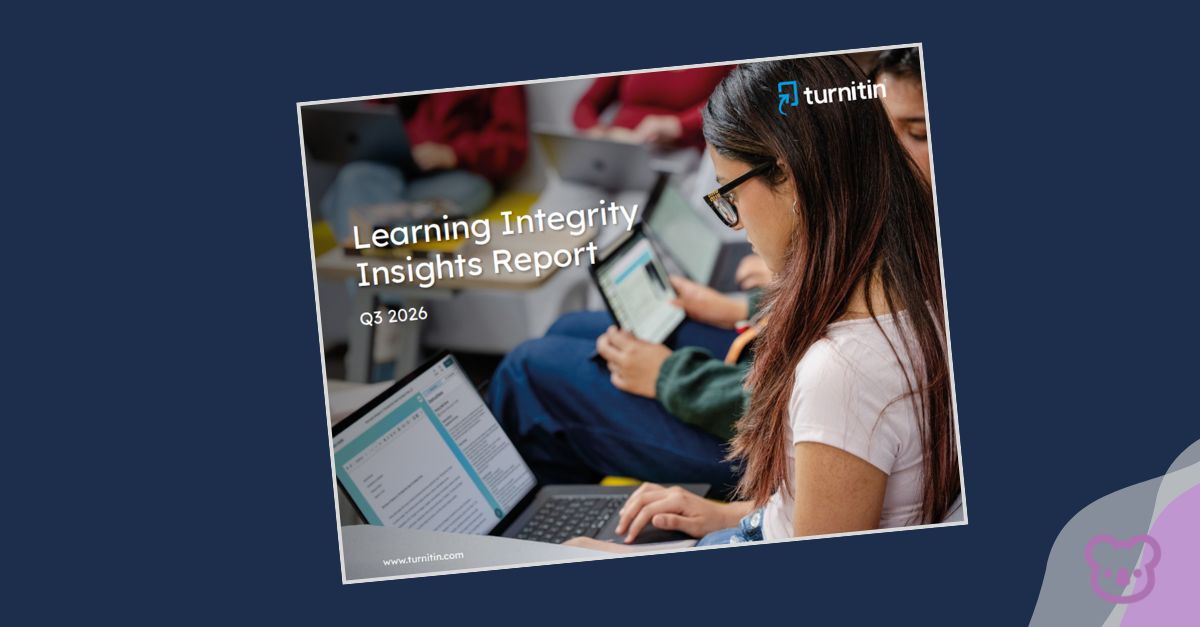
A new report from academic integrity company Turnitin suggests students are less likely to outsource most of their writing to artificial intelligence when they work in a transparent, guided writing environment, while highlighting a persistent gap between institutional AI policies and classroom practice.

Turnitin’s Learning Integrity Insights Report Q3 2026 found that 3.96% of submissions from Australia and New Zealand completed using its Clarity writing environment recorded an AI writing score above 80%, compared with 6.7% of submissions completed outside the platform.

The findings cover submissions from 1 July 2025 to 26 August 2026, with the Australia and New Zealand analysis drawing on 956 submissions completed in Clarity and 312,003 submissions completed outside it.

The company argues that giving educators visibility into the writing process, including drafts and revisions, can help discourage students from handing over most of their work to AI. However, the findings compare different groups of submissions and do not establish that the writing environment alone caused the difference.

Students not always turning to AI

The report also challenges the assumption that students will automatically use AI whenever it is available.

An analysis of almost 841,000 prompts submitted to Turnitin Clarity’s AI assistant across the United States, United Kingdom, Australia and New Zealand found that 66% of assignments were completed without students engaging with the assistant.

Twenty per cent of assignments involved between one and five prompts, while 14% involved six or more.

More than 95% of prompts were either written by students themselves or involved students editing the platform’s preset prompts, suggesting that those who used the assistant generally engaged with it through their own instructions rather than relying exclusively on pre-written requests.

The findings cover activity between July 2025 and August 2026. They relate specifically to Turnitin Clarity users and should not be interpreted as a measure of AI use across the broader student population.

Different approaches across education levels

The report found differences in how secondary and higher education students used AI assistance.

Among secondary students, the most frequently used preset prompts focused on brainstorming ideas, outlining assignments and obtaining feedback on writing. Brainstorming prompts were used 4,140 times, followed by outlining at 3,764 and feedback at 3,134.

Higher education students were more likely to seek feedback on work already in progress. Feedback was the most frequently used preset prompt, with 1,976 uses, followed by outlining at 1,572 and brainstorming at 1,396.

Turnitin suggests the pattern reflects secondary students using AI earlier in the writing process, while higher education students are more likely to use it to review and refine their work.

Educators are also configuring AI tools differently according to education level. An analysis of almost 30,000 assignments across more than 1,000 institutions found that higher education educators placed greater emphasis on quality checks, while secondary educators were somewhat more likely to enable collaborative features.

Among higher education assignments where educators had customised AI settings, 90% had grammar checks enabled and 75% had citation checks enabled. In secondary education, the corresponding figures were 78% and 60%.

Secondary educators also showed greater use of features supporting planning, proofreading, revision and illustrative examples.

Institutional policies not reaching the classroom

One of the report’s more significant findings concerns the translation of institutional AI policies into practical guidance for students.

Turnitin found that 50% of institutions in its analysis kept the AI assistant enabled at all times, while 45% enabled it sometimes and 5% kept it disabled.

At the classroom level, however, settings were more consistent. Among instructors whose institutions enabled the assistant, 73% kept it enabled for all assignments, 13% kept it disabled and 14% switched it on or off depending on the task.

The report argues that broad institutional policies may leave students and educators uncertain about what constitutes acceptable AI use in individual assessments.

It cites an Inside Higher Ed and Generation Lab survey of more than 5,000 students conducted in 2025. In that survey, 41% of respondents said they understood appropriate AI use through expectations set out in their syllabuses, while 35% cited classroom discussions. Only 17% identified institutional policies as their source of understanding.

The figures reinforce the importance of making expectations explicit at the subject and assessment level, rather than relying on a university-wide policy to do all the work.

For international education providers, where students may be navigating different academic conventions and expectations, clear guidance on permitted AI use is an important part of supporting the student learning experience. The report does not specifically examine international students, however, and its findings should not be treated as evidence of different AI behaviours among domestic and international cohorts.

Beyond detection

Turnitin argues that the sector needs to move beyond an approach centred on identifying AI-generated submissions and towards greater transparency in how students produce their work.

The company says access to outlines, drafts and revisions can give educators a better understanding of student development while helping students understand how their work is evaluated.

That argument raises a broader question for higher education: whether academic integrity can be protected through detection and institutional rules alone, or whether assessment design and teaching practice need to change alongside the technology.

The report is published by Turnitin, which provides academic integrity and assessment tools. Its findings draw substantially on activity within the company’s own platform, meaning they offer insight into how participating institutions and users engage with its tools rather than a comprehensive picture of AI use across education.

The central message is that the challenge is no longer simply whether students use AI. It is whether institutions can establish clear expectations that allow students to use it appropriately without surrendering the thinking, writing and learning that assessment is intended to develop.


Tags: AITurnitin
Previous Post

HEA launch puts employer connections at the centre of postgraduate offer

Next Post

Why small decisions have a big impact in PBSA

Dirk Mulder

Dirk Mulder

Dirk Mulder is the founder of the Koala and Principal of MulderPR, a strategy and marketing communications consultancy specialising in international education. Dirk has had extensive experience in International Education and Service Management, holding Directorships at the University of South Australia, Curtin University and Murdoch University as well the Lead for International Student Initiative across the Asia Pacific region at Allianz Partners. He has been member of the boards of Perth Education City (now Study Perth) and Education Adelaide, he has chaired the Universities of Perth International Directors Forum and has been a past board member of the Hawkesbury Alumni Chapter, his alma mater. His views are widely published and quoted across the media and has been seen in Campus Morning Mail, the Australian Financial Review and ABC television and online. Acknowledgement/disclosure: Dirk holds shares in and outside of the education sector including in IDP Education.

Next Post
Why small decisions have a big impact in PBSA

Why small decisions have a big impact in PBSA

What Now? What Next? What Now? What Next? What Now? What Next?
Cambridge Cambridge Cambridge
iDAT Logo iDAT Logo iDAT Logo
The Koala News

The Koala is intelligent, it can be cheeky, it aims to be informative and is uniquely Australian though proudly global.

It unashamedly promotes best practice in International Education. It loves seeing students succeed via vibrant offerings and a supporting mix of policy, recruitment and support settings.

Follow the Koala

Get the App for your mobile device

Subscribe: Have the Koala Delivered to your Inbox

  • About
  • Terms of Use
  • Privacy Policy
  • Contact

© 2023 The Koala News

The Koala News app
Get
No Result
View All Result
  • News
  • About
  • Contributors
  • Advertise
  • Jobs
  • Events
  • Subscribe
  • Archive
  • Shop
  • Contact

© 2023 The Koala News










