











The 2026 Navitas Agent Perception Survey offers a revealing look at where international education is heading. Visa volatility, rising costs, changing student expectations and AI are reshaping how students choose where and how they study overseas. Drawing on thousands of agent responses across key markets, the survey captures a sector in the middle of a significant reset. The Big Four face growing policy and affordability pressures, while students are widening their options to include regional and home country alternatives. At the same time, agents are adapting to a world where AI provides more information, but human advice remains essential. In this four part Koala News series, we unpack what agents are telling us and explore the trends shaping the next chapter of global student mobility.
There was a time when the education agent was often the person students turned to for information.
Which country should I choose? Which university? How much will it cost? What are the visa requirements?
Now students can ask those questions to ChatGPT and a growing range of other AI tools before they ever speak to an agent.
So it’s reasonable to assume that AI is making education agents less important.
According to the 2026 Navitas Agent Perception Survey, that is not what is happening.
AI is changing the relationship between students and agents, but it is not removing the need for one.
In fact, it may be making the agent’s role more important in some areas.
Students are doing their homework
The survey shows that 78 per cent of agents agree that students are doing more independent research using AI before they approach an agent.
That is hardly surprising.
Students can now compare countries, universities and courses in seconds. They can research costs, look at visa requirements, compare rankings and even get help drafting personal statements.
But getting more information does not necessarily make the decision easier.
If anything, it can make it more complicated.
That is where agents continue to have an important role. Eighty per cent of agents agree that students still rely on them to validate or interpret information they have found through AI.
There is a fairly obvious reason for that.
AI can tell a student what the rules say. An experienced agent can help explain what those rules could mean for that particular student.
There is a big difference.
Information is not advice
A student deciding where to study is not making a simple information-based decision.
Their academic results, finances, family circumstances, career ambitions and personal preferences all matter.
Then there are the things that are much harder to put into a prompt.
Will the student cope with the academic environment? Will they be comfortable living in the city? How will they manage the cost of living? Is a particular visa pathway realistic? What happens if something goes wrong?
These are the sorts of questions where context matters.
The survey shows an interesting split in how agents see the impact of AI.
Twenty-eight per cent say students are relying on them slightly or much less because of AI.
But 43 per cent say students are relying on them slightly or much more.
That suggests the agent’s role is not disappearing. It is changing.
The agent is moving further away from simply providing information and closer to helping students make sense of it.
Students are carrying more uncertainty
That role becomes even more important because the decisions students are making are becoming harder.
Families are dealing with rising living costs, changing visa policies, exchange rate movements, safety concerns, travel disruption and geopolitical uncertainty.
AI can provide information about all of those things.
But when a family is trying to decide whether to spend tens of thousands of dollars sending their child overseas, information alone is not necessarily enough.
They want someone who understands the situation and can help them work through the options.
That is where the human element matters.
The support students need is changing too
The survey also points to growing demand for support once students arrive.
Seventy-eight per cent of agents say students now require more academic support.
Even more, 82 per cent report increased social and mental health needs.
Those are not problems that can simply be solved by producing more information.
They require people who can listen, understand the circumstances and know when a student needs additional help.
This is particularly important as the idea of the “best” destination continues to change.
Students are increasingly looking for the best fit rather than simply the highest ranked university or most prestigious destination.
That means looking at academic readiness, finances, wellbeing, career ambitions and personal circumstances.
AI can generate a list of options.
An agent can help a student work out which option actually makes sense.
AI creates another question
There is also an interesting twist to all of this.
AI is not just helping students make decisions about education. It is making them more anxious about what happens after graduation.
Seventy-five per cent of agents agree that students are concerned about the impact of AI on their future careers.
That adds another layer to course selection and career planning.
Students are not just asking where they should study. Increasingly, they are asking what they should study in a world where the nature of work is changing quickly.
Again, there is no shortage of information available.
The challenge is making sense of it.
The agent is still the person in the middle
The big takeaway from the survey is that AI has not removed the need for education agents.
It has changed what students need from them.
Students are arriving with more information than ever before, but more information does not necessarily mean more certainty.
In some cases, it means the opposite.
The agent’s value is increasingly in interpretation, judgement, context and reassurance.
AI has made it much easier for students to explore the map of international education.
But when the choices become complicated, someone still needs to help them work out where they should actually go.
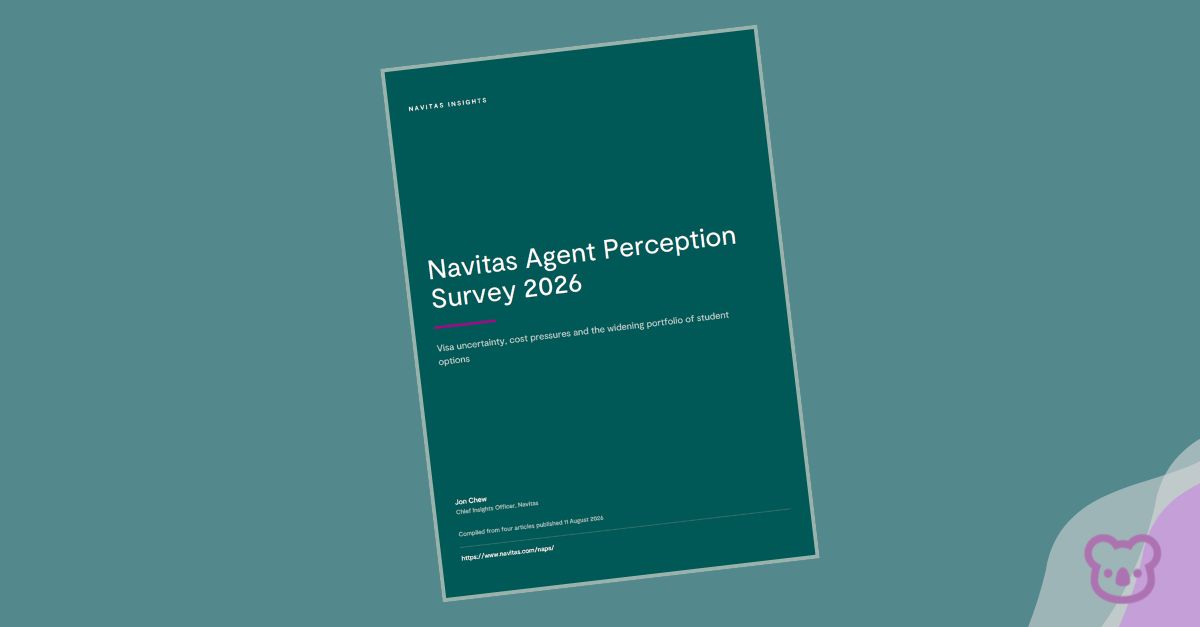
The Navitas Agent Perception Report 2026 can be seen here.












