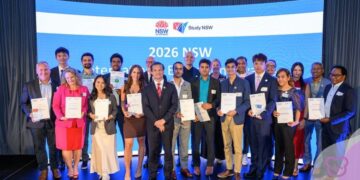











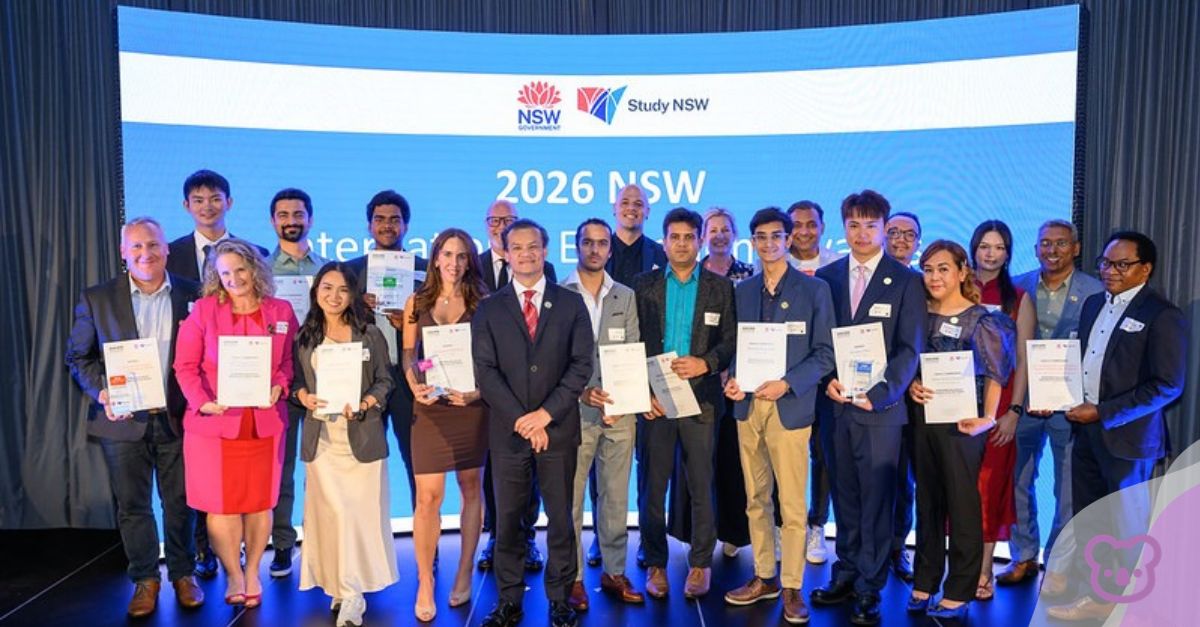
Five winners have been recognised at the 2026 NSW International Education Awards, with this year’s refreshed program placing greater emphasis on the contributions international students and education providers make to communities, research and industry.
The awards, presented at a ceremony in Sydney on Monday night (23 November), recognised three international students and two education innovators, highlighting the impact of international education beyond the classroom.
Among the student winners was Dezijian Zhou, from China, who received the International Student of the Year Award for Contribution to Research. A University of Sydney student, Zhou is developing virtual reality and touch-based technologies designed to help older people maintain connections with family and friends living at a distance.
Mohammad Ashhar Mehdi, from India, received the International Student of the Year Award for Regional Community Engagement. Studying at the University of Newcastle, Mehdi has supported hundreds of students through mentoring, advocacy and community initiatives. He also founded Causes at Campus UON, creating further opportunities for students to volunteer and develop leadership skills.
The Sydney Metropolitan Community Engagement award went to University of Sydney student Madelaine Pankhurst, from Canada. Pankhurst has established a research community of around 100 students, helping undergraduate and international students gain practical experience, build leadership capabilities and explore research careers.
Two organisations were also recognised for their contributions to the sector.
The OurFutures Institute received the International Education Excellence Award for EdTech and Innovation for its online education platform, which aims to improve mental health outcomes and address alcohol and drug abuse.
Education technology company Practera took home the International Education Excellence Award for Industry. The company delivers the Study Australia Industry Experience Program (NSW), connecting international students with businesses to work on real-world challenges, gain workplace experience and develop professional networks.
A different emphasis for the awards
This year’s awards were refreshed to place greater emphasis on outcomes and the human stories behind international education, rather than simply the ceremony and its trophy recipients.
The revised student categories specifically recognise contributions to research, regional communities and metropolitan communities, shifting attention towards what international students contribute to NSW beyond their studies.
Organisers also sought to celebrate the broader finalist cohort and the connections international students build with families, educators and communities across the state.
The choice of venue was another deliberate statement about the sector’s place in the NSW economy. The Collider at Tech Central brought the awards into the heart of the state’s innovation ecosystem, alongside technology companies, start-ups and university researchers.
The event attracted 155 attendees from across the international education sector.
International education is NSW’s second-largest export, contributing approximately $21 billion to the economy and supporting around 120,000 jobs across the state.
But the awards offered a reminder that the sector’s contribution extends well beyond export earnings and employment figures. Research, innovation, workplace connections and community leadership are all part of the value international students and education providers bring to NSW.
And while economic figures remain an important measure of the sector’s significance, the stories recognised this year offer a more personal illustration of what that contribution looks like in practice.