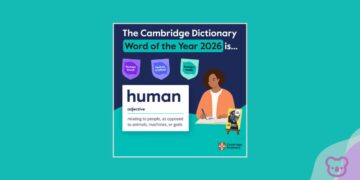






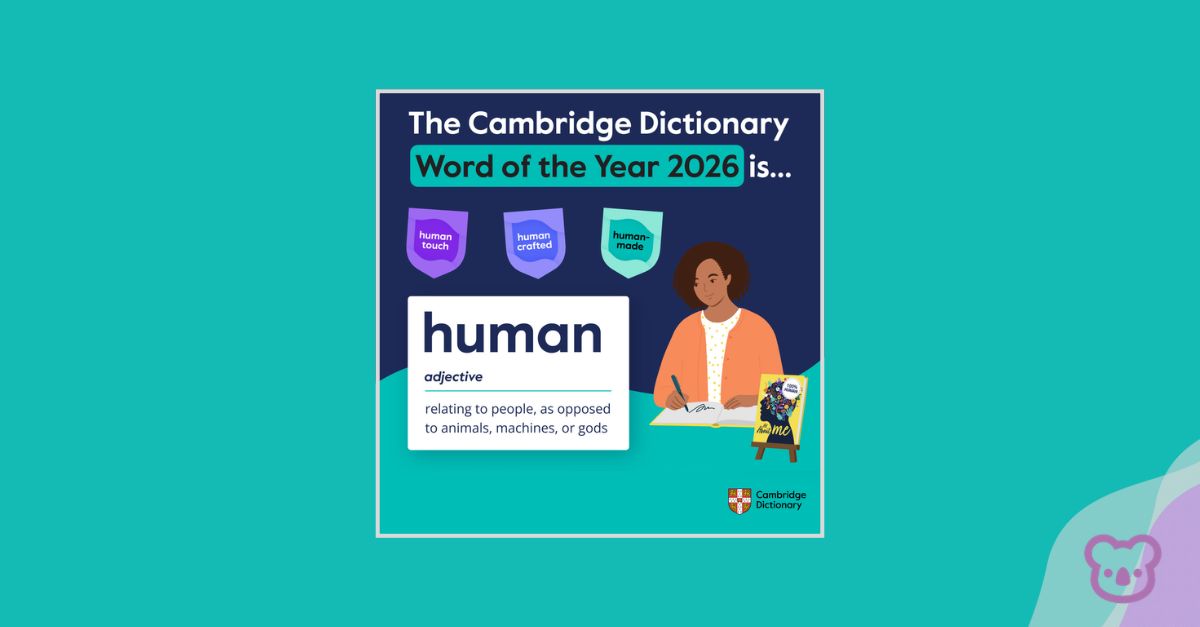
Cambridge Dictionary has named ‘human’ its Word of the Year for 2026, reflecting growing global debate about the implications of artificial intelligence and what people risk losing as machines become increasingly capable of replicating human abilities.
The dictionary defines human as ‘having the qualities, faults, and feelings that people have, as opposed to gods, animals, or machines’.
The selection reflects a year in which concerns about AI have moved well beyond questions of productivity and technological innovation, prompting broader discussions about creativity, identity, employment, safety and the future role of people in an increasingly automated world.
Among those weighing into the debate was Microsoft co-founder Bill Gates, who argued for the protection of ‘human reserved jobs’, including caregiving roles, that should remain the domain of people rather than machines.
“The measure of AI’s success should be how much it improves human lives,” Gates said.
AI pioneer and Nobel laureate Geoffrey Hinton offered a more cautionary perspective, warning: “We’re creating alien beings. I’m willing to be selfish and choose humans.”
Pope Leo XIV also addressed the issue in his Magnifica Humanitas letter, highlighting new forms of dehumanisation and the pressing duty to remain profoundly human.
The debate has extended into the creative industries, where concerns about AI-generated replicas and the unauthorised use of human-created content have prompted a growing campaign for artists’ rights.
Actors Scarlett Johansson and Cate Blanchett, musicians Billie Eilish, LeAnn Rimes and Tayla Parx, and authors Jodi Picoult and Jonathan Franzen have been among those challenging what they describe as an assault on human creativity.
Meanwhile, the growing sophistication of AI-generated deepfakes has prompted public figures to take steps to protect their identities. Actors Matthew McConaughey and Taylor Swift have pursued trademarks covering aspects of their voices and images to guard against unauthorised digital reproduction.
Safety concerns have also intensified following high-profile incidents involving AI platforms and warnings from industry insiders about the potential existential risks posed by increasingly powerful systems.
The phrase ‘probability of doom’, commonly shortened to P(doom), has even entered mainstream discussion as a way of describing the perceived likelihood of AI destroying humanity.
Keeping the human in learning
For international education, the choice of ‘human’ carries particular relevance as institutions grapple with how AI is changing teaching, learning, assessment and the skills graduates will need.
Colin McIntosh, lexicographer at Cambridge Dictionary, said the technology was changing the way people think and talk about being human.
He pointed to concerns about what people might lose when they outsource their thinking, with the debate extending from mathematicians to teachers of young children.
The increasing use of terms such as ‘human-made’ also reflects a shift in language, with the word increasingly being used to distinguish the work and qualities of people from those produced by artificial intelligence.
Matthew Ellman, an English teaching expert at Cambridge University Press & Assessment, said the selection was a reminder that authentic connection remained central to language learning.
“In the English language classroom, focusing on the human encourages us to see language less in terms of grammar or vocabulary, and more as a vehicle for identity and expression,” he said.
Ellman highlighted collaboration, critical thinking and creativity as fundamentally human skills that language learning can help develop, enabling learners to connect with other English users in richer ways.
Cambridge supports more than five million learners each year to develop and demonstrate their English proficiency.
The organisation is also looking ahead to the release of the first PISA Foreign Language Assessment results in 2027. The assessment, which includes English as a foreign language for the first time, reflects the growing importance of language learning in an increasingly interconnected world. Cambridge partnered with the OECD to design and develop the English language tests.
Professor Rachel Adams, an AI governance and human rights expert at the University of Cambridge, said AI presented both significant opportunities and risks for humanity.
She warned that the technology could deepen existing inequalities, while also offering the potential to address them.
“The question is whether the profits of AI – in terms of wealth, productivity and scientific advances – can be harnessed to tackle the great political challenges of our time,” she said.
Other words making their mark
While ‘human’ took the top spot, other contenders for the 2026 Word of the Year included ‘agent’, referring to AI systems capable of operating with limited human control, and ‘wholesome’, which gained attention following positive displays of sportsmanship at the FIFA World Cup.
Cambridge Dictionary also added several new terms during the year, reflecting the influence of social media and changing cultural trends.
These included ‘aura farming’, the deliberate cultivation of an admired or attractive online persona, and ‘looksmaxxing’, the pursuit of physical attractiveness, particularly popular among young men on social media.
Other additions included ‘air jail’, a controversial animal-training technique involving holding an animal off the ground.
Among the words being considered for future inclusion are ‘FOBO’, or the fear of becoming obsolete as AI threatens traditional employment, and ‘dusking’, the practice of watching daylight turn to darkness as a form of relaxation.
For a year dominated by technological advances and questions about what machines might eventually be capable of, Cambridge Dictionary’s choice is a reminder that the debate is ultimately about people.
The challenge for education, like much of society, will be ensuring that technological progress does not come at the expense of the very human qualities it is supposed to serve.