






This series of stories in the Koala News shares highlights from Days of our Lives: Making sense of leadership in international education, a qualitative research exploration with 24 senior leaders in Australian education. Last week we got up before dawn with our leaders, walked the dog, packed the lunches, and caught our first glimpse of some habits and pressure points sitting behind those polished profiles.
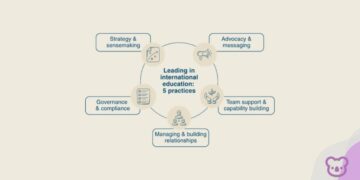
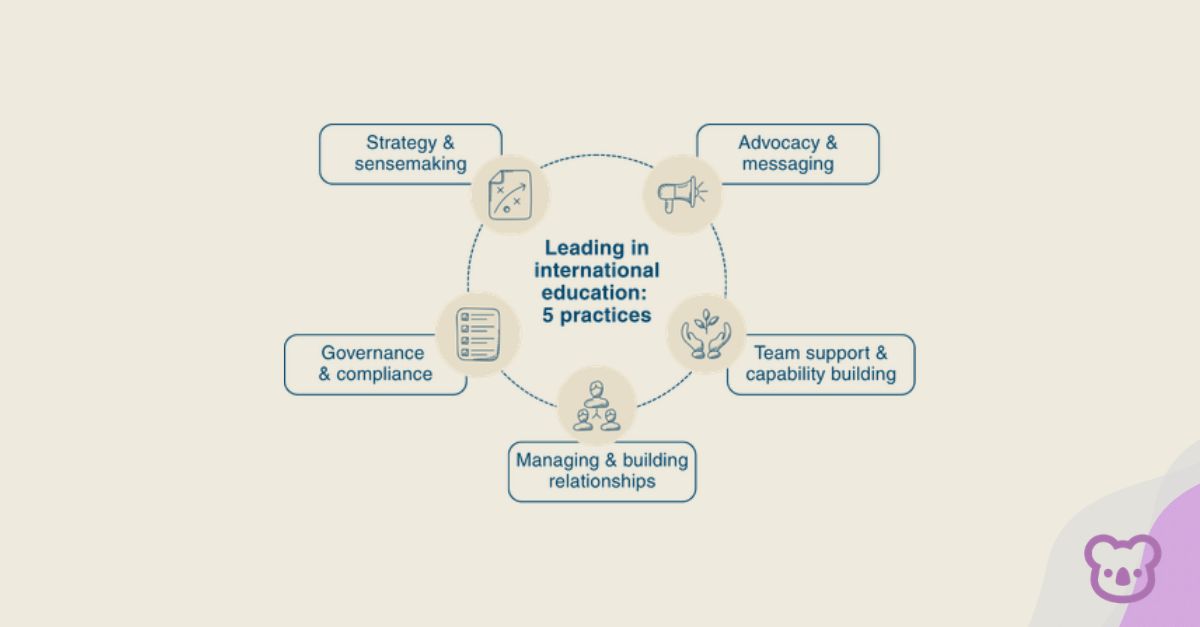
Asking only one question, we found some remarkable similarities across leaders from diverse institutions in higher education, VET, ELICOS and schools. This week we look at five key practices in detail; they may sound familiar, but how these practices play out in different contexts is where it gets really interesting.
In search of sense and strategy
Our first practice is essential in leadership roles, but not easily spotted in daily routines. Strategic thinking is woven through everyday tasks, report edits, board papers, and advice to colleagues. Decisions are underpinned by data and insights, which are fed into team meetings, executive conversations and presentations to internal and external stakeholders. So far, so normal.
But people never stop asking about data in international education: applications, offers, visa approvals, turnaround times, conversion rates, retention – the list goes on. Over time, ‘The Numbers’ have become a double-edged sword; a good story opens doors to the executive suite, but if they’re off-target, jobs and reputations are at stake.
“We do all sorts of things in the international office, but at the end of the day, it is about the numbers. If the numbers are good, everything will be easy for everyone; the numbers go off the rails, it’s problematic”
After dealing with the numbers, one of the biggest challenges with strategy is simply finding time in the day when there are so many other priorities competing for attention. The language used here is striking: ‘burning infernos’, ‘fires’ and ‘bombs’ waiting in your inbox, and potential catastrophe if an important call or Teams message is missed. Leaders may try to set boundaries, but if the VC or another VIP calls, you drop everything and answer.
The international voice in the room
Advocacy and messaging make up our second set of practices, and remind us that leading in international education asks us to be an external, coherent voice for students, global partners, and the sector as a whole. Leaders communicate in multiple directions, including ‘inwards’ to their institution and ‘outwards’ to a range of local, national and international stakeholders.
“They might come up with a great program and it could be run half online, but you can’t do that if you’re hoping for an international student. That’s the voice, that’s the role you’re playing…”
As well as time spent advocating internally to support colleagues’ understanding of international education, our senior leaders are also representing the institution and its interests to external partners, governments and other audiences. This means they not only need international knowledge, but also a deep understanding of the institution’s strategy, its strengths and its distinctive assets in a highly competitive global environment.
“You don’t ever switch off. You’re always advocating in one way or another in the work you do, or the discussions you have – what’s in the best interest of the schools, and how can international education be enhanced, or how can the sector be built up…”
Preparation is everything, from checking the political temperature and refining words of welcome, to choosing the right thing to wear when an overseas delegation is in town.
Make space for the dream team
Our third set of practices are about team support and capability building – because even the most competent leaders can’t do their jobs in isolation. As they described their daily work, our interviewees spoke highly of their teams, noting their individual and collective strengths, knowledge, skills, and diversity. It’s the leader’s job to get roadblocks and red tape out of their way, so they can keep doing what they do best.
“They’re quite senior people, so it’s really just, ‘what can I do to help you maximise your time? What noise can I get out of your way?”
Senior leaders are not only driving strategy, but also interpreting and connecting it to team priorities in an uncertain internal and external environment. Many staff are unsettled by frequent regulatory changes, organisational restructuring and polarising media narratives on international education. Sensing the mood, leaders are working hard to moderate the conversation, calming tension whilst keeping teams focussed and realistic about the future.
Chief Relationships Officer
Despite the tyranny of distance, international education retains its relational roots, with formal and informal connections stretching across institutional silos and international borders. Duties range from hosting foreign delegations and overseeing strategic partnership arrangements to spending up to a third of their time overseas, making new connections and nurturing established ones. That means you usually need to dress the part, too.
“You’re meeting with high-level delegates from other countries, or vice chancellors, or government officials, so you’re thinking, okay, I’ve gotta suit up today, I can’t wear my sneakers, even though it’s Friday…”
Leading can be a lonely business, especially if you’re a small international team or the only senior representative of ‘international’ in the building right now. Networks and relationships with peers across the sector offer a sanity-saving lifeline amid the policy storms and global uncertainty; at least someone knows what it feels like, and may even have a solution they can share with you.
“You’re on speed dial with maybe 20-30 other directors or PVCs around the country, and different chat groups. You’re just checking, hey, this is coming through in our data, are you guys seeing similar things?”
Seat on the board, feet in compliance
Our final practice may be the least glamorous of leadership duties, but is fundamental to maintain trust, reputation and the integrity of the international student experience. Taking responsibility here goes beyond checklists, TEQSA reporting or an upcoming CRICOS renewal. Leading governance means knowing your product, students, and regulatory context so well that you can immediately spot when a decision won’t work for international, and you’re ready to advocate for what’s needed instead.
“The main priority is don’t let anybody make any silly decisions today. You’re looking for things you know are not in the institution’s interests…”
Whilst reports and meetings can feel a world away from the student and staff experience, the accountability that comes with senior leadership brings it all back into focus, especially when things go wrong. It’s the senior leader they call when the social media team picks up a signal that a student may be at risk of harm, or a staff member overseas is taken ill and can’t get home.
“If it’s an absolute crisis, like a student, some critical incident, if anything like that happens all bets are off – that’s what you’re doing. Drop everything.”
In a way, governance and compliance brings leaders back to the reasons they’re still in this sector, despite all its challenges: they believe it matters, and they care about the students, staff, and colleagues who are in it.
In next week’s highlights, we’re getting into the personal stuff – the routines that make or break the day, from a precious 20 minutes of fiction on the train ride to work, right through to the 11pm reckoning with burnout.
Can’t wait that long? Download the full report: Days of our Lives: Making sense of leadership in international education