












RTOs are being reminded that the cancellation of a qualification can have consequences well beyond the provider originally targeted by regulatory action, with ASQA setting out clear expectations around trainers, students, credit transfers and recognition of prior learning.
The Australian Skills Quality Authority (ASQA) has issued a new Statement of Regulatory Expectations, making it clear that registered training organisations (RTOs) cannot afford to treat the cancellation of qualifications as somebody else’s problem.
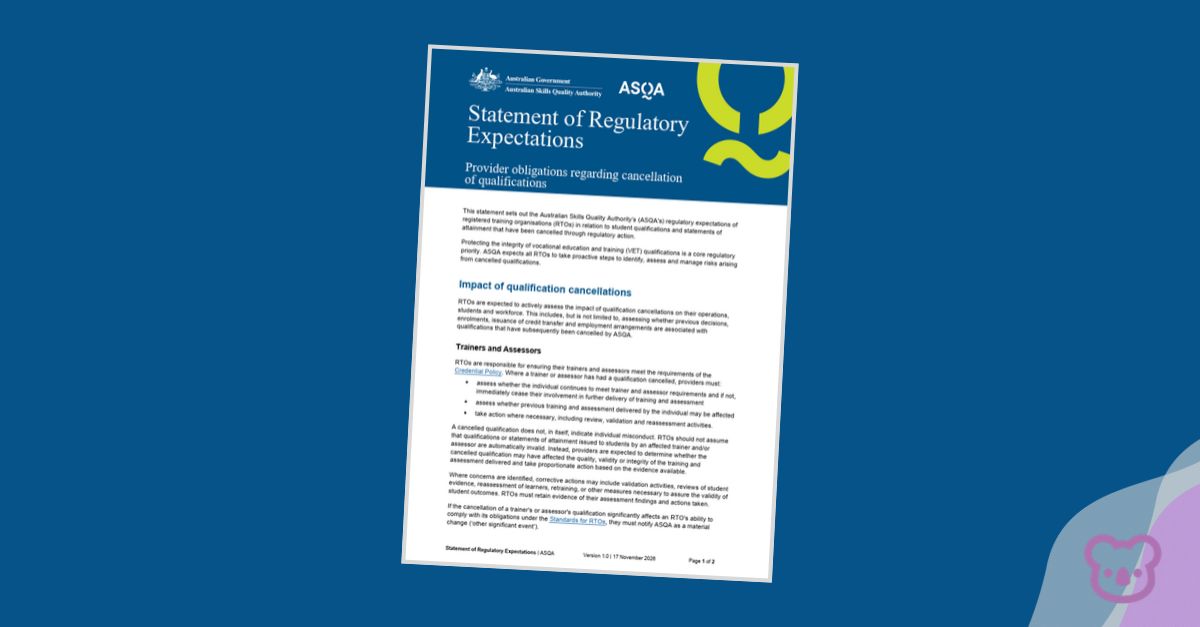
Published on 17 November, the statement sets out what ASQA expects RTOs to do when qualifications or statements of attainment have been cancelled through regulatory action. More importantly, it spells out the potential ripple effects, placing responsibility on other providers to identify where they may have relied on affected qualifications and determine whether that reliance has compromised the integrity of their own training and assessment.
At its heart, this is about protecting the credibility of VET qualifications. But it is also a reminder that regulatory action against one provider can create obligations for many others.
Under the statement, RTOs are expected to proactively assess the impact of cancelled qualifications across their operations, students and workforce. This includes examining previous enrolment decisions, credit transfers, employment arrangements and qualifications that may have subsequently been cancelled by ASQA.
In other words, a qualification that was once accepted as legitimate evidence of competency may no longer be able to serve that purpose.
The implications extend to trainers and assessors
One of the more significant elements of the statement concerns trainers and assessors whose own qualifications have been cancelled.
RTOs are responsible for ensuring their trainers and assessors continue to meet the requirements of the Credential Policy. Where a trainer or assessor has had a qualification cancelled, providers must assess whether the individual still meets the necessary requirements.
If they do not, their involvement in further training and assessment must cease immediately.
However, ASQA is also asking providers to look backwards. They must consider whether training and assessment previously delivered by the individual may have been affected, with reviews, validation and reassessment undertaken where necessary.
Importantly, ASQA has made a point of distinguishing between the cancellation of a qualification and individual misconduct.
A cancelled qualification does not automatically mean that the person holding it has acted improperly. Nor does it mean that every qualification or statement of attainment subsequently issued to their students is automatically invalid.
Instead, RTOs must establish whether the cancelled qualification has affected the quality, validity or integrity of the training and assessment delivered.
Where concerns are identified, corrective action could include reviewing student evidence, undertaking validation activities, reassessing learners or providing further training.
This is a reasonably important distinction. ASQA is not calling for a wholesale invalidation of student outcomes. It is requiring providers to demonstrate that those outcomes remain defensible.
Students and credit transfers are also in the frame
The statement also has implications for students who have received credit transfer or recognition of prior learning (RPL) on the basis of a qualification that has subsequently been cancelled.
RTOs must review affected student records and decisions, determine whether retraining or reassessment is required, and ensure that any decisions are supported by robust and reliable evidence.
This is where the potential consequences become particularly significant.
Students may have made education, employment and career decisions based on qualifications they believed were legitimate. Some may have used those qualifications to gain entry into further study, receive credit towards another qualification or demonstrate competency for employment.
If the underlying qualification is subsequently cancelled, the provider accepting it cannot simply ignore the issue.
There is an obvious challenge here for both providers and students. Any corrective action needs to protect the integrity of the qualification without automatically penalising students who may have acted in good faith and had no knowledge of the circumstances surrounding the original qualification.
ASQA’s statement makes clear that providers must assess the evidence and take proportionate action rather than assume every affected student outcome is invalid.
Due diligence is no longer optional
Beyond addressing existing cancellations, ASQA is also reinforcing the need for RTOs to have effective systems in place to prevent questionable qualifications entering their operations in the first place.
This includes conducting due diligence and authenticity checks when recruiting trainers and assessors, ensuring credit transfer and RPL decisions are based on reliable and authenticated evidence, and maintaining appropriate records of training and assessment decisions.
Providers are also expected to regularly monitor information published by ASQA, particularly its Qualification Integrity Regulatory Action page, to remain informed about providers subject to regulatory action and qualifications that have been cancelled.
Reliance on outdated information, or simply failing to keep up with developments, is considered inconsistent with a provider’s regulatory obligations.
The statement also reinforces existing material change notification requirements. Where the cancellation of a qualification significantly affects an RTO’s ability to meet its obligations under the National Vocational Education and Training Regulator Act 2011, the provider is expected to notify ASQA as a material change or other significant event.
ASQA says it places significant weight on proactive disclosure and timely engagement, identifying early notification and voluntary disclosure as indicators of a provider’s commitment to compliance.
Why this matters
There is a bigger issue sitting behind ASQA’s statement.
Qualifications are not simply pieces of paper. They are the currency of the VET system, providing evidence of skills and competency to employers, other education providers, industry and, ultimately, the students who invest their time and money in obtaining them.
That currency depends on trust. Employers need confidence that a qualification represents genuine competency. Universities and other RTOs need confidence when accepting qualifications for credit transfer or further study. Students need to know that the qualification they work towards will have value beyond the day it is issued.
When that confidence is undermined, the damage can extend well beyond the provider responsible for the original problem.
ASQA’s latest statement is therefore significant because it makes clear that qualification integrity is a shared responsibility. Regulatory action against one provider does not necessarily end with that provider. The consequences can travel through employment relationships, student records, credit transfer arrangements and the operations of other RTOs.
For providers, the message is straightforward: knowing that a qualification has been cancelled is not enough. They must understand where it has been relied upon, assess the consequences and be able to demonstrate what they have done about it.
For students, the important distinction is that a cancelled qualification does not automatically invalidate every subsequent student outcome. But it may trigger a review, and potentially further training or assessment, depending on the evidence.
Ultimately, ASQA is reminding the sector that the integrity of a qualification cannot be taken for granted. It must be established, maintained and, when questions arise, demonstrated.
And that responsibility does not end at the front door of the RTO that originally issued the qualification.
See the Statement of Regulatory Expectations here.











