










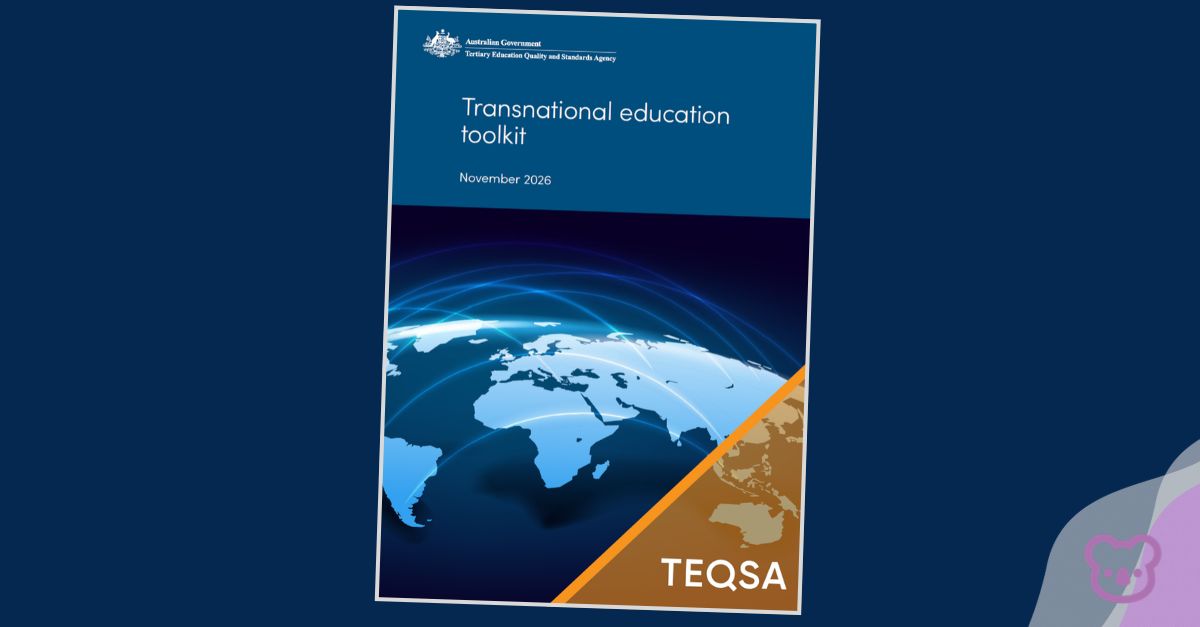
An updated Transnational Education (TNE) Toolkit to help Australian higher education providers manage the risks and quality assurance requirements of offshore delivery was launched by the Tertiary Education Quality and Standards Agency (TEQSA) at its annual conference yesterday.
The revised toolkit reflects changes in the regulatory and policy environments, and the way Australian institutions operate offshore, with new practical guidance for providers establishing and managing TNE arrangements. It links renewed interest in TNE to Australian Government policy on onshore international student numbers.
Launching the toolkit, TEQSA Executive Director, Regulatory Operations, Jen Bahen acknowledged that the update had been a long time coming.
“It’s had the gestation of about an elephant,” Bahen said, adding that it was important to get the revisions right in light of TEQSA’s new responsibilities and requirements for TNE.
Bahen was joined by Dr Samantha Young, Senior Program Director in the Office of the Vice-Chancellor at Monash University, who authored both the original 2022 toolkit and the updated version.
What’s changed?
The revised toolkit retains the five-phase TNE lifecycle approach of the original publication, covering establishment and contract renewal, course delivery, governance arrangements, stakeholder management and cyclical review.
The most significant additions are two implementation guides, providing practical advice on developing business cases, selecting partners and establishing governance arrangements, together with examples of how providers can manage operational problems through their corporate and academic governance structures.
The toolkit also carries a warning for providers considering TNE as a means of diversifying revenue.
“TNE should not be seen as an income-generating activity,” it states, adding that offshore delivery is costly and can disrupt institutional operations if it is not approached strategically.
While the 2022 edition addressed the financial viability of offshore arrangements, the new version places greater emphasis on the costs, resources and ongoing institutional responsibilities associated with delivery.
The revised toolkit also strengthens the guidance on governance and accountability, setting out more explicit expectations for governing body and academic governance approvals, due diligence on prospective partners, and ongoing oversight of academic quality, staffing and student support. It provides more detailed advice on compliance with local employment laws, subcontracting arrangements, student safety and wellbeing, and managing the intersection of Australian and overseas regulatory requirements.
The updated guidance also addresses emerging academic integrity risks associated with generative AI and the use of student performance data to identify potential problems in offshore delivery.
Young said the original toolkit had been developed in response to COVID-19 and the rapid expansion of online learning, while the new version reflects changes in government policy, governance expectations and the way institutions deliver education offshore.
She identified three key risks for TNE providers: governance, the geopolitical environment and student experience.
“Risk isn’t prohibitive. Risk is something to manage, mitigate, work through, and to go in with eyes wide open,” Young said.
On ensuring academic quality, Young emphasised that offshore delivery does not have to be identical to delivery in Australia.
“We look for comparability, not equivalence,” she said.
Providers need to understand which elements of a course are fundamental to its academic quality and learning outcomes, and which can be adapted to local circumstances.
Young said the guidance was intended to be useful to institutions of all sizes, including smaller independent higher education providers, which may need to implement the same checks and balances with fewer resources.
New regulatory requirements
TEQSA had flagged its intention to release the updated toolkit in July 2025, but publication was delayed following changes to the legislation governing offshore education delivery.
The Education Legislation Amendment (Integrity and Other Measures) Act 2025 amended the TEQSA Act to introduce new requirements for Australian higher education providers delivering courses offshore. These include obtaining TEQSA authorisation to offer or confer Australian higher education awards offshore, notifying the regulator of new or changed arrangements, and submitting annual reports detailing offshore delivery activities.
Under the new requirements, providers must notify TEQSA of relevant changes as soon as they become aware of them and within 90 days, while annual reporting is due on 31 October.
During the launch, Bahen said TEQSA was analysing the information submitted by providers under the new arrangements and encouraged institutions to examine their own data, including unexpected student numbers and the extent of their oversight of offshore partners.
She said one experienced TNE provider had already identified something about its own arrangements through the reporting process that enabled it to strengthen oversight.
TEQSA intends to share further insights from its analysis.
Bahen also said TEQSA shares the toolkit with overseas regulators, including those in Southeast Asia, China and South Asia, and would continue to do so with the updated version.
The November 2026 TNE Toolkit is available on the TEQSA website.










