









The international education sector has become increasingly focused on the regulation of education agents, but one rather fundamental question remains difficult for some institutions to answer: who exactly is recruiting students in their name, and under what commercial arrangements?
Sydney-based HE Comply believes it has a solution.
Formerly known as Feezy, the company rebranded in October, positioning its technology as a specialist contract-management platform for universities, colleges and education agencies navigating an increasingly complicated compliance environment.
Its proposition is relatively straightforward: to take the paperwork out of managing agent agreements, provide greater visibility of commercial arrangements and make it easier for both institutions and agencies to keep track of what they have agreed.
This area arguably deserves more attention than it has traditionally received.
Background material provided by HE Comply points to NSW Budget Estimates proceedings in which three-quarters of universities reportedly could not provide data on their commercial arrangements with education sub-agents. Some institutions were even unable to confirm whether sub-agents existed within their recruitment networks.
That is a fairly uncomfortable position for a sector facing heightened scrutiny over agent relationships and the transparency of international student recruitment.
The introduction of the 2025 ESOS Integrity amendments has increased the importance of understanding who is involved in recruitment, what they are being paid and how those arrangements are documented. Yet, according to HE Comply, the systems used to manage many of these relationships have changed remarkably little.
Contracts are still routinely exchanged by email, stored across shared drives and manually transferred into spreadsheets. Variations, bonus arrangements and expiry dates can end up scattered across different documents and systems.
For institutions managing extensive international recruitment networks, that creates obvious opportunities for things to go wrong.
When the paperwork becomes a commercial risk
HE Comply says its experience with agreements uploaded to the platform has already revealed some concerning gaps.
Approximately one-quarter of Australian agreements added to the system had expired but were apparently still being used by both parties.
In one instance, an agency CEO discovered during onboarding that more than 80 of the organisation’s 240 partner agreements had lapsed without being noticed.
Another offshore agency had apparently been invoicing a university at the lowest of several commission bands for a decade, despite having contractual arrangements that provided for higher payments.
These examples highlight why contract administration should not necessarily be regarded as a back-office function.
For some institutions and colleges, a substantial proportion of international tuition revenue is generated through education agent relationships. Commission structures, bonus arrangements and contractual obligations can therefore have significant financial implications.
Getting those details wrong can be expensive. Not knowing that an agreement has expired, or being unable to establish which version of a contract is current, also creates potential compliance and reputational risks.
As HE Comply co-founder John Connolly argues, contracts underpin the sector but are often treated as a tick-and-flick exercise rather than an important commercial instrument.
What does HE Comply actually do?
The platform is designed to work across both sides of the institutional-agency relationship.
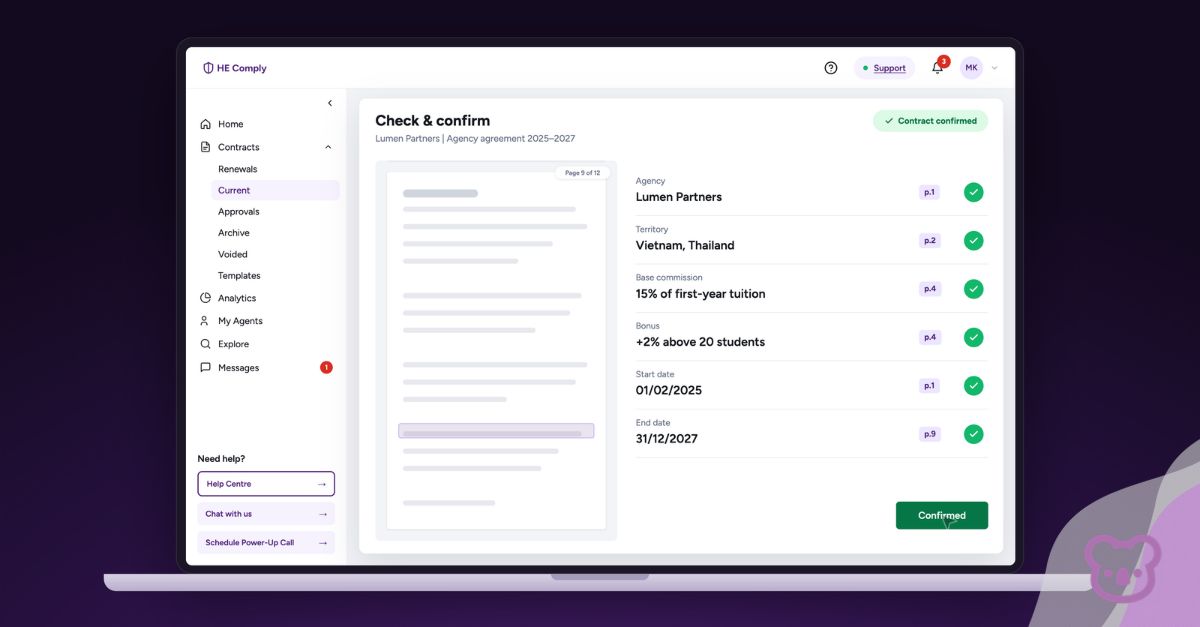
Users can upload existing agreements in bulk, with the platform’s AI extracting key information including commission rates, bonus tiers, territories and expiry dates. The extracted information is linked back to the relevant sections of the original agreement for checking.
Contracts, variations, supporting documents and due diligence material can then be stored together, with renewals, approvals and digital signing managed through the platform’s integrated DocuSign functionality.
Importantly, institutions and agencies can invite their counterparties to co-manage agreements, giving both parties access to the same contractual information rather than relying on an endless exchange of email attachments.
Agencies can also record and manage their own sub-agent networks, providing another layer of visibility around the recruitment relationships operating beneath primary agency agreements. The decision to share this data with institutions always sits with the agent.
HE Comply is keen to distinguish its offering from traditional customer relationship management systems. It is not designed to replace an institution’s existing CRM or tell it how to manage its agent network. Rather, it focuses on the contracts and supporting documentation that underpin those relationships.
There is also a deliberate effort to make the platform accessible to agencies. When invited by an institutional partner to co-manage an agreement, agencies can join without paying for access.
The company also places considerable emphasis on data security. It says customer information is held in Australia, or in the European Union where relevant, and that contracts are not used to train public AI models.
A bigger question for institutional leadership
Connolly brings 15 years of experience managing international recruitment within Australian and UK universities, including the Australian National University. Co-founder Trent Tighe has spent 20 years working in financial markets compliance across Sydney, Singapore and Hong Kong.
Their argument is that international recruitment teams do not necessarily need another layer of consultants telling them how to manage their agent relationships. They need better tools to do the job, without spending so much time navigating administrative processes.
There is some merit in that argument, particularly as institutions face pressure to demonstrate greater accountability over their recruitment networks.
But the more interesting question raised by HE Comply’s experience is whether institutions have given agent contract management the level of senior attention it warrants.
Connolly says it is astonishing how few senior leaders have direct access to reporting on agent commercial arrangements, despite potentially tens or hundreds of millions of dollars in revenue flowing through those relationships.
That raises an uncomfortable distinction between having an agent management policy and actually knowing how the commercial arrangements underpinning that policy operate.
The rebrand from Feezy to HE Comply reflects an ambition to position the business around this broader compliance and contract-management challenge.
The company says its platform now manages agreements covering more than 1,000 global providers, with users operating across 86 countries. Recent additions include agency analytics, more detailed counsellor access controls and automated reminders for unsigned institutional contracts.
Whether institutions embrace another piece of technology will depend on how effectively it integrates with their existing systems and whether they see the value in bringing contract administration into sharper focus.
But the underlying problem is not going away.
The sector has spent considerable time discussing agent commissions, sub-agents and recruitment accountability. Perhaps it is time to pay a little more attention to the agreements, records and processes that make those relationships work.
More information: hecomply.com
See HE Comply in action below: