











Australia’s international student market does not run on a predictable or recurring cycle. It swings like a pendulum, pushed by policy and knocked about by global and domestic shocks. Leaders who treat the current downturn as the trough of a natural cycle will plan for a recovery that the new rules may not support.
Listen to enough sector conversations and you’ll hear the same reassurance. “We’ve been here before. It always comes back.” There is some truth in this. Since 2000, Australia has been through two deep contractions in international student numbers, and each was followed by a strong rebound. But a pattern seen twice is not a law of nature. The useful question for a provider is not whether numbers will recover. It is what moves the pendulum, and whether the forces that once swung it back are still in play.
This article posits that the pattern is real, but its mechanics have changed. The 2024–26 tightening is not just another swing. Unlike every downturn before it, it comes with a permanent and legislative brake.
Thirty years, four contractions
Since 1994, enrolments have contracted four times. They recovered from the first three to reach new highs.
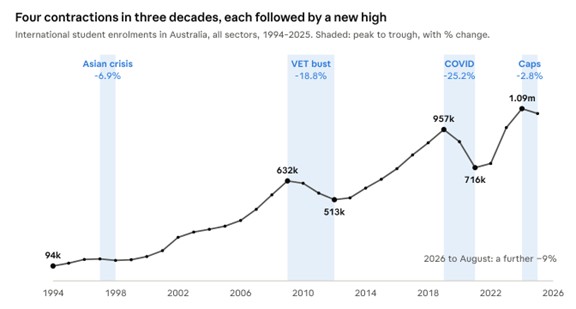
Source: Department of Education, International Student Data. 1994–2019 from the 2019 time series (break in series 2001–02); 2020–2025 from the YTD December 2025 release. Enrolments, not individual students.
The first, in 1998, was a shock from outside: the Asian financial crisis cut English-language enrolments by more than a third over two years. The second, from 2009, was largely self-inflicted. The causes included tighter migration policy and visa processing, a crackdown on backdoor migration schemes, a high Australian dollar, and a slow official response to attacks on Indian students. The third was COVID’s closed borders.
The fourth is the one we’re in now. It is deliberate and intentional. Total enrolments fell 3% in 2025, while new commencements fell 15%. Up to August 2026, enrolments are down another 9% and commencements 12%. Commencements are a leading indicator, so the cumulative decline is still building. We have not yet reached the nadir.
The anatomy of the pendulum
The two policy-driven downturns, 2009 and 2024, followed the same five steps. Only the actors and the triggers changed.
| Stage | The 2009 swing | The 2024 swing |
| 1. Settings loosen | Study linked to permanent skilled migration through the 2000s (Reich 2016, ANU Press) | Work-hour limits relaxed during and after COVID (THE) |
| 2. Growth pools at the margins | Growth piles into private VET: cookery, hairdressing | Growth in “the least reputable parts of the sector” (Minister’s release) |
| 3. Social licence erodes | Attacks on Indian students; multiple college collapses amid visa fraud | Housing pressure and net overseas migration, and ‘crooks and shonks’ (the Minister’s words) |
| 4. Policy tightens | Tougher migration and visa rules (Marginson) | Ministerial Directions 107 and 111, higher visa fees, the National Planning Level |
| 5. A review, and a reset | Knight Review: less red tape, post-study work rights (THE) | None yet. Planning level frozen at 295,000 for 2027 |
The sequence is predictable because the players and their incentives remain consistent. Universities need international fees to fund domestic teaching and research. Governments value the export income until a visible problem affects the public mood. Then the politics of migration overrules the economics of education. When the revenue pain becomes acute, a review restores competitiveness. One New Zealand analyst called it “a continuous cycle of tightening and loosening”.
Note what the 2009 recovery needed: a deliberate policy reversal. Even then, it was slow. Visa grants to Indian students took about a decade to regain their 2008–09 level (ApplyBoard).
Where the cycle story breaks
The pattern is real, but calling it a “cycle” invites an oversimplification.
It isn’t periodic. The contractions came in 1998, 2009, 2019 and 2024. Two of the four were shocks from outside that no policy cycle predicted. Two cases of a policy-driven swing are too few to forecast the next turn.
The release valve has been bolted down. In 2011, recovery came when Canberra reversed its policy. Today the brake is structural. The National Planning Level is frozen at 295,000 for 2027, even though commencements are tracking below it. And from 2027 the Australian Tertiary Education Commission will oversee provider allocations. A quota system dampens the pendulum in both directions. If demand comes back, the next upswing will be capped growth, not a boom.
The national total obscures which providers are getting penalized. Twice now, the burden of “fixing” international education has fallen to the same sectors. From 2009 to 2012, VET and English-language enrolments each fell by almost a third. In the first half of 2026, VET is down a fifth and ELICOS by more than a quarter. Higher education grew 1.9% both times. Each crackdown is aimed at the whole system, but in practice VET and ELICOS carry the cost, while universities ride it out.
That is short-sighted, even on the universities’ own terms. English-language and VET colleges are the pathway into higher education for a large share of international students. Squeeze the front door hard enough and, a few years later, the universities find their pipeline has thinned.
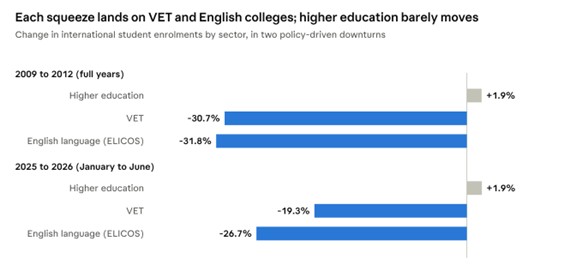
Source: Department of Education. 2009–2012 from the 2019 enrolment time series; 2025–2026 from the YTD June 2026 monthly summary.
The composition is shifting too. New commencements in higher education have been flat for four years, and providers are relying more on students already onshore. That pool is shrinking.
What leaders should do
For established higher education providers, a quota means waiting out a flat couple of years. For newly registered and prospective providers with little historical buffer, it’s a tougher proposition. Here are four things to consider.
- Don’t build the business case on a rebound. Model enrolments at or below your likely allocation for the next three years. Treat any upside as a bonus, not the plan. A regulator reading a business case that assumes a return to 2023 growth will see a risk, not an opportunity.
- Diversify by design. In every downturn, providers who relied on one source country and/or one discipline were hit first and hardest. Domestic demand, a second or third source market, and transnational delivery are strategic hedges, not afterthoughts.
- Compete on legitimacy. Every tightening phase has targeted the bottom of the market. Visa-processing priority now follows provider allocation and risk. Strong governance, academic integrity, and student outcomes are what earns increased allocation.
- Watch for a review, not a rebound. The swing back will come through a policy decision, as it did in 2011. That could be an ATEC allocation review, a change of government, or a fiscal crunch in the universities. Providers who track those signals will move first.
Our colleagues are right that history rhymes. But it is rhyming in a new metre. The pendulum still swings, and from 2027 it swings on a shorter rope.
Dr. Tim Weir is the founder and principal of Teton Advisory Group; a boutique consulting firm focused on supporting governance and compliance in the tertiary sector. Tim holds degrees in business, education and music and has more than 20 years’ experience as an academic leader in both public and private higher education institutions.
References
- Australian Bureau of Statistics (2011). Australian Social Trends, Dec 2011: International students. Cat. 4102.0.
- Clare, J., Giles, A. & Hill, J. (2026). Managing a sustainable international education sector. Joint media release.
- Department of Education (2020). International Student Enrolments in Australia 1994–2019. Time series.
- Department of Education (2026). International Student Data, YTD December 2025.
- Department of Education (2026). International student monthly summary, YTD June and YTD August 2026.
- Department of Education (2025). Managed growth: international education arrangements for 2026. Factsheet.
- ICEF Monitor (2026). Australia: decline in international higher education commencements projected for 2026.
- Knight, M. (2011). Strategic Review of the Student Visa Program 2011. Australian Government.
- Marginson, S. (2011). International education in Australia: a long way down. International Higher Education, 62.
- Marginson, S. (2012). International education in Australia: the roller coaster. International Higher Education, 68, 11–13.
- Reich, S. (2016). Great Expectations and the Twilight Zone: The Human Consequences of the Linking of Australia’s International Student and Skilled Migration Programs and the Dismantling of that Scheme, in M. Dickie, S. Reich & D. Gozdecka (eds), Unintended Consequences: The Impact of Migration Law and Policy. Canberra: ANU Press.
- The PIE News (2026). Overseas student commencements fall 5% in Australian higher education; YTD December 2025 data.
- Times Higher Education (2023). How the West fell out of love with international students.
- ApplyBoard (n.d.). Indian student enrolment trends in Australia.