













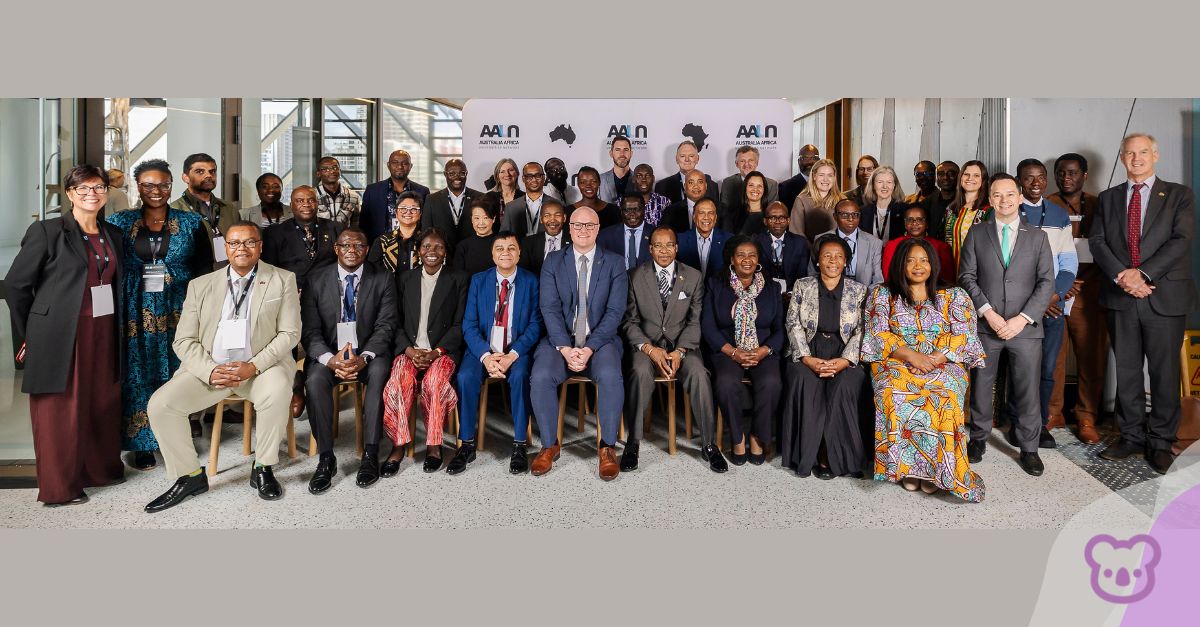
The recently concluded annual national Australia-Africa Week convened in Perth is a major celebration of connections and relationships between the two continents and their peoples across the Indian Ocean.
While anchored on the mining industry through its longstanding Africa Down Under (ADU) conference, the importance of collaboration in higher education, research and training to the building of human capital, people-to-people ties, sustainable development, and innovative solutions to shared challenges is gaining prominence in the story, as highlighted by ministers Hon Dr Anne Aly and Hon Matt Thistlethwaite in their conference remarks.
Although Australia is a major player in the natural resources sector across Africa, Australia-Africa connections in the university sector have hitherto been less pronounced, with limited awareness of reciprocal opportunities and attention largely focused on other regions. Indeed, a Universities Australia discussion paper warned in 2023 that “Our sector needs to become more Africa literate, and quickly.”
As argued in recent analyses, the relatively marginal higher education sector engagement between the Australian and African continents to date suggests there’s much potential to grow new strategic partnerships (Coates, Mickler and Isike, 2026) and also an imperative to think critically about the nature of such relationships in order to centre equality, reciprocity and mutual benefit (Mickler and Isike, 2026).
The Australia Africa Universities Network (AAUN), which launched its 2030 strategy at its annual forum during Africa Week, provides a ready-made collaborative vehicle to drive principled and impactful university engagement and in doing so is positioning the higher education and research sector as a central pillar of emerging Australia-Africa relations.
Now 15 years old, the flagship co-chaired network currently represents 29 member universities from around Australia and across 11 African countries. With a core focus on building research partnerships, the AAUN Partnerships & Research Development Fund (PRDF) has seeded over 80 collaborative research teams in areas of mutual priority including agriculture, climate change, the energy transition, public health, social inequality, and artificial intelligence.
The AAUN also prioritises capacitating and connecting our next generation of academic and diplomatic leaders through its active Early Career Researchers (ECR) Steering Group and its Emerging Leaders in Australia-Africa Diplomacy (ELAAD) Program.
The energetic ELAAD Fellows—a cohort of postgraduate students from AAUN member universities mixed with serving junior diplomats from both continents—presented a number of policy recommendations on enhancing higher education partnerships, including opening additional Australian university campuses in Africa (Curtin University Mauritius is currently the only one), creating African and Australian Studies degree programs, respectively, on each continent (none currently exist), and creating more dedicated reciprocal student mobility, scholarship and fellowship programs (the New Colombo Plan currently excludes African study destinations, for example, while the highly-regarded Australia Awards Africa scholarships are few in number).
In this work, the AAUN has embraced academic diplomacy—using the convening power of universities to connect research, education, and knowledge to policymaking and international cooperation—as a means to position higher education collaboration as a central pillar in the development of a new strategy for Australia-Africa relations.
For more on AAUN, see: www.aaun.network
Associate Professor David Mickler is Dean Global, Africa & Director, Centre for Australia-Africa Relations at Curtin University. He serves as the Co-Chair of AAUN.












