










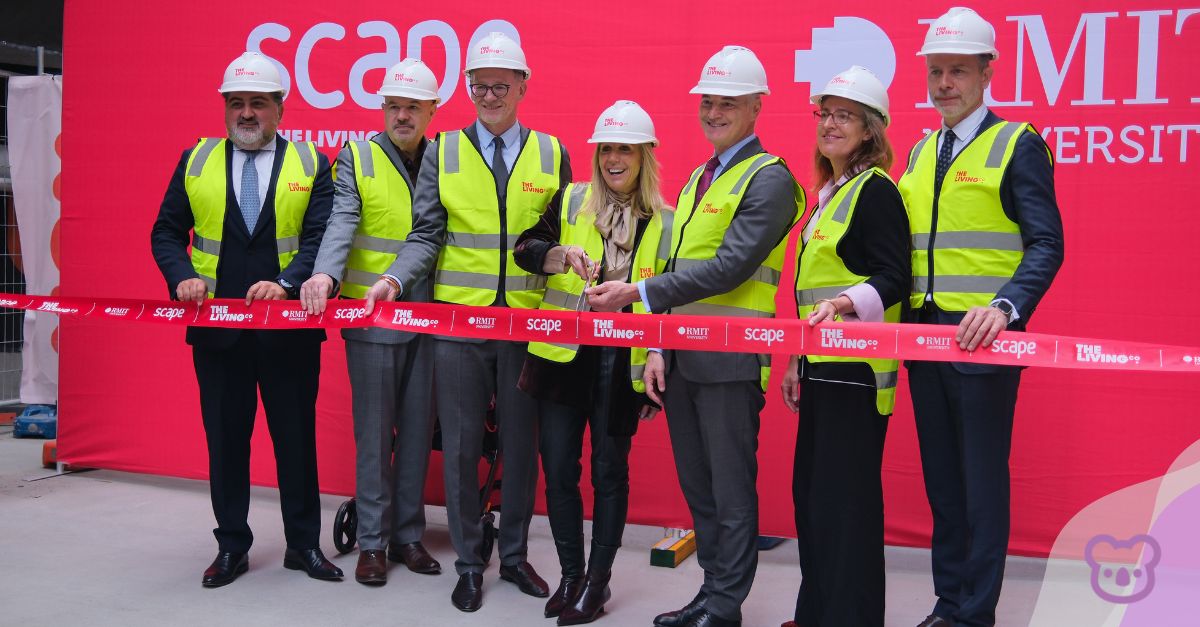
RMIT University and Scape by The Living Company are combining for a more than $270 million investment in a major new development above Melbourne’s State Library Station, bringing student accommodation, education, research and industry engagement together in the heart of the CBD.
The State Library Exchange is being positioned as a city-shaping project for RMIT, with the university leasing the first nine levels of the development for new learning and teaching facilities, while 46 levels will be dedicated to student accommodation.
The development is expected to open from 2029 and will sit directly above State Library Station, linking RMIT’s City campus with the Metro Tunnel and one of Melbourne’s most important transport and civic precincts.
For a city that has long traded on its reputation as a global student destination, the project is significant for more than its scale.
Melbourne’s international education proposition has always been closely tied to the experience of living and studying in the city. Access to transport, accommodation, employment, cultural attractions and a vibrant CBD all form part of the value proposition presented to prospective students.
Putting learning and student housing into the same development, and connecting both directly to a major public transport interchange, reflects how the infrastructure supporting international education is increasingly becoming part of the education proposition itself.
RMIT says the project will strengthen its City campus while creating spaces designed around hands-on learning, collaboration and industry engagement.
Students will be able to work with industry in real-life settings, build professional connections and gain work-ready experience, according to the university.
That focus is particularly relevant as international students increasingly look beyond the classroom when assessing where to study. Graduate employment outcomes, access to industry and the ability to build professional networks have become increasingly important considerations in destination and institution choice.
The development also adds another significant tranche of student accommodation to Melbourne’s CBD.
While 2029 remains some distance away, additional purpose-built student accommodation will be important as Melbourne works through the challenge of housing a large student population while continuing to attract international students.
Student accommodation has become one of the more obvious pieces of the international education infrastructure puzzle. Universities can increase their teaching capacity and governments can invest in transport, but without somewhere for students to live, particularly in a high-cost housing market, the ability to grow sustainably is constrained.
The State Library Exchange also continues a relationship between RMIT and Scape that has already produced the Franklin Street collaboration, where RMIT University Pathways students live and learn under the one roof.
This latest project takes that concept considerably further, combining a much larger student living component with university facilities and direct access to public transport.
RMIT Vice-Chancellor Professor Alec Cameron described the investment as a defining moment for the university’s future and said the location would place students, researchers and industry partners at the centre of Melbourne.
RMIT Property Executive Director Seamus McCartney called it one of the university’s biggest long-term investments in Melbourne and said it would act as a catalyst for the university’s Living Places Plan.
For Scape by The Living Company, the project is also a significant statement about the role of student accommodation in the future of Melbourne.
Scape CEO Anouk Darling said the State Library Exchange would sit at the “literal crossing point” of how Melbourne moves, learns and lives, highlighting the relationship between transport, education and student living.
The city has a substantial advantage in being able to offer students a dense combination of universities, cultural institutions, employment opportunities, public transport and lifestyle within a relatively compact CBD. Projects such as the State Library Exchange are effectively building that proposition into the physical fabric of the city.
The $270 million-plus commitment also comes with a broader economic argument, with RMIT and The Living Company pointing to jobs, investment and long-term CBD growth generated by the development.
RMIT, which has more than 104,000 students across its Australian and Vietnamese campuses, is one of Melbourne’s largest education institutions and already has a substantial physical presence across the city.
The State Library Exchange will further reinforce that presence while giving the university an opportunity to reshape parts of its City campus around a more integrated model of learning, industry engagement and student life.
The bigger question for Melbourne will be whether projects like this can keep pace with the city’s ambitions as a global education destination.
The State Library Exchange will not solve Melbourne’s student housing challenge on its own, nor will a new learning facility address every issue facing international education. But it does demonstrate what is possible when university infrastructure, private student accommodation and major public transport investment are planned around the same student population.
And with students increasingly judging destinations on the total experience rather than simply the quality of a university, that integrated approach could prove to be just as important as the buildings themselves.












