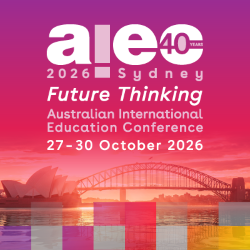











If you’re attending the 40th Australian International Education Conference at the ICC Sydney, from 27 to 30 October, this is for you. Whether you’re speaking, chairing a session or sitting in the crowd, I’d like to share five questions to take to the room.
The theme is Future Thinking, a timely one given that over recent years international education has been drawn into Australia’s debates around migration, housing and quality. Governments have responded with caps, tighter visa rules and higher fees, with providers adapting as best they can, and often with little notice. This is understandable, but a conference on the future might want to ask itself whether we are building long-term resilience or simply responding to the immediate pressure.
I speak from Kathmandu. Having worked with Australian providers on recruitment, admissions, partnerships and compliance for more than a decade, I see the sector from two sides: the policy and institutional focus in Australia, and the families overseas making a very big decision about their children’s lives. What this has taught me is that confidence in a study destination takes a long time to build but can be destroyed very quickly.
What the program gives us to work with
The AIEC plenary program is a good place to start. The conference opens on Tuesday 27 October with the Welcome Plenary. On Wednesday, futurist Michael McQueen takes the opening keynote on the forces reshaping education, technology and global engagement. Thursday brings the mini plenaries.
Friday 30 October is the day I’ll be thinking about most. It opens with “Future Thinking: What International Students Really Think About Australia”, moderated by Annabel Crabb, followed by “AIEC at 40: Then. Now. Next.”, and closes with a keynote from the Hon. Julia Gillard AC. Each is a good opportunity to ask the questions below.
1. Does policy look the same from Canberra and from Kathmandu?
A national policy can have very different implications depending on where you are. I explored this in my ICEF Monitor article, “One test, five markets”, which examines how the same visa conditions apply to five South Asian markets. Students from different countries have different finances, different study pathways and different willingness to take risks. One test will not give one result.
The numbers prove that. According to ICEF Monitor, the overall grant rate for primary student visas fell to 75.5% in August 2026, the lowest for almost two decades. Offshore, just 13% of Nepali applicants and 34% of Bangladeshi applicants were successful, compared with 92% and 98% a year earlier. India was at 51%. The further changes from 2 October, including limits on students’ dependants, have added to the questions families are asking.
| 75.5%
Overall primary student visa grant rate, August 2026, the lowest since 2006/07 |
13%
Nepali offshore applicants granted, against 92% a year earlier |
34%
Bangladeshi offshore applicants granted, against 98% a year earlier |
51%
Indian offshore applicants granted, against 72% a year earlier |
Source: ICEF Monitor, “Has Australia’s genuine student test gone too far?”
This is not an argument for lighter scrutiny. Australia is entitled to demand that students come for genuine study. But good regulation requires understanding how rules operate on the ground, and diversification requires more than aiming recruitment at a new country every time a market tightens. When a session talks about “the South Asian market”, ask which one.
2. Are we managing numbers, or building a system?
The government’s managed growth settings hold the National Planning Level at 295,000 new overseas student commencements for 2027, the same as 2026, with a Ministerial Direction continuing to manage visa prioritisation. The stated aim is stability and quality, and the policy should be judged against that aim.
But an enrolment ceiling cannot give a sense of whether students are receiving a good education, whether providers are financially healthy, or whether Australia’s international relationships are strengthening. Managing numbers is an administrative task. Building a sustainable system is a bigger one, and it belongs to government, providers and the sector as a whole.
That is the concern raised in my Times Higher Education piece, “Australia must be careful what it wishes for on international HE”. Housing, integrity and quality are genuine public issues. But every policy choice comes with a cost, and some costs occur later, in student confidence and in Australia’s reputation as a place to study. Delegates setting institutional strategy should ask what the settings mean for quality, not just quantity.
3. Who is missing from the student plenary?
I’m glad that AIEC has placed student voices at the heart of Friday’s program. International students are prominent in our political and economic discussion, yet they rarely get as much airtime as the enrolment and migration figures do.
Any panel of students, by definition, represents those who made it through the door.
Behind them is a pool of applicants who were refused, families who changed their plans, and those who decided the uncertainty made another country the safer option. When only 13% of Nepali offshore applicants were granted in August, most of those students will not be taking a microphone in Sydney.
That is the conversation I hear in my own work every week, and it is one I have written about from a South Asian perspective in Pearls and Irritations and Independent Australia. For these families, international education is not a visa file, but it can represent years of preparation and the family’s savings. When the rules change, they want to know that their plan remains viable and that Australia remains a trustworthy option. The question for the room is how to listen to them.
4. Where do partnerships sit on the agenda?
International education generates a lot of revenue for Australia and is right to take credit for it. But its value runs deeper than this. Students who spend years here develop links with institutions, communities and professional networks. Some stay and work where the rules allow. Others return home and carry those links for decades.
So I’d like to see the sector treat source countries as more than recruitment markets. There is room for academic partnerships, joint research, transnational education and professional exchange. This creates value for both parties, and it makes Australian institutions less dependent on each year’s recruitment cycle. If your session is about recruitment, ask where the partnership conversation is. If it’s about partnerships, ask whether it’s a strategic priority.
5. What is technology for?
With a futurist giving the conference’s opening keynote, it’s no surprise that artificial intelligence will get plenty of airtime. I’m exploring its value for admissions, institutional knowledge and compliance in my own work, and it can reduce delays and support students.
But an automated process is not necessarily a fair one, and a swift offer is no guarantee of a positive student outcome. Software cannot replace honest advice, ethical recruitment or accountable institutions. The measure of any new technology is whether it improved the student’s experience and the quality of the decision.
| What I’d ask of delegates and speakers
• Bring market-level evidence, not national averages, and say which market you are talking about. • Consider students who are not in the room, including those who were refused or chose elsewhere. • Add partnerships and transnational education to the strategy conversation, not the closing slide. • Assess new technology on student outcomes, not processing speed. • Ask what the policy settings mean for teaching quality and student services, not just numbers. |
What should we celebrate at AIEC 50?
The closing sessions will reflect on forty years and the next chapter. I’d like the sector to leave Sydney asking what it hopes to celebrate in 2036.
Higher enrolments may be part of the answer, but they cannot be the whole of it. I’d like to see Australia recognised for education quality, student wellbeing, responsible recruitment, institutional integrity and international partnerships. This will require clearer policy communication, genuine engagement with students, better measures of educational outcomes and a willingness to take an honest look at what regulation does over the long run. It will also require providers to invest in teaching and the student experience rather than relying on recruitment growth.
I remain confident in Australian education, and that is precisely why I offer constructive criticism. Forty years is a significant milestone, but the next ten should be about ensuring the system is deserving of the confidence placed in it.
Future Thinking should not be about how many students Australia can attract tomorrow. It should be about building something students, institutions and communities will still trust in 2036.
Mukesh Dhamala is a Kathmandu-based international education professional and policy commentator with more than a decade of experience working with Australian higher education and vocational education providers. His work focuses on student recruitment, institutional partnerships, admissions, compliance and education policy. His commentary has appeared in ICEF Monitor, Times Higher Education, Independent Australia, Campus Review and Pearls and Irritations.
The views expressed are personal and do not represent the positions of any institution with which the author is associated.
Sources and links
- AIEC 2026 plenary program https://aiec.idp.com/plenaries
- AIEC 2026 announcement: ICC Sydney, 27 to 30 October (The Koala News) https://thekoalanews.com/call-for-proposals-opens-for-aiec-2026-as-conference-marks-40-years
- Australian Government: A managed system for international education https://www.education.gov.au/managed-system-international-education-2026
- ICEF Monitor: One test, five markets https://monitor.icef.com/2026/10/one-test-five-markets-what-do-australias-student-visa-changes-mean-for-south-asian-recruitment/
- ICEF Monitor: Has Australia’s genuine student test gone too far? https://monitor.icef.com/2026/10/has-australias-genuine-student-test-gone-too-far/
- ICEF Monitor: New restrictions on student family members and “visa hopping” https://monitor.icef.com/2026/09/australia-moves-to-reduce-net-migration-with-new-restrictions-on-student-family-members-and-visa-hopping/
- Times Higher Education: Australia must be careful what it wishes for on international HE https://www.timeshighereducation.com/opinion/australia-must-be-careful-what-it-wishes-international-he
- Pearls and Irritations: Be careful – international students are listening https://publish.pearlsandirritations.com/be-careful-international-students-are-listening/
- Independent Australia: Student visa crackdown puts international students and families in limbo https://independentaustralia.net/politics/politics-display/student-visa-crackdown-puts-international-students-and-families-in-limbo,21675