












New global research puts a price on the long-term economic contribution of international graduates, while highlighting their role in addressing skills shortages and building connections across borders.
International graduates from the 2024 cohort are estimated to generate US$1.7 trillion in economic output over their working lives, with Australia among four major study destinations accounting for almost 60% of the total.
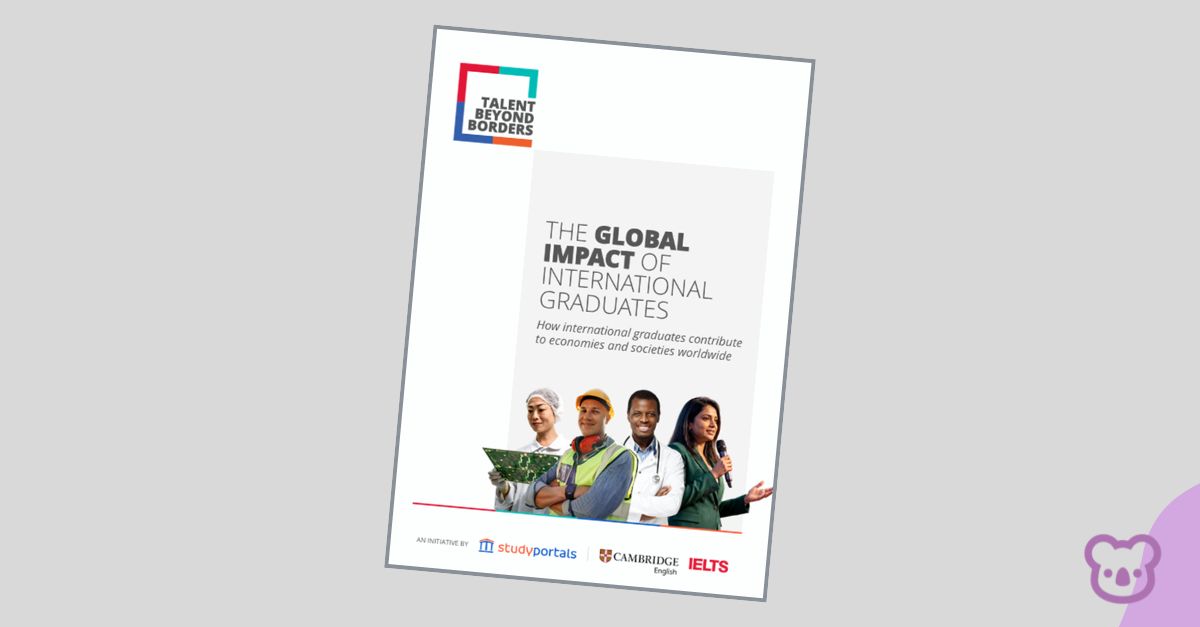
The findings come from Talent Beyond Borders: The Global Impact of International Graduates, a new report developed by Studyportals and Cambridge IELTS that examines what happens after international students leave university and where they go on to build their careers.
Rather than measuring international education primarily through tuition fees and student spending, the report follows graduates into the workforce, examining their economic contribution and the broader role they play in their host communities and beyond.
The research estimates that around 2.67 million international students graduated worldwide in 2024, with approximately 41% remaining in their study destination to enter the local workforce by 2025.
These graduates are estimated to have generated US$110 billion in economic output in their first year of work alone. Modelling their contribution over a 40-year working horizon produces a lifetime-equivalent estimate of US$1.7 trillion.
The United States, United Kingdom, Australia and Canada account for an estimated US$1 trillion of that lifetime contribution, despite hosting just over a third of the world’s international students.
The report argues that international education should be understood as more than an export industry, with graduates contributing through their employment, entrepreneurship, knowledge, professional networks and participation in community life.
“International students are worth so much more as a talent source than they are in tuition fees and local spend,” said Edwin van Rest, Studyportals chief executive and co-founder.
He said the research was intended to encourage policymakers to consider the full contribution of international education, including the social impact and soft power that cannot be captured in economic calculations.
“As global demographics shift, that talent impact is only going to become more critical,” van Rest said.
Three pathways after graduation
The report identifies three broad pathways for international graduates, reflecting the different ways their education can contribute to economies and societies.
The largest group, accounting for 41% of graduates in the dataset, are classified as “Stayers”. They remain in the country where they studied and enter its workforce, potentially helping address local skills shortages.
A further 35% are “Homecomers”, who return to their country of origin with new skills, knowledge and professional networks. The remaining 24% are “Nomads”, who move to a third country to pursue career opportunities.
The report emphasises that these pathways are not a hierarchy of value. Graduates who return home can transfer knowledge and strengthen their domestic economies, while those who move between countries can build professional relationships and facilitate international collaboration.
For host countries such as Australia, retaining graduates is one way to translate an international education into longer-term workforce capacity. However, the report also highlights the wider value created when graduates take their experience and connections elsewhere.
Australia recorded a graduate stay rate of 53% in the Studyportals dataset, placing it among the destinations with the highest proportions of international graduates entering the local workforce. Canada recorded the highest rate at 66%.
The figures are based on Studyportals’ Graduate Outcomes dataset, which tracks education and employment pathways and contains more than 1.1 million graduate outcomes globally. The report’s stay-rate analysis draws on a dataset of more than half a million international graduates.
Graduates and the skills shortage equation
The research also examines the role international graduates can play in sectors experiencing workforce shortages, particularly medicine and health, engineering and technology, and computer science and IT.
Across these fields, graduates who remain in their study destination represent the largest pathway group. Stayers account for 48% of graduates in medicine and health, 59% in engineering and technology, and 56% in computer science and IT.
The report suggests that internationally educated graduates can provide a valuable source of talent for employers, particularly where their qualifications, skills and experience align with workforce demand.
Their contribution is not confined to technical or commercial roles. The research also identifies international graduates working in community-oriented, creative and non-profit fields, including more than 35,000 graduates in the dataset employed by non-profit organisations.
Francesca Woodward, global managing director of English at Cambridge University Press & Assessment, said the report demonstrated the economic, social and cultural value of international graduates.
“International students enrich communities, plug vital skills gaps, boost diversity and help build stronger connections between people and countries,” Woodward said.
Beyond the balance sheet
The report arrives amid ongoing international debate about the purpose of international education, including how governments balance education exports, migration settings and domestic workforce needs.
Its central argument is that assessing international students primarily through the revenue they generate while studying provides an incomplete picture of their contribution.
International graduates may establish businesses, create employment, support research and innovation, mentor others and maintain relationships between their host and home countries. Those who return home can also transfer knowledge and experience, while graduates who move to a third country can extend professional networks across markets.
The US$1.7 trillion figure should nevertheless be read as a modelled estimate of economic output, rather than a direct measure of government revenue, university income or the net fiscal benefit of international education.
The analysis focuses on graduates who remain in their study destination and uses graduate retention patterns, country-level economic productivity and projections over a 40-year working horizon. It draws on 15 major study destinations, which collectively host approximately 60% of internationally mobile students, alongside estimates for the wider global cohort.
The report acknowledges that graduate pathways are complex and that available data cannot capture every subsequent move or contribution. Its estimates therefore provide a broad picture of the potential economic value generated by retained graduates, rather than a precise forecast of the contribution each country will ultimately receive.
Even with those qualifications, the findings offer a different perspective on the international education debate. Students are not simply temporary consumers of education services, nor do their contributions necessarily end when they graduate or leave the country where they studied.
For Australia and other major study destinations, the question is not only how much international students contribute while on campus, but how education, employment opportunities and graduate pathways shape the value they create over the decades that follow.











