














In recent months, the Albanese government has been working tirelessly to develop a so-called ‘’strategy’’ for giving our International Education a facelift. Despite the industry tending to do well enough & bringing $47.8 Billion to the Australian economy as it is and without further Government’s interventions, a number of claims have been made. While some of the claims such as blaming international students for the rental crisis, are rather anecdotal and have already been soundly refuted (not that the refutation convinced the government to turn the wheel of capping international enrollments back) the efforts to send international students and graduates to places where they do not necessarily want to be studying are in full bloom as the current settlement offerings for students and graduates keep pushing them towards certain states and locations.
But will it develop the respective regions and truly address the skill shortages identified or is it simply yet another pre-election twist? The Koala News has just published an excellent duology by Tracy Harris that looks into the government’s efforts to make international graduates meet our skills needs and clearly demonstrates that the restrictive approach that the government tends to be aiming to adopt is not taking us any closer to bridging the skills gaps. Another dimension of the ‘’managed’’ international education landscape that we are supposed to be moving to is channeling international students towards locations where they are arguably needed most – that is, regional areas as well as the states where the skills shortages are particularly evident. The purpose of this article is it take a brief look into the data available on the ‘’least-desired territory’’ to see whether the never-ending efforts to regulate the international education sector are going to be beneficial rather than simply disruptive to the current (very profitable!) situation within the industry.
What the data is telling us
Those of us who have data-driven mindsets are going to have difficult time understanding rationale behind the proposed reforms as the so-called successful implementation does not appear to be realistic.
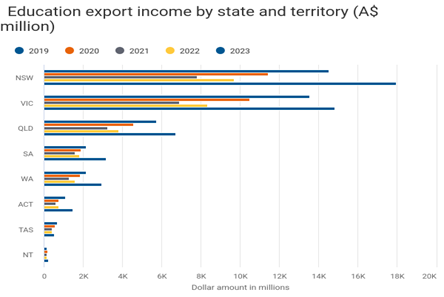
Table1. Education export Income By State, source: IEDR
Table 1 above clearly shows that international students do NOT want to go to states and areas where the respective skill shortages have been identified. The 5 states where international graduates are going to be ‘’most welcome’’ are currently at the bottom of the Table. Driving international students’ population to those states is going to be problematic. Furthermore, if they do opt for studying in NT or other locations where the government wants them to study and consequently to settle down, they will be doing so purely to qualify for the Australian Permanent Residence and will do little to resolve the skills shortage.
The NT as an example
Let’s look at the NT as an example.
| Country | Student Numbers |
| Nepal | 1120 |
| India | 706 |
| Bangladesh | 442 |
| Philippines | 406 |
| Vietnam | 329 |
| China | 310 |
| Pakistan | 221 |
| Sri Lanka | 105 |
Table 2. International Students studying in NT (compiled on the basis of the IEDR Data)
Table 2 shows international student numbers in NT further by singling out & ranking 8 countries that have 100+ students enrolled in NT institutions in the period of Jan-March 2024. It is quite transparent that promotions of NT as a study destination, though well-intentioned and constructed, are not achieving the desired outcomes. It should be noted that the State Sponsorship Program has been running for some years now but even those who eventually opt to apply for the NT sponsorship upon graduation rarely chose the territory as their study destination. They would rather study in Victoria or NSW, then apply to move to the NT as the ‘’last resort’’ for obtaining Australian permanent residency.
Thus, there is little reason to believe that the new government caps on the international student numbers are going to drive more students towards enrolling in regional and developing areas the NT example illustrates it rather clearly. A similar situation can be observed in other states and territories where education providers are far more concerned about attracting more international students rather than the newly introduced international student caps. Re-distribution of the enrollments across different states is not happening irrespective of the immigration policies, enrollment caps or marketing campaigns. The total number of student visas granted for January- April 2024 is almost 30% lower than for the same period in 2023. If this is what the government has been trying to accomplish…the reform undertaken is certainly a success. It is just that it has little to do with economic rationalism.
Closing Remark
The international education landscape of NT is representative (more or less) of developments and trends in other areas where (according to the government) international students are meant to be heading. Without speculating any further about political motivations for the international education reforms undertaken or even about hypothetical long-term benefits of the international student caps/international education controls implementation and by looking at the data alone it could be concluded that:
- International student enrollments are declining heavily across all states and territories
- The paradigm shift towards the decline is consistent
- No significant redistribution of the international student population towards regional and developing areas (despite the combination of international student caps + immigration policy) is taking place
From a data perspective alone, continuing with the current international education policies would be either wishful thinking (not that I am clear what the wishes are) …or simply delusional!












