













International partnerships have always been the main driver of Japan’s growth and prosperity, turning it into the global economic powerhouse it is today. Even in times of strict isolationism during the Edo period, Japan still maintained a vital ‘window to the world’ through an exclusive 220-year trade agreement with the Dutch. It was through this single partnership on the island of Dejima that Western science and innovation still flowed into the country, allowing Japan to develop and prosper even while its borders were officially closed.
The need to attract international talent
Just as international partnerships were the engine of Japan’s growth in both the distant and recent past, once again, cross-border cooperation is key to overcoming today’s domestic challenges. While Japan’s aging population is a significant concern, the crisis facing higher education is even more acute: the number of 18-year-olds has already halved from its 1991 peak of 2.07 million to just 1.06 million in 2024.
With this demographic projected to fall to 0.88 million by 2040, Japan must attract international talent at an unprecedented scale – not just to fill classrooms, but to create a pipeline of skilled graduates who can join the local workforce and support the government’s broader economic goals.
And once again, the solution lies in building strong, sustainable, quality partnerships. In this new era, those vital partners are the professional education consultants and study abroad agencies worldwide, the ‘Dejima islands’ of the 21st century.”
Demystifying the “Broker” misconception
At this year’s APAIE conference in Hong Kong and on a recent webinar I hosted, we explored why, still today, so many Japanese institutions remain hesitant to adopt the agency recruitment model, despite its success across the “Big Four” destinations – the traditional leaders in international education: the US, Canada, the UK, and Australia.. As Professor Hiroshi Ota of Hitotsubashi University, a long-time advocate for professionalising international student recruitment, pointed out: “there is a persistent misconception in Japan that agencies are merely ‘brokers.’ In reality, professional, accredited agencies act as highly experienced education consultants that are essential for sustainable growth.”
The world is looking at Japan
To move beyond these perceptions and understand the true global demand for study in Japan, ICEF conducted a dedicated research project between October 2025 and February 2026, that generated 303 submissions from high-quality education consultants worldwide. The geographic diversity of the responses, including East and Southeast Asia (40%), Africa (34%), the Americas (11%), and Europe (11%), proves that Japan’s appeal is truly global.
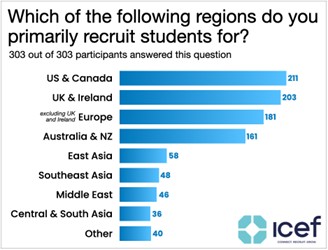
Traditional destinations
Our data confirms that the agency sector is currently anchored in the traditional study destinations in the West: the vast majority of respondents are heavily concentrated in the “Big Four” (US, Canada, UK, and Australia).
The striking reality of untapped demand
However, as agencies are looking to diversify beyond these traditional destinations, the appetite for Japan is reaching a tipping point. The results reveal a massive, untapped potential: while 265 (87.5%) of respondents have never formally partnered with a Japanese university, their enthusiasm to do so is remarkably high, with a mean interest level of 4.41 out of 5.
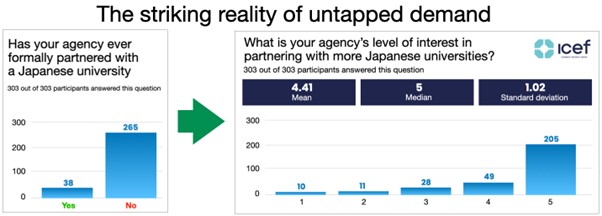
Meanwhile, the market remains significantly underdeveloped. Even among those agencies already working with Japan, most manage only one to three partnerships which emphasises that the opportunity for growth is substantial. To capture it, the existing potential simply needs to be activated, and old misconceptions replaced by a modern, professionalised strategy that incorporates quality agency partnerships.
Boots on the ground: The ‘Full-Service’ quality partner
Our research clarifies that, contrary to the ‘broker’ stereotype, quality, accredited agencies act as full-service partners assisting students and institutions throughout the entire recruitment and admissions funnel and beyond. Among the 303 submissions:
- 97% manage application and admission support.
- 95% provide initial counseling and career guidance.
- 92% handle visa and pre-departure briefings: one of the most complex hurdles for students entering Japan.
Professional agencies also serve as ‘boots on the ground’ marketing partners: 272 agents (90%) actively promote their partner schools and institutions on social media, while 212 (70%) represent universities at international student fairs for example.
For Japanese higher education institutions, this provides potential access to an immediate global footprint that would otherwise take years to build. The path to engagement is also more straightforward than many assume. Our survey data highlights a clear industry standard: over 85% of professional agencies prefer a commission-based model, with more than 70% stating that typical rates for a new university partner fall between 10-20% of the tuition fee. This performance-based approach offers a low-risk, high-reward entry point for institutions looking to increase and diversify their student populations. While commission is the industry standard, various partnership models – including service-based fees or marketing agreements – can be tailored to accommodate Japan’s specific institutional and legal frameworks.
Overcoming the Information Barrier
The survey also identified clear, solvable hurdles that currently prevent deeper engagement with Japanese higher education institutions. Three-quarters of the consultants (229 agents) cited a lack of brand recognition of Japanese universities, while 228 noted the persistent misconception that programmes are not taught in English.
In addition, half of all surveyed agencies actively ensure the quality and integrity of their services through rigorous staff training, ongoing professional development, and formal industry accreditations. For institutions looking for an extra layer of security, tools like ICEF Agency Status (IAS) can provide valuable peace of mind. Rather than adding complexity, these resources simply build on an existing foundation of professional transparency and ethical conduct, making it easier for risk-averse institutions to move forward with confidence.
A growing number of pioneering, ‘early adopter’ universities in Japan have already shown that by engaging with professional, accredited agencies and managing these relationships strategically, they can achieve a level of scale and student diversity that was previously out of reach.
From Rangaku (蘭学) to Ryugaku (留学): Japan’s journey from isolated learning to a global student hub
Having studied in Japan and later lived and worked in Tokyo, I have seen firsthand how this country transforms those who it welcomes. Japan already has nearly every ingredient required to attract international talent at scale: world-class education, an exceptionally safe and welcoming society, a supportive government, relatively affordable tuition and cost of living, and a cultural depth that remains a “hidden gem” to much of the world. But as outlined above, just one ingredient, one crucial piece, is missing to properly tap into this potential: the professional agency network to attract international students to Japan.
In the Edo era, Rangaku (蘭学, the study of Western knowledge, science and technology facilitated by the Dutch as Japan’s exclusive trading partners) was the key ingredient for Japan’s prosperity, flowing through the narrow gates of Dejima island. Today, the key to Japan’s 21st-century growth is Ryugaku (留学, international student mobility and study abroad) – the gateway to Japan becoming a global student hub by building upon the Dejima islands of our time: the study abroad agencies.
To view a copy of the report see here.
Martijn van de Veen is the CBDO at ICEF and a recognised leader in international student & youth mobility. With a professional background rooted in Tokyo and a degree in Japanese, he combines local cultural expertise with a global strategic vision. Martijn currently oversees ICEF’s expansion into emerging study destinations, with a particular focus on the growth and vitality of the East and Southeast Asian markets.












