











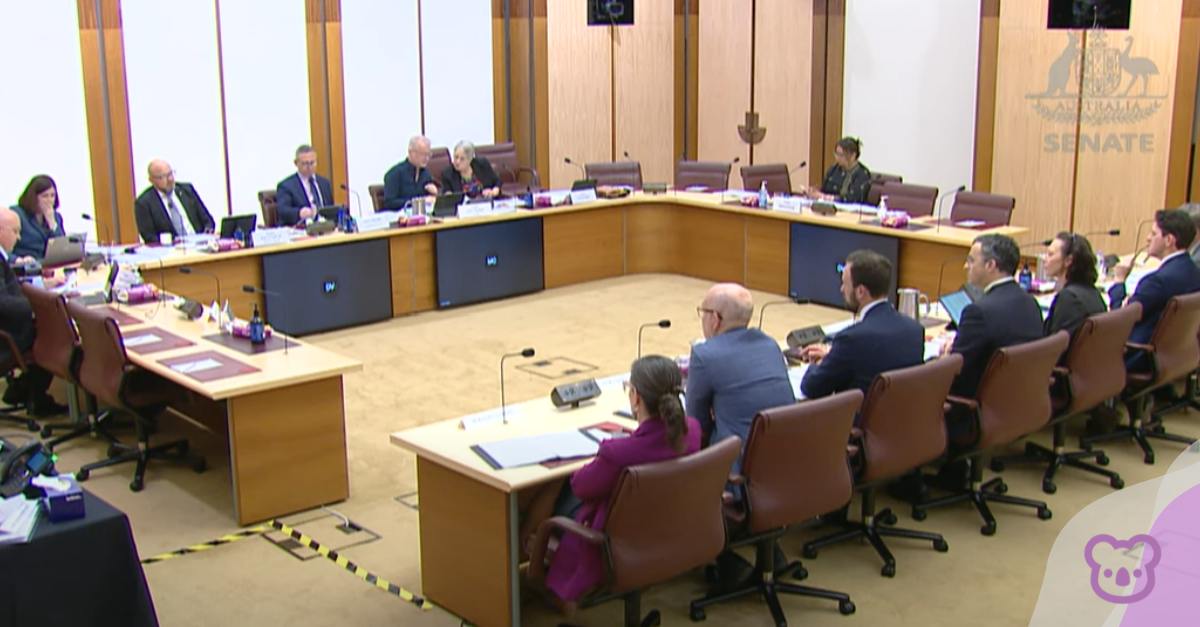
As has been the pattern for the Senate Education and Employment Committee hearings into the Education Services for Overseas Students Amendment (Quality and Integrity) Bill 2024, government officials were the last to appear on the fourth and final day of the inquiry.
Officials from the Department of Home Affairs (DHA), Department of the Treasury, Australian Skills Quality Agency (ASQA), Department of Education (DoE), Department of Employment and Workplace Relations (DEWR) and the Tertiary Education Quality and Standards Agency (TEQSA) appeared at the hearing. A list of officials and their agencies is at the bottom.
There wasn’t a lot of new information that we didn’t already know from previous appearances. These are some of the notable exceptions.
“We do not expect any job losses as a result of this bill”
The moment in the hearing when I could hear heads exploding across the sector was when Reinhardt told the Senate Committee “we do not see any impacts of this bill from a macroeconomic sense, and we do not expect any job losses as a result of this bill”. There was incredulity from non-government senators, with Senator Faruqi calling the statement “audacious and outrageous”.
Cagliarni had previously reported, and reiterated in this hearing, that Treasury does not “anticipate a significant economic effect” of the National Planning Level of 270,000 new overseas student commencements.
Treasury may be speaking from a macroeconomic perspective, but this will be little comfort for the individuals who will lose their jobs because of caps being imposed.
The government would have us believe that the ESOS Amendment Bill is about quality and integrity, but according to Reinhardt, as international students make up about 50% of total Net Overseas Migration it explains why “this bill was considered important”.
“Scare campaign”
Labor Senator Catryna Bilyk, who seemed to be making up the numbers for the Government at yesterday’s hearing, characterised concerns raised about the automatic suspension for exceeding enrolment limits component of the Bill as a ‘scare campaign’. DoE’s Sandercock clarified exactly what the automatic suspension meant, that a provider’s registration is suspended for the rest of that year, leaving them unable to enrol any more new students until the following year.
Technically, if a provider has really exceeded their cap, they can’t enrol any more new students anyway. But there are legitimate concerns about data, processes and systems, and ITECA covered these earlier in the day, which Bilyk either didn’t listen to or didn’t understand.
There is also an unknown for me in what it means to have your provider registration suspended; in the short term in terms of reputation (domestically and internationally) because there is no doubt that this will make the media, and in the long term if the Government decides it is going to use this against a provider (eg. when calculating a provider’s visa risk rating or whatever the equivalent is at the time).
I was also astounded by Bilyk asking the panel of DOE, DEWR, ASQA and TEQSA officials if caps were necessary to control NOM. A DEWR official dutifully responded with a blah, blah, quality, integrity, blah, blah answer.
TEQSA’s letters to providers
Senator Henderson expressed concern that TEQSA has sent letters to some providers that they will be “forced to go through financial compliance obligations as a result of their indicative cap” without mentioning in the letter that the legislation is yet to pass Parliament. It transpired that there was an appendix that went with the letter that set out the basis for the letter being issued, including that there was a warning letter sent by DHA.
Senator Sheldon called it an own goal by Henderson, with her seemingly unaware of the attachment. Yes, and no. Any letter from a regulator that relies on an appendix for context, which isn’t mentioned in the letter (or I assume Henderson would have twigged something was up), is poor practice.
Some other quick notables
- The Home Affairs IT release to manage caps won’t happen until December. It was November in a previous hearing. DoE wasn’t asked about the status of its IT system upgrade; I would like to have heard that answer.
- We already know that Australian Catholic University has suspended any further offers for 2025. We learned that this was because of a caution from DOE of concerns they may exceed their NOSC.
- The Secretary of DoE made his first appearance at the Senate Committee, probably in response to Henderson’s attack on Rimmer in the last hearing. This wasn’t his first rodeo.
- The 12 suspended VET providers that are currently in the AAT have been given a cap due to “procedural fairness”. I haven’t bothered to provide the other responses that agencies gave following questions about the methodology used, caps, or the data. There wasn’t anything particularly notable that we were not already aware of.
- Senator Canavan made a surprise first appearance (there’s obviously been some lobbying). He seemed to focus on the red herring of a trading scheme for unused caps.
What happens now?
The Senate Committee is scheduled to table its report, including any recommended amendments, on 8 October in the Senate. This will be followed by debate and voting in the Senate.
As the Coalition has already stated its support for caps, the Bill will almost certainly pass and will include enrolment limits. The question really is what amendments will be proposed that are palatable for both the Government and the Coalition to agree to.
Once the Bill is passed in the Senate, it goes to the Governor-General for Royal Assent, and the Bill becomes an Act of Parliament, leaving the sector to deal with its consequences.
Officials who appeared at the hearing, last names and agency are used in this article for brevity:
Department of Home Affairs
Mr Damien Kilner, First Assistant Secretary, Immigration Programs Division
Mr Brendan Tegg, Assistant Secretary, Migration Reform Taskforce
Department of the Treasury
Ms Sam Reinhardt, Deputy Secretary, Fiscal Group
Dr Adam Cagliarni, First Assistant Secretary, Macroeconomic Conditions and Population Division
Ms Kerren Crosthwaite, First Assistant Secretary, Housing Division
Mr Brendan McKenna, A/g First Assistant Secretary, Labour Market, Environment, Infrastructure and Industry Division
Mr Nick Latimer, Assistant Secretary, Centre for Population
Australian Skills Quality Authority
Ms Saxon Rice, Chief Executive Officer
Ms Fiona O’Brien, Executive Director, Policy and Partnerships
Department of Education
Mr Tony Cook PSM, Secretary
Mr Ben Rimmer, Deputy Secretary, Higher Education, Research and International Group
Ms Karen Sandercock, First Assistant Secretary, International Division
Ms Vanessa Lapthorne, Assistant Secretary, Engagement Branch
Dr Damian Oliver, Assistant Secretary, Partnerships
Ms Alexandra Procailo, Assistant Secretary, Quality Branch
Department of Employment and Workplace Relations
Ms Anna Faithfull, Deputy Secretary, Skills and Training Group
Ms Laura Angus, First Assistant Secretary, Careers, International, Defence and Assessment Division
Mr Daniel Langer, A/g Assistant Secretary, International Policy and Defence Branch
Ms Katerina Lawler, Assistant Secretary, VET Quality and Regulation Branch
Tertiary Education Quality and Standards Agency
Ms Adrienne Nieuwenhuis, A/g Chief Commissioner
Dr Mary Russell, Chief Executive Officer












