












International study of English language teachers calls for a rethink of AI policy, assessment and professional development, warning that convenience can come at the expense of independent thinking.
Artificial intelligence is already changing how English is taught around the world, but the teachers experimenting with the technology are clear about one thing: AI should support educators, not replace them.
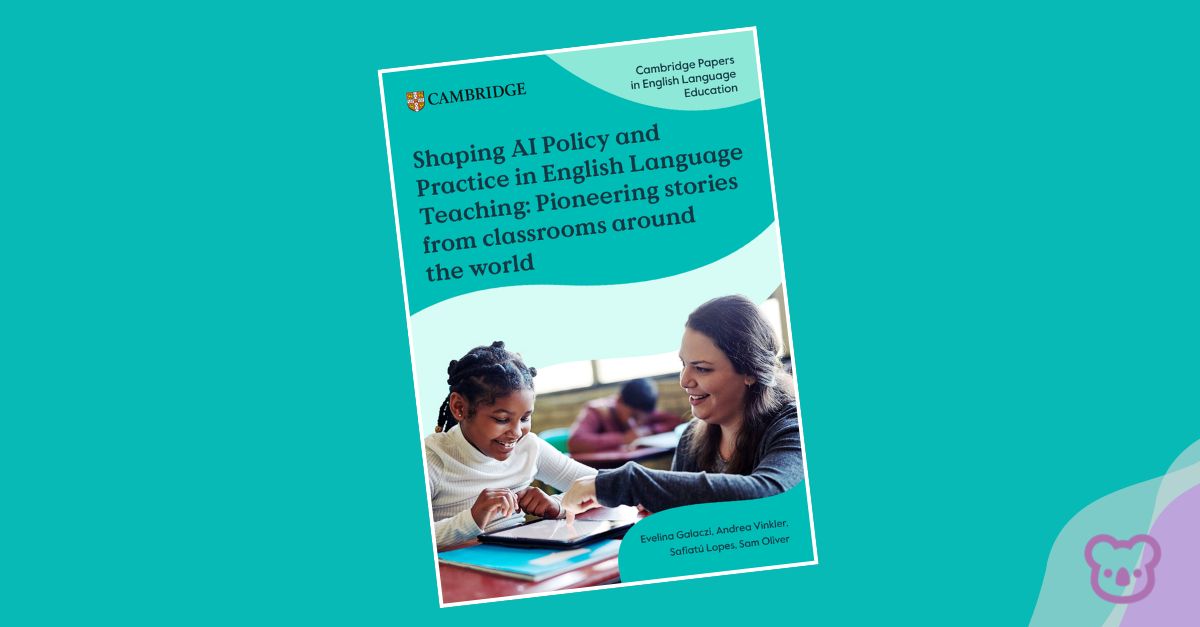
That is a central finding of a new Cambridge research paper, Shaping AI Policy and Practice in English Language Teaching: Pioneering stories from classrooms around the world, which draws on interviews with 15 teachers and teacher trainers across 13 countries and six continents.
The study, conducted in early 2025, explores how early adopters are incorporating generative AI into primary, secondary and adult English language education. Its findings point to practical benefits in lesson preparation, personalised learning materials and student feedback, alongside concerns about accuracy, bias, privacy and the risk of students outsourcing their thinking to technology.
The message for education leaders and policymakers is that access to AI tools alone will not deliver better learning. Effective integration requires teacher expertise, sustained professional development and policies grounded in what actually happens in classrooms.
Less time preparing, more time teaching
Teachers interviewed for the study described using generative AI to produce lesson plans, adapt materials for different proficiency levels, develop quizzes and create more engaging classroom activities.
For teachers managing large classes, AI assisted with feedback and marking, potentially freeing up time for more personalised instruction. Others used the technology to create songs, visual resources, role plays and multimedia activities that connected language learning with students’ interests and experiences.
Australian teacher Gabriel Azpilcueta, who works at the English Language Centre at Adelaide University, described the importance of retaining the teacher’s role in the process.
“It’s not about radically changing the way we do things, … because we’re still the experts in the classroom,” he said.
The distinction matters. The teachers did not describe AI as a replacement for established teaching principles, but as a way to extend what they could do when time and resources were limited.
The report argues that effective use begins with the learning objective, not the technology. Teachers need to determine whether AI genuinely improves an activity or simply adds another layer of complexity.
As one example, German teacher trainer Anna Schönbach described how adapting materials for different student levels could be reduced from hours of research to a few minutes of testing prompts.
For language educators working with students at different stages of proficiency, that flexibility offers a practical reason to experiment.
The risk is students stop doing the thinking
The benefits come with a significant concern: students may become so accustomed to receiving instant answers that they lose confidence in their own abilities to think, write and learn independently.
Several teachers reported that students were turning to AI before attempting a task themselves. The report warns that this dependency could undermine foundational skills and weaken critical thinking, creativity and autonomous learning.
Vietnamese educator Trang described the problem as a loss of confidence in students’ own thinking and experience. She argued that AI is most effective for learners who have already developed the skills needed for independent study.
The study suggests that the distinction between using AI to learn and using it to avoid learning needs to become a central part of classroom practice.
Teachers are experimenting with ways to make that distinction visible. One example involved students comparing three texts: one written by a student, one written by a student and revised using ChatGPT, and one generated by AI. Students then analysed the differences and discussed how they might identify AI assistance.
Other teachers encouraged students to test AI-generated answers against information they already knew, helping them identify errors and question confident but inaccurate responses.
The report’s underlying argument is that AI literacy cannot simply mean knowing how to use a chatbot. Students also need to understand when to use it, when not to use it and how to evaluate what it produces.
Human judgement remains central
The educators interviewed overwhelmingly rejected the idea that AI could replace teachers.
They emphasised the importance of human connection, encouragement, empathy and the ability to make informed decisions about individual students and their learning needs.
Australian educator Azpilcueta said the strongest learning outcomes came when teachers and AI worked together.
“Our role is to be there, to be present, to provide encouragement,” he said.
That emphasis challenges a purely technology driven approach to education reform. The report argues that teachers should be treated as professional decision makers who help select, integrate and evaluate AI tools, rather than as implementers of technologies chosen elsewhere.
It also raises questions about the suitability of generic AI products for diverse educational environments. The tools widely available to teachers were not necessarily developed specifically for education, meaning their usefulness depends on how carefully they are adapted to learning objectives and student needs.
The study’s participants highlighted the importance of questioning bias in AI outputs, protecting student privacy and ensuring tools are inclusive of different linguistic and cultural contexts.
Danson Kimathi, a teacher in Kenya, pointed to the need for AI tools to better accommodate local languages, including Swahili.
For international education, the issue extends beyond the classroom. As students encounter AI across different languages, cultures and educational systems, the quality and inclusiveness of the tools may influence how effectively they can participate in learning.
Policy needs to move beyond access and restrictions
The report makes eight recommendations for national and institutional policymakers, placing teacher involvement, professional learning and critical AI literacy at the centre of responsible adoption.
It calls for teachers and learners to be involved in decisions about AI implementation, sustained investment in teacher training, and explicit curriculum expectations around evaluating AI outputs and identifying bias.
It also argues that assessment frameworks need to recognise the learning process, not just the final product.
As AI makes it easier to generate polished assignments, the authors suggest that assessment should place greater emphasis on evidence of progress, student reflection, feedback literacy and independent thinking alongside conventional measures of achievement.
The recommendations also include stronger safeguards around privacy, transparency, age appropriate access and accountability, as well as more equitable access to high quality tools.
The authors expect education to move beyond using AI to replicate existing activities towards more substantial changes in how learning and assessment are designed. They argue that traditional and AI supported approaches will coexist, with success depending on considered practice and evidence informed policy.
An emerging picture, not the final word
The findings offer a useful snapshot of how educators are navigating the early stages of generative AI adoption. However, the study’s scope matters.
Its 15 participants were selected because they were already experimenting with AI, so their experiences should not be taken as representative of all teachers. Nor does the research establish, through a large scale measurement of student outcomes, that the reported practices consistently improve learning.
What it does provide is a set of grounded observations about the opportunities and problems educators are encountering as they put AI into practice.
For policymakers, the implication is that broad rules about acceptable use will not be enough. Teachers need the skills and authority to make decisions, students need to develop the capacity to question AI, and institutions need to consider how technology affects both educational quality and equitable access.
The report’s clearest message is that the challenge is no longer simply whether AI belongs in education. It is how to ensure that its growing presence strengthens learning rather than displacing the human judgement, relationships and independent thinking on which education depends.












