











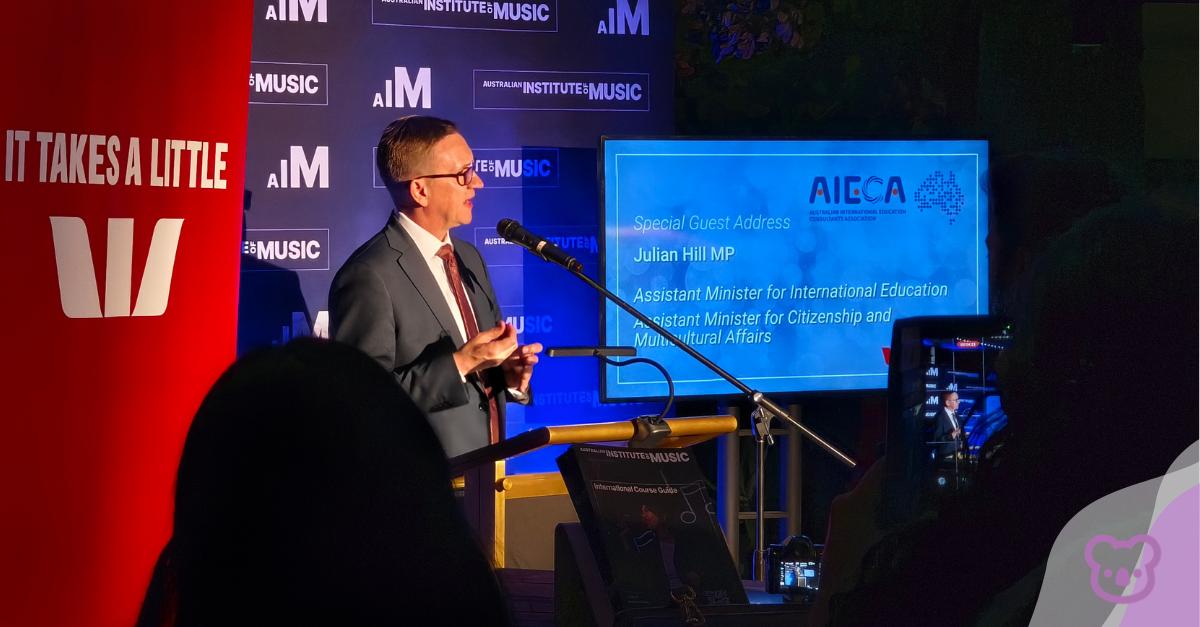
There was a sense last night that something long discussed had finally taken shape.
In a room that brought together agents, consultants and sector leaders, the Australian International Education Consultants Association quietly stepped into being. Known as AIECA, the new body represents the merger of the Education Consultants Association of Australia and the International Student Education Agent Association. More than a consolidation, it is being framed as a reset.
At its core, AIECA is about structure and standards. A professional home for consultants operating in a sector that has, at times, struggled to clearly define them. The ambition is straightforward. Lift practice, sharpen accountability and ensure those advising students are recognised as part of the system rather than orbiting around it.
The timing is not incidental. International education continues to move through a period of reform, with scrutiny falling heavily on intermediaries. In that context, AIECA arrives with a promise to bring coherence. Ethical frameworks, ongoing professional development and a clearer voice in policy discussions all sit at the centre of its agenda.
Speaking at the launch, Assistant Minister for International Education Julian Hill positioned consultants as critical to the sector’s future, but also central to its challenges.
He described international education as one of Australia’s great success stories, while cautioning that its future depends on an unrelenting focus on quality and the student experience. Within that, agents and consultants play a pivotal role in bridging what he called a profound information gap faced by students, many of whom are young and making decisions from offshore.
At the same time, he did not shy away from the tensions.
There remains, he noted, a social licence question hanging over the sector. Not driven by the majority in the room, but real nonetheless. And it is this backdrop that has prompted a firmer regulatory stance.
Hill pointed to instances where intermediary behaviour has distorted the market, referencing the government’s move to remove onshore commissions for student transfers as a necessary intervention to protect quality. He also signalled that further action remains possible, particularly if loopholes or questionable practices continue to surface.
A recurring theme was evidence over instinct. The government, he said, is focused on building a clearer data picture before moving on broader measures such as commission transparency.
On visas, Hill addressed rising rejection rates in parts of South Asia, pushing back on suggestions they are being used to manage overall student numbers. Instead, he outlined a more complex picture shaped by application surges, integrity concerns and increasingly sophisticated fraud.
One area he highlighted stood out.
There is now a deeper examination of the financial capacity underpinning visa applications. Not simply whether a loan exists, but whether it is realistic. Assessments are extending to a student’s ability to repay, the credibility of declared family income and the true value of assets used as security. In some cases, he noted, claims have not withstood that scrutiny.
For consultants, the message was clear. Greater diligence is needed, particularly in markets where financial structures are more complex and, at times, more vulnerable to manipulation.
Despite the tightening environment, Hill maintained that the long term outlook for international education remains positive. Growth, however, may not come through volume alone. A shift toward higher value enrolments, diversified markets and expanded offshore delivery is firmly on the table.
Against this backdrop, AIECA’s arrival feels well timed.
Its stated goal is not simply to represent consultants, but to professionalise the role itself. To ensure those guiding students are equipped, accountable and embedded in the broader policy conversation.
If the sector is entering a phase defined by quality, integrity and evidence, then last night suggested consultants intend to be part of shaping that phase, rather than being shaped by it.












