














Australia retained its world-class university system when the Times Higher Education World University Rankings for 2025 were released earlier in October 2024.
Media headlines suggested that Australia’s universities had tumbled down the global rankings. Yes, The University of Melbourne, Australia’s top ranked university, slipped from 37 to 39. But Melbourne Vice-Chancellor Duncan Maskell got it right when he said:
These latest rankings have underscored that international education is a prized national asset and as a country we should be proud to see the number of Australian universities ranked in the top 100 globally.
Australia had six universities ranked in the world’s top 100 in 2024, and those same six remain in the top 100 in 2025.
Those six universities make up 14.6% of Australia’s 41 universities. The United States (37 universities) and United Kingdom (12 universities) dominate the world’s top 100. But compared with Australia’s 14.6% in the top 100, 8.5% of UK universities and 1.4% of US universities are in the top 100.
In the world’s top 200 universities, Australia has 10 universities, making up 24.4% of Australia’s 41 universities, compared with 24 UK universities (17.0% of all UK universities) and 53 US universities (2.0% of all US universities).
In the world’s top 500 universities, Australia has 33 universities, making up 80.5% of Australia’s 41 universities, compared with 52 UK universities (36.9% of all UK universities) and 102 US universities (3.9% of all US universities).
We may need to hold the mirror up the other way to show the finding that does not beat about the bush.
Australia has 8 of its 41 universities outside the world’s top 500, 19.5% of all Australia’s universities, compared with 89 of 141 UK universities (63.1%) outside the world’s top 500, and 2,526 of 2,628 US universities (96.1%) outside the world’s top 500.
Proportions of Students in World Ranked Universities
Perhaps what is more important than numbers of universities is proportions of students. That analysis takes a lot of number crunching.
But, a year ago, analysis from the Times Higher Education World University Rankings 2024, released in 2023, compares Australia, UK and US.
In Australia,
26% of all students were at universities ranked in the world’s top 100,
14% of students were at universities ranked 101 to 200,
49% of students were at universities ranked 201 to 500,
12% of students were at universities outside the world’s top 500.

In the United Kingdom
13% of all students were at universities ranked in the world’s top 100,
15% of students were at universities ranked 101 to 200,
17% of students were at universities ranked 201 to 500,
55% of students were at universities outside the world’s top 500.
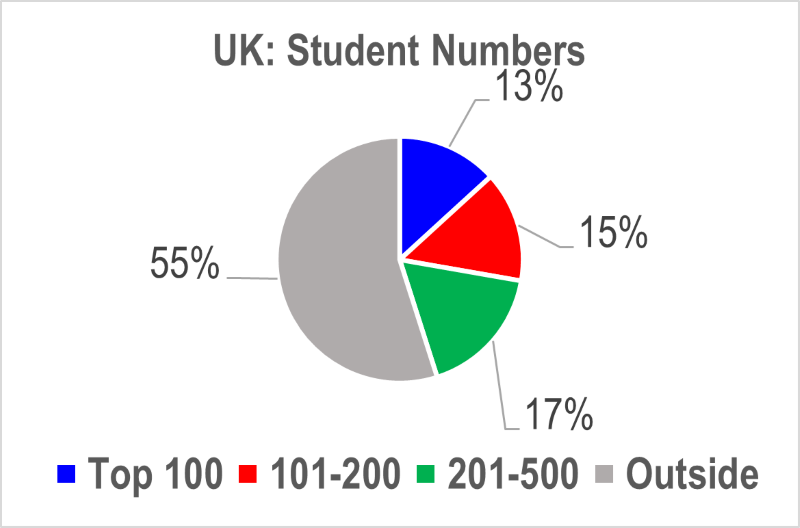
In the United States
9% of all students were at universities ranked in the world’s top 100,
5% of students were at universities ranked 101 to 200,
9% of students were at universities ranked 201 to 500,
77% of students were at universities outside the world’s top 500
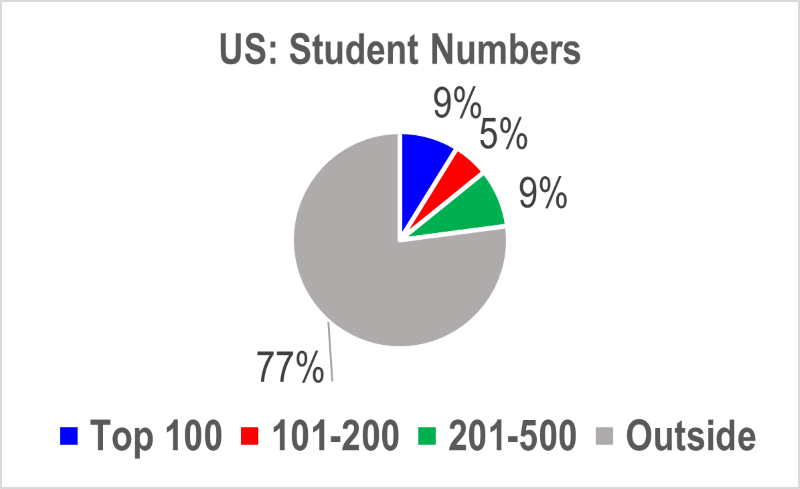
26% of students in Australian universities were at universities in the world’s top 100, while 28% of students in UK universities were at universities in the world’s top 200 and 23% of students in US universities were at universities in the world’s top 500.
Detailed analysis of numbers of students, based on the 2024 rankings released in 2023, is in the January 2024 paper Global Rankings of Australia’s Universities 2023 on the Directors page of www.spre.com.au
The Times Higher Education World University Rankings 2025, released October 2024, are at
https://www.timeshighereducation.com/world-university-rankings
Strategy and Policy are guided by Research in Education.











