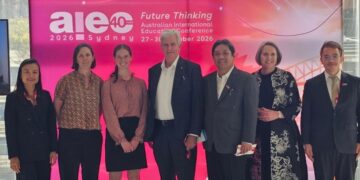










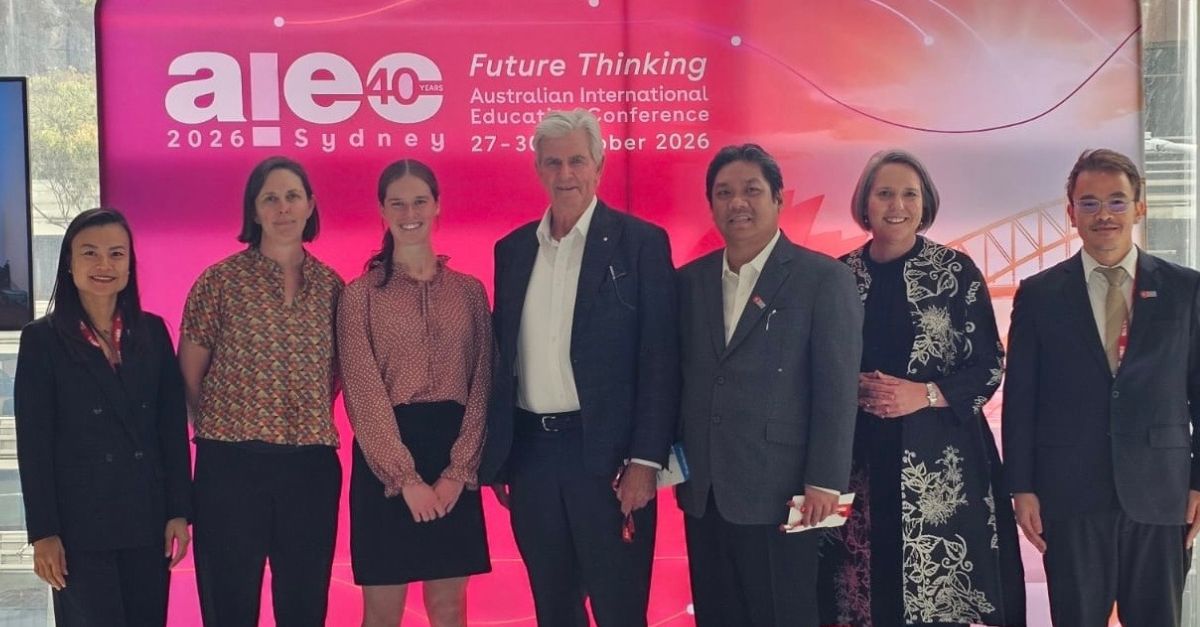
The AIEC Conference Plenary “AIEC: THEN. NOW. NEXT.” provided an opportunity for panelist Dorothy Davis to share with the audience her “I Was There” moment” and look back on the pioneering days of Australian international education in the 1980’s.
AIEC founder, the International Development Program of Australian Universities and Colleges, now ASX listed company IDP, had humble beginnings in Canberra, Indonesia and other Southeast Asian capitals in the 1980’s, supporting the regional Australian government scholarship program.
Higher education market deregulation in 1986 meant that IDP was well placed to expand its remit to include the recruitment of fee-paying international students. It was also provided with an opportunity to partner globally with the British Council on the introduction of the IELTS English Test, an early win for quality assurance as a feature of successful international education.
IDP became a global success in student recruitment and language testing that would underpin a new Australian export industry. With growth as the driver, commodification of international education developed at an unsurprising pace, attracting many other new service businesses. Australia became the envy of its European and North American competitors. International education however gradually became a runaway train, with a cash strapped university sector reluctant to drive with the brakes engaged. Shareholders had come to expect 10-15% growth year on year in the business.
40 years later, the 2026 Sydney AIEC conference highlighted concern by many in the sector, that unsustainable growth cannot continue. It has led to government legislated steep cuts in inbound student numbers, and a much-discussed ‘loss of social licence’. It’s ironic that Australian higher education institutions trumpet the importance teaching about and supporting the UN Sustainable Development Goals while ignoring the application of sustainable development principles to the management of international education.
Southeast Asia and the Association of Southeast Asian Nations-ASEAN provided a bright spot at AIEC. Both Australian government policy and growing higher education sector attention indicate that the 11 countries of ASEAN are an important focus for mutually beneficial partnership building. It is the region favoured by Australian government policy and DFAT strategic support. It continues to be the most active region for Transnational Education. It is also giving rise to increasingly competitive regional education hubs in Malaysia and Singapore with Thailand, Vietnam and the Philippines working to strengthen their global appeal.
For the first time the regional peak body for higher education in Southeast Asia, the ASEAN University Network (AUN), was an exhibitor at AIEC 2026. AUN had previously undertaken a 4-year strategic scoping study of Australian higher education, relevant counterpart bodies and quality assurance mechanisms. This resulted in the signing of a MOU with Universities Australia in December 2025 and initial partnerships with universities in Western Australia and NSW. AUN also signed a MOU with English Language Quality Assurance peak body, the National ELT Accreditation Scheme (NEAS Australia). English as the official language of ASEAN is a matter of on-going relevance.
In 2024 AUN co-convened the ASEAN Australia Education Dialogue (AAED) in Laos and again in 2025 in Penang, Malaysia. Interestingly in October 2026, while AIEC was meeting in Sydney, the British Council was co-convening the ASEAN-UK Higher Education Week in Manila with the Commission on Higher Education (CHED).
AUN is focused on strengthening its higher education partnerships with Australia around areas of strategic alignment, including quality assurance best practice, student mobility, English language teaching and Sustainable Blue Economy multi-disciplinary research partnerships.
With support from the Australian government through the Australia for ASEAN Futures Initiative, the ASEAN Secretariat engaged the Australian National Centre for Ocean Resources and Security-ANCORS at the University of Wollongong, partnering with the Blue Economy Cooperative Research Centre, to author the ASEAN Blue Economy Implementation Plan. This was launched in Malaysia last year and presented to an ASEAN and Australia audience by ANCORS at last year’s ASEAN Australia Education Dialogue (AAED) in Penang, co-convened by AUN and hosted by AUN core member Universiti Sains Malaysia (USM).
The next steps are a joint ASEAN Australia Blue Economy online webinar series, March to June 2027, addressing multi-disciplinary research around ocean and water partnerships, culminating in a planned 3-day regional workshop in Darwin in late 2027.
Other Darwin initiatives include showcasing sustainable maritime innovation at the Monaco Energy Boat Challenge; and a Timor-Leste higher education capacity-building workshop with Timor Leste, Australian and ASEAN University Network (AUN) partners.
“NEXT” for Australian international education is to engage more boldly on dialogue, knowledge exchange and mutually beneficial partnership development in and with ASEAN. As we stress to our New Colombo Plan mobility students who are choosing Southeast Asia in increasing numbers “Regional interaction broadens the mind”.
Michael Fay OAM is a Fellow of UTS and Special Advisor to the AUN Secretariat.