











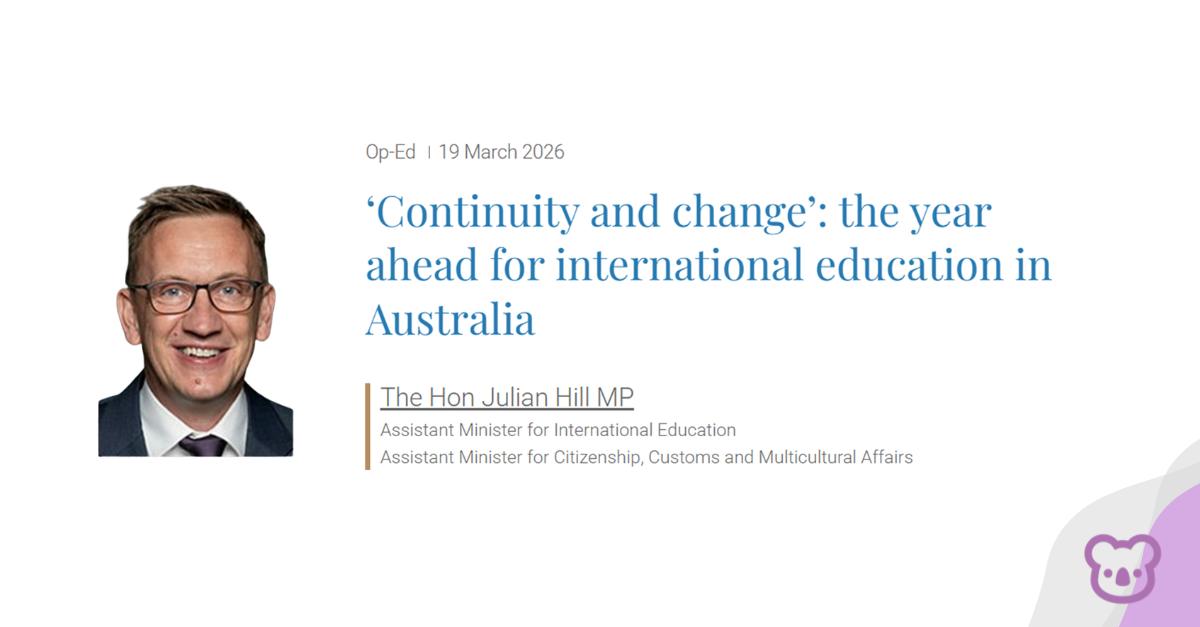
When Julian Hill published his op-ed “Continuity and change: the year ahead for international education”, it landed with a tone that felt, at first glance, reassuring. Stability. Sustainability. Quality. All the right words. But beneath the language sits something far more deliberate and far more political.
This is not just a sector update. It is a positioning document.
At its core, Hill’s piece attempts to walk a careful line, maintaining confidence in Australia as a destination while justifying a sustained period of government intervention. The phrase “continuity and change” is not accidental. It is political framing designed to calm a sector that has been through two years of disruption, while signalling that the direction of travel will not materially shift.
And that direction is clear.
The government will continue to manage the size and shape of the international student market, with planning levels, integrity measures and regulatory controls now firmly embedded.
The policy lens: value over volume
From a public policy perspective, the op-ed is consistent with a broader shift already underway. The government is reframing international education away from a growth industry and towards a managed system.
Hill makes this explicit. Growth is no longer the goal. Instead, the emphasis is on higher quality students, alignment with skills shortages, economic contribution and soft power outcomes.
This aligns with earlier messaging where Hill warned the sector not to expect growth, but rather a focus on more value for Australia.
In policy terms, this is a classic recalibration. When a sector loses social licence, in this case driven by housing pressures and migration concerns, governments pivot from expansion to optimisation. The introduction of planning caps, integrity legislation and tighter controls is part of that reset.
But the op-ed goes further. It signals a structural shift toward onshore constraint through caps and tighter visas, offshore expansion through transnational education, and stronger regulatory oversight through legislation and agent controls.
This is not temporary. It is the new model.
Another notable element in Hill’s piece is the clear foreshadowing of a new overarching framework for international education. While details remain limited, the intent is unmistakable, a more coordinated, whole of government approach that brings together migration, education, skills and economic policy under a single lens. On one level, this signals maturity in how the sector is being positioned within national priorities. On another, it raises questions about how prescriptive and centralised the system may become. For providers, the opportunity lies in greater clarity and alignment, while the risk is reduced flexibility and increased compliance burden. As with much of the current reform agenda, the success of any new framework will hinge not just on its ambition, but on how transparently it is communicated and how predictably it is implemented.
When ready, and the Koala understands significant has work has been complete, the question is whether this will be another late Friday policy drop, or whether there will be meaningful consultation to bring the sector with it and provide opportunity to contribute to it’s design.
The political lens: message discipline and narrative repair
Politically, the purpose of the piece becomes clearer.
Hill is attempting to solve a difficult balancing act. He must reassure voters that migration is being controlled, reassure the sector that Australia remains open, and reposition international education as a premium product.
His language is tightly constructed around this tension. Phrases like sustainable, integrity and premium destination are doing heavy lifting. They are not just descriptors; they are narrative tools.
The repeated focus on “dodgy providers” and “rorting the system” is particularly telling.
This creates a political buffer. By framing past growth as partly driven by bad actors, the government justifies intervention without appearing anti sector.
It is, in effect, a reset narrative. The system grew too fast, quality slipped, integrity was compromised, now we are fixing it.
That framing is politically powerful. It attempts to shift blame away from policy settings and onto parts of the sector itself, something that sits uncomfortably with the majority of the sector and is a growing frustration with the current government.
What’s not being said
What is equally important is what the op-ed does not say.
There is no acknowledgement of the financial impact on providers, particularly smaller ones. There is little reflection on the speed, volatility and consultation, or lack thereof, of policy changes over the past 18 months. Nor is there meaningful engagement with the competitive risk to Australia’s global position.
Instead, the piece leans heavily into future strategy, a new framework, offshore growth and two way mobility, without fully addressing the immediate disruption still being felt on the ground.
This is typical of political communication. It attempts to move the conversation forward before the current one has been resolved.
Early reactions: cautious, but telling
Initial reactions, particularly in industry circles and on platforms like LinkedIn, have been measured rather than enthusiastic.
More broadly, the tone across the sector appears to be one of cautious acceptance. There is an understanding that the agenda is politically non-negotiable, but also an undercurrent of concern about what a permanently managed system means for growth, competitiveness and institutional viability.
Across the many voices The Koala has spoken to, a consistent theme has emerged, people are feeling worn down, fatigued and increasingly dispirited.
So what is the point of writing this?
Stripped back, the op-ed serves three key purposes.
First, it is a signal to the sector that the settings of the past two years are not a phase, they are the foundation of a new policy era.
Second, it is a message to the public that the government is in control of migration and is acting to protect quality and integrity.
Third, it is a repositioning exercise. International education is no longer being sold purely as an export industry, but as part of national strategy, economically, socially and geopolitically.
Hill even elevates the sector into the language of “statecraft”, signalling its role beyond dollars and into influence.
The Koala’s take
For all its talk of continuity, the op-ed confirms something more fundamental. The era of demand driven international education in Australia is over. It is a statement that reaffirms the pedal is still on the gas for reform even though numbers appear to moving in the governments favoured direction.
In its place is a system that is more controlled and more politically sensitive.
For a sector like international education, predictability is not a luxury, it is foundational. Providers plan years in advance, setting recruitment targets, building offshore pipelines, investing in partnerships and staffing based on policy settings they expect to hold. When those settings shift rapidly or without clear forward guidance, the impact is immediate and far reaching. Agents lose confidence, students look elsewhere, and institutions are left recalibrating mid cycle. In this context, predictability is not about resisting reform, but about enabling it to land effectively. Without a stable and clearly signalled policy environment, even well-intentioned changes undermine the very outcomes they are designed to achieve. This is a message the government is reluctant to accept.
The integrity debate also deserves a more balanced lens. Recent regulatory action by the Australian Skills Quality Authority has seen the cancellation of a number of qualifications, reinforcing the government’s narrative around quality and compliance. But a closer look raises an important nuance. Relatively few of these actions have been directly tied to international student cohorts. In other words, integrity challenges are not solely, or even primarily, an international education issue. Framing them as such risks misdiagnosing the problem and overcorrecting in areas that are already heavily scrutinised. A more effective approach would recognise that integrity is a system wide responsibility, requiring targeted, evidence-based responses rather than broad measures that disproportionately impact one or multiple parts of the sector.
The recent increase in student visa fees is another pressure point, and one that lands unevenly across the sector. While the rise may be absorbed, albeit reluctantly, by students enrolling in higher education or longer duration programs, it has a disproportionately heavy impact on the ELICOS sector. English language courses are typically shorter, lower cost, and often serve as a first entry point into Australia’s education system. A significant upfront visa fee, when weighed against the total cost of a short course, fundamentally shifts the value equation for prospective students. For many, it makes alternative destinations more attractive or delays their decision altogether. In effect, a blunt pricing lever risks constraining the very pipeline that feeds into broader international education pathways, with consequences that extend well beyond the ELICOS sector itself.
The challenge now for the sector is not just to adapt to this reality, but to understand it. Because this is no longer just an education story.
It is a migration story.
An economic story.
And increasingly, as we all know, a political one.
Hill’s Op-Ed can be seen here.