












The cost of living and changes to visa conditions are the main reasons for students who said their feelings towards Australia had worsened in the last 12 months, according to 2024 Study Australia International Student Sentiment Survey summary results released by the Australian Trade and Investment Commission (Austrade) last week.
For those who expressed that their feelings had become more positive in the last 12 months, feeling more comfortable in Australia and new friendships and connections were the top two reasons.
The International Student Survey is in its fifth year and provides a snapshot from current international students about living and learning in Australia.
The study also found that the overall sentiment towards Australia declined slightly in 2024 from 2023, although it remains positive (average above 7 out of 10).
When asked about specific aspects of studying in Australia, 51 per cent of students said their perceptions had improved about Australia as ‘safe and secure living and learning’ and 48 per cent said ‘Australian community is welcoming to international students’.
Negative sentiment about ‘potential for future residency/immigration’ had worsened over the last 12 months for 45 per cent of students, followed by ‘graduate career opportunities’.
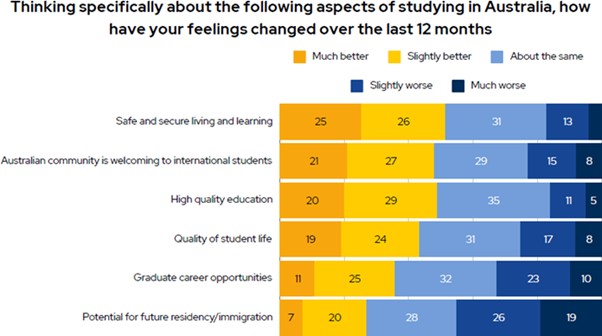
These responses are consistent with the trends and discussions picked up by Voyage’s The Social Source, that international students in Australia are increasingly concerned about their future career prospects.
Varsha Devi Balakrishnan, Head of Student Insights and Strategy, Voyage told The Koala, “Ongoing policy uncertainty and visa restrictions are creating significant barriers to post-study employment and migration pathways leaving many students questioning their investment in an Australian education.”
The top three concerns outside of study for students remain the same as 2023, being financial pressures, employment issues, accommodation issues, noting there was some reduction in the scale of concern for all three.
“Compounding these concerns, tuition fees for international students rise by an average of 3-5% per year, yet many students aren’t aware of these creeping costs due to the sheer number of factors they must consider when deciding to study abroad. This financial strain builds up over time while they simultaneously tackle the rising cost of living,” said Balakrishnan.
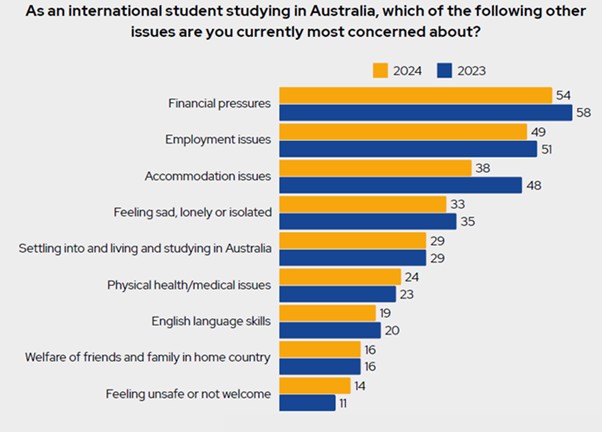
Although at the lower end of the issues that students said they are concerned about, ‘physical health/medical issues’ increased slightly from 2023 to 2024, as did ‘feeling unsafe or not welcome’, although from a much lower base.
The survey also covered awareness of support services, with the results showing that students living in dedicated student accommodation had a much higher awareness of available services. The conclusion drawn from these results being “the need for robust and pro-active outreach to students who many spend less time on or near campus”.
Careers and employment services were the most used support services, followed by health and medical services.
Breaking down the financial pressures faced by students, housing was the highest expenditure, with 39 per cent of students spending over 60 per cent of their income on accommodation. This may explain the result that 54 per cent of students said that they would work more hours if they were allowed.
The survey instrument was designed by QS and Study Australia Partnership (the international education arms of the eight state and territory governments).
The summary of findings is available to Austrade subscribers.