











Australia’s Genuine Student requirement is creating a new challenge for international education providers: how do universities help prospective students explain why they want to study in Australia without effectively writing the answer for them?
Successful Graduate believes it has found part of the answer in what it describes as an “ethical AI” approach to the Genuine Student statement, combining structured preparation, student-led drafting and institutional oversight.
The company has introduced a Genuine Student Statement Builder that sits within its existing pre-departure and academic readiness courses. The proposition is relatively simple. Students do not receive access to the tool immediately. Instead, they unlock it after completing their university’s licensed pre-departure or academic readiness course.
Tackling two problems at once
The first is the growing complexity and anxiety surrounding the student visa process. The second is a problem universities have been wrestling with for years: how to keep offer holders engaged between accepting an offer and actually turning up.
Successful Graduate points to its work with London South Bank University as evidence that structured pre-arrival engagement can influence that second part of the equation.
The conversion figures were stark. Students who engaged with the micro-credentials converted to enrolled students at a rate of 15.8%, compared to just 8.5% among non-engaged students. This represented an 85.9% improvement in enrolment conversion yield, on a cohort of 5,800 future students.
International recruitment has traditionally focused heavily on the period before an offer is made. Increasingly, however, the period between offer and arrival is becoming just as important. An applicant who has accepted an offer but remains uncertain about the visa process, their course or their decision to study in Australia is not necessarily a student who will eventually arrive.
That makes pre-arrival engagement more than a student services exercise. It can become part of the recruitment funnel.
From checklist to conversation
The GS Statement Builder takes that concept into an area where universities need to tread carefully.
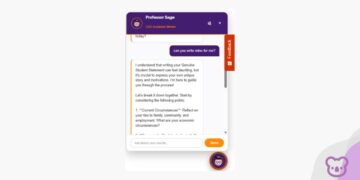
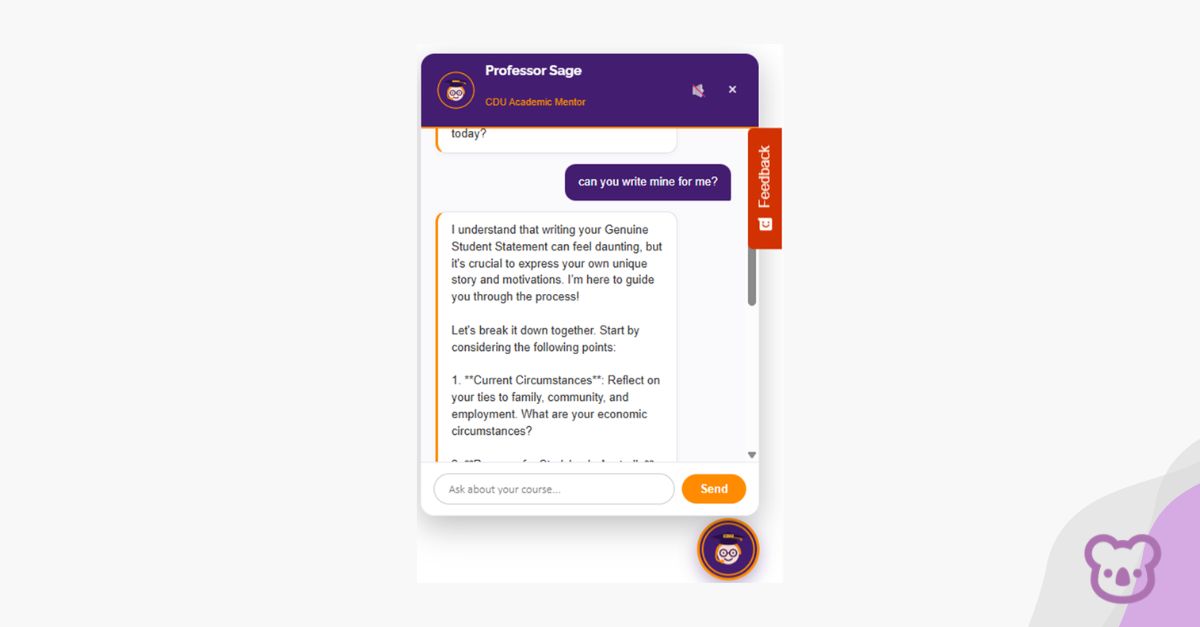
Successful Graduate says its tool guides students through the five Department of Home Affairs GS criteria, including word-count controls and structured prompts. The company says students must write their own responses, with its AI mentor, Professor Sage, prohibited from writing, translating or paraphrasing the student’s statement.
Instead, Sage operates as a Socratic coach.
If a student asks the system to write an answer, it declines and instead asks questions about the student’s circumstances, family connections, financial situation, course choice and future career plans. The student then writes their own response, with the system providing feedback on clarity, relevance and alignment with the criteria.
That distinction between writing and prompting is important.
There is a growing temptation in education to use generative AI to make difficult processes easier. But the easier it becomes for AI to produce polished answers, the harder it can become to establish whether those answers actually belong to the person submitting them.
The GS process is particularly sensitive because the purpose is to understand the individual student’s circumstances and intentions. A beautifully constructed statement that does not reflect the student’s own story is arguably less useful than a less polished response that does.
The challenge for universities is therefore not simply how to use AI. It is where to draw the line between supporting a student to articulate their own story and constructing that story for them.
The challenge for students is how to construct a statement, which is becoming more difficult and subjective via the GS assessment process.
Successful Graduate says its approach deliberately puts that line on the student side.
Turning visa anxiety into engagement
There is also a commercial logic behind the model.
By making the GS Builder an incentive that students unlock after completing the pre-departure course, the visa process becomes part of a broader engagement journey rather than a standalone compliance task.
Students complete preparation. They receive access to a tool they perceive as valuable. The university gets another opportunity to engage with an offer holder. And the student potentially arrives better prepared for both the visa process and life at the institution.
The idea reflects a wider shift in international recruitment.
The traditional funnel has been relatively straightforward: generate an enquiry, convert an application, make an offer, secure an acceptance and wait for the student to arrive.
That model is looking increasingly dated.
Between acceptance and arrival sits a growing collection of risks: visa uncertainty, financial pressures, changing government settings, competing destinations, accommodation concerns and simply changing one’s mind.
The institutions that can maintain a relationship with students during that period have more opportunities to identify problems before they become withdrawals.
The compliance question remains
Successful Graduate’s model also highlights a question that universities will need to answer for themselves.
Institutional visibility can be useful, but there is a fine line between supporting students and creating another layer of scrutiny around what they write.
The company’s Insights Dashboard allows university admissions and compliance staff to view saved drafts across the five criteria before submission. Successful Graduate says this gives institutions visibility of whether responses appear authentic, well-reasoned and unassisted.
That may reassure compliance teams, but it also raises questions about governance, privacy, and student expectations.
What exactly should a university be able to see? When does feedback become intervention? And how should institutions distinguish between a student who has received legitimate guidance and one whose response has effectively been produced by someone else?
Those questions are likely to become increasingly important as AI becomes embedded in the student journey.
The GS Statement Builder is therefore interesting not simply because it is another AI product entering the international education market.
It is an example of where the sector may be heading: using technology not necessarily to do the work for students, but to structure the process around them.
For universities dealing with a more demanding visa environment, that distinction could prove increasingly important.
The bigger question is whether tools such as this can genuinely improve student preparedness and enrolment conversion while preserving the thing the Genuine Student requirement is ultimately trying to test: the student’s own story, in the student’s own words.