













China, India and Nepal are significantly ahead of the rest when it comes to international source country numbers. How far and can new markets be developed in the current climate?
Understanding trends and consequent shifts of our international education paradigm would be so much harder if not for the Department of Education kindly sharing very comprehensive data on International Student Demographics. Furthermore, the data has already undergone some cleaning and formatting and comes in PivotTable format making it easy for those who are interested to gain further insights into our international education landscape and being a data-driven analyst rather than a speculator, I always try to understand underpinning reasons for the scenarios faced and to see whether the data may be of assistance to deal with the challenges faced.
With government immigration and student visa rule changes multiplied by some of the leading Universities knocking back visa applications from countries where the lion’s share of the international students hail from, the future of our international education offerings appears to be far from transparent. The most recent ‘’head count’’ suggests that at the end of February 2024, we had 662,895 international students enrolled with the Australian training providers, with a staggering 309,003 of the cohort (46.6%!) coming from 3 countries only: China, India, and Nepal. Something the Education framework consultation picks up on.
Risks related to relying on international students from all these countries are rather obvious. The current visa debacle affecting Indian students’ enrolments can occur at any point in time with Sub-continent nations such as Nepal. As far as Chinese students’ enrolments are concerned, all it would take to reduce the student numbers dramatically is a single education policy-related decision by the Chinese government, something countries such as New Zealand have experienced in the past.
I am not suggesting that the education providers should reduce efforts within these respective markets, it is easy to see that the time is right for International Education (IE) marketers to explore other, arguably less easy and therefore for now less lucrative, options more proactively. And it may also be the government’s will.
Short-term, it would be particularly beneficial for the smaller providers where every single enrolment counts and long term, it could be a gamechanger even for the larger ones.
Central Asia as an example
Central Asia is an example of such a relatively unexplored region. It is young with most states gaining independence in 1991 after the USSR ceased to exist. Central Asian States are relatively large and while some of them may not be able to boast high GDP, as always with developing nations, the there is a subset of the community with large disposable incomes intent to prove a better life for their children.
Chart 1: International Students from the ‘’New’’ Central Asian States in Australia
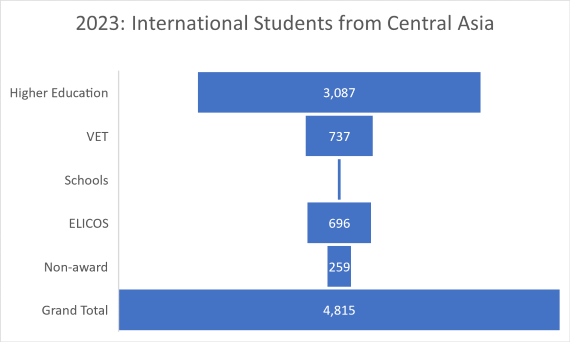
The chart above has been compiled based on data available from the Department of Education and is based on combined enrolments from 5 ex-Soviet Central Asian countries: Kazakhstan, Kyrgyzstan, Tajikistan, Turkmenistan and Uzbekistan. As 2 of these nations (Kirgiz, Tajik &Turkmen students studying around the globe are few and far between) are fairly large economies with many students choosing to study abroad.
There should be sufficient rationale to at least consider expanding the marketing of our educational programs to these marketplaces. It is obviously unrealistic to expect rapid growth in Central Asian enrolments, but Rome was not built in one day!
Should providers of educational programs be able to identify new potentially lucrative marketplaces – they should at the very least give them a go!