












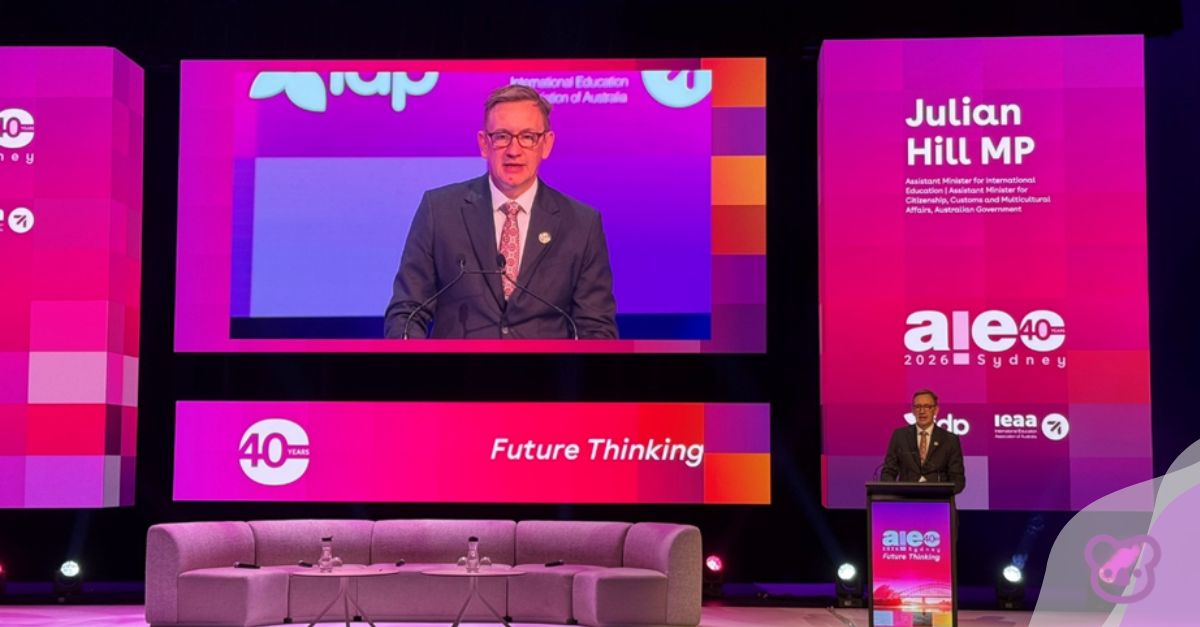
Assistant Minister for International Education Julian Hill has revealed that he is actively considering using Section 97 of the Education Services for Overseas Students (ESOS) Act for the first time, potentially suspending education providers from recruiting international students.
In a wide-ranging address to the Australian International Education Conference (AIEC) on Friday, Hill also criticised universities over high student visa refusal rates, defended recent restrictions on onshore visa applications and drew a sharp distinction between the contributions of public and private education providers.
Although Hill opened his address by describing international education as a major Australian success story, he also delivered some pointed messages to education providers about the government’s determination to maintain integrity and public confidence in the sector.
Section 97 under active consideration
Hill said he was “actively considering use of Section 97 of the ESOS Act for the first time ever”, as part of the government’s continuing efforts to strengthen integrity in international education. Section 97 allows the Immigration Minister to issue a suspension certificate where, in the Minister’s opinion, a significant number of international students or prospective students associated with a provider are entering or remaining in Australia for purposes not contemplated by their visas.
The Minister can consider factors including student visa applications involving fraudulent information, breaches of visa conditions, students remaining unlawfully in Australia after completing their courses and a provider’s risk score. A suspension certificate would prevent the provider from recruiting new international students for six months, with the possibility of further certificates.
Although Hill did not identify particular providers in his speech, the comments follow the government’s first use of new powers to suspend and cancel courses, targeting the Graduate Diploma of Management (Learning).
Hill also pointed to the ban on commission payments for onshore student transfers and the first use of course cancellation powers, saying he did not rule out further use of those powers. He also flagged further regulation of onshore student transfers.
‘I would have preferred Universities to put forward more students who meet visa requirements’
Hill acknowledged that it had been a difficult year for the sector, with policy changes and migration reforms adding to pressures from global competition and changing student demand. He expressed particular concern about the continuing high rate of offshore student visa refusals in South Asia, but rejected suggestions that tougher financial capacity assessments were being driven by migration targets.
He attributed the increase in refusals to integrity concerns, including applications from students unable to afford an Australian education without obtaining a longer-term migration outcome.
“Frankly, I would have preferred Universities to put forward more students who meet visa requirements,” Hill said.
He said new overseas student commencements at public universities were projected to fall by around 18% in 2026, reducing university revenue by approximately $2 billion over the next three years, with consequences for domestic students, staff and research.
At the same time, Hill acknowledged that high refusal rates were discouraging prospective students who Australia wanted to attract. Citing IDP and Navitas data and market feedback, he said students were increasingly concerned that an Australian visa refusal could damage their chances of studying in other countries.
Hill said the government wanted to make financial requirements clearer and improve visa grant rates, even if this meant raising financial standards and reducing the pool of prospective applicants.
He announced consultation on new financial standards and a replacement for Ministerial Direction 106, including options that would require prospective students to deposit substantial funds into Australian bank accounts before applying for a visa.
The proposals are covered in more detail in a separate article: https://thekoalanews.com/australian-bank-accounts-among-proposed-student-visa-reforms/
Five-day processing aim for some offshore applications
Hill also defended recent restrictions on onshore student visa applications, saying they were intended to address the growth of what he described as “permanently temporary” migrants.
He said the government wanted to reduce the number of people moving repeatedly between temporary visas and remaining in Australia without a realistic pathway to permanent residency.
However, Hill acknowledged that the changes would mean some genuine students would need to apply offshore to complete their studies. He said a new triage process had been established to give these applications the highest priority, with the Department instructed to aim for processing within five days for complete, straightforward applications.
For higher education students, the primary consideration would be whether they were genuinely progressing with their new provider, with clear evidence of progression an important part of their application.
Private providers and the public interest
Hill also drew a sharp distinction between public and private education providers, arguing that they should not be regarded as delivering equivalent value to Australia. He acknowledged that private providers could innovate, respond quickly to changing industry needs and expand or contract as demand shifted.
However, he argued that public providers reinvested their surpluses into teaching, infrastructure and research, while private providers generated private returns.












