









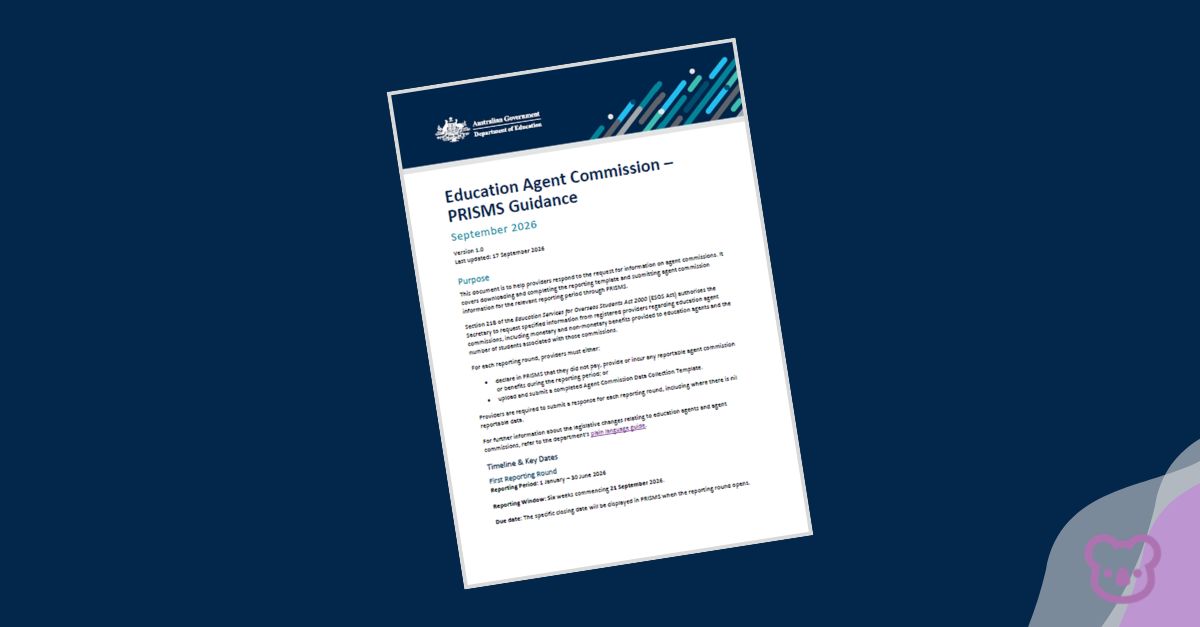
The first Education Agent Commission Data Collection opened in PRISMS today, requiring every CRICOS provider to report the commissions, incentives and non-cash benefits it provided to education agents between 1 January and 30 June 2026.
The collection runs until 30 October, with formal requests issued by the Department of Education to Principal Executive Officers and Registered School Delegates under section 21B of the ESOS Act.
On the surface, it is a data collection exercise.
In reality, it is the first serious attempt to shine a light on what happens financially between education providers and the agents who recruit their international students.
And the first round matters.
The data will give the department a baseline of how agent commissions and incentives operate across the sector and will help inform future reporting arrangements, policy and potentially regulation.
It sounds simple. It isn’t.
Providers have been asked to report direct commissions, indirect commissions, non-monetary benefits and the number of accepted students associated with direct payments.
The supporting guidance makes clear that this is not going to be a job for someone in finance to knock over between other tasks.
Recruitment, admissions, finance, legal, governance and PRISMS teams are likely to have a role in getting the numbers right.
That is because the department is asking providers to connect financial arrangements with the students and agents behind them.
For many institutions, this will be the first time they have had to map their agent relationships at this level of detail.
And that could be where things get interesting.
Direct or indirect? Good question.
The attribution test sits at the centre of the collection.
If a payment can be linked to the acceptance of an identifiable student, it is considered direct. If it cannot, it is indirect.
Straightforward enough.
Until you start looking at how agent agreements actually work.
Tiered commissions can be direct. Retainers are indirect. Volume bonuses will generally be indirect, even when they are triggered by enrolment numbers. Scholarships requested by an agent can also be treated as direct where they reduce revenue for a particular student.
Expect a few conversations around boardroom tables.
Finance may see one thing, recruitment another and legal will probably be the team asking everyone to document why they made the decision they did.
That is one of the less obvious consequences of the collection. It is not simply asking providers to report what they paid. It is asking them to understand why a payment should be classified in a particular way.
Then there are the things that aren’t cash
The collection also brings non-monetary benefits into the frame.
Familiarisation trips, merchandise, event support, portal access and discounted courses for agent staff are among the types of benefits providers may need to report.
There is no requirement to put a dollar value on these benefits. Providers simply need to describe them in 255 characters or fewer.
Which could produce an interesting snapshot of just how much agent engagement sits outside the traditional commission cheque.
PRISMS gets a new job
PRISMS is now the mechanism for collecting the information, with providers required to download the mandatory template, complete it and upload it through the system.
The department will pre-populate agent names, but providers are responsible for adding agents who meet the ESOS definition but aren’t listed.
Accepted students can only be counted where a direct commission is reported. Negative values are also permitted, which accommodates things such as clawbacks and reversals.
And providers with multiple CRICOS registrations will need to submit separate templates.
For a system more commonly associated with student and provider information, this is a fairly significant new role for PRISMS.
Which means the final week of the collection could get busy.
This is the baseline
The department says the purpose of the collection is to build a consistent evidence base on agent commissions across the international education sector.
There is also scope under section 175 of the ESOS Act for aggregate data to be published in the future.
The department will analyse the submissions and seek feedback before confirming future reporting arrangements.
That makes this first collection more than a six-week compliance exercise.
It is the baseline.
For providers, the immediate task is to reconcile finance, recruitment, admissions and PRISMS records, document classification decisions, check nil returns against actual activity and keep the working papers behind the submission.
For the department, the bigger task comes afterwards: deciding what this first look at agent commissions actually tells us.
The sector is about to find out just how transparent its agent ecosystem really is.
And so is the government.
For more information and to access published fact sheets, see here.