








Australia’s English language sector is undergoing a profound transformation, with a new national market report providing detailed analysis of the industry’s rapid contraction over the past two years. The findings suggest this may be more than a temporary correction.
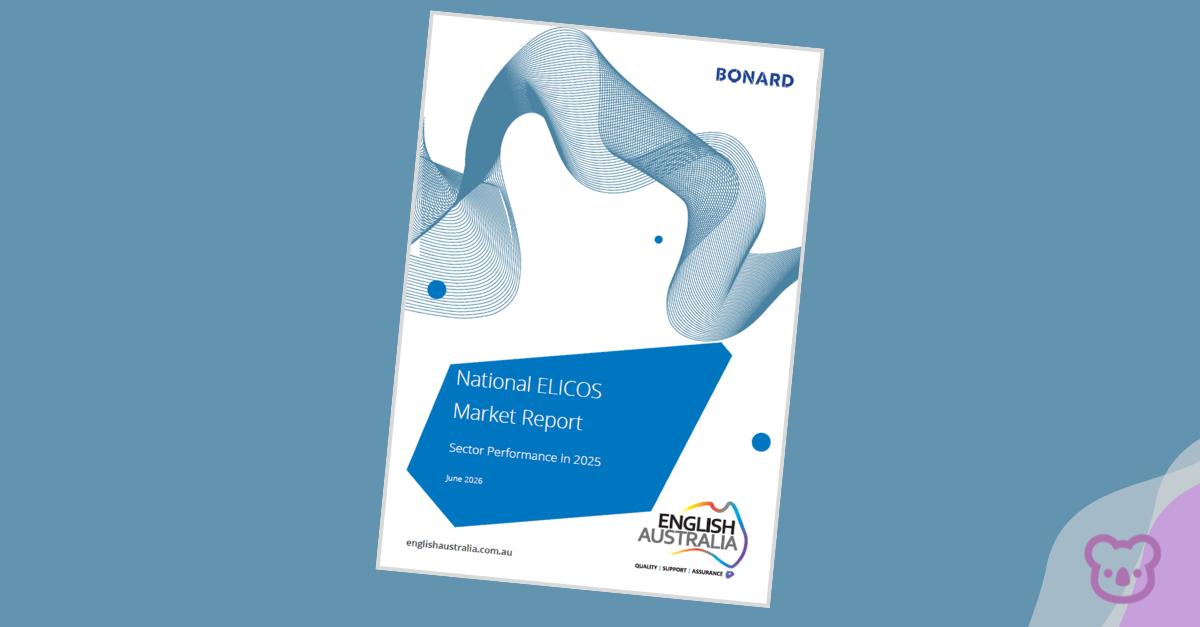
Presented during an English Australia webinar yesterday, the National ELICOS Market Report 2025 provides comprehensive data and analysis of enrolments in ELICOS in 2025 covering a range of key data points not available in government data that only covers student-visa holder headcount. The data paints the picture of a sector adapting to a very different operating environment after two consecutive years of significant contraction. While the full report remains available exclusively to English Australia members, the data it presents point to an industry being reshaped by visa policy, changing student behaviour and shifting global competition.
Rather than framing 2025 as simply another difficult year with a fall in enrolments of nearly 30%, the report shows the English language market has entered a new phase where government policy settings now exert greater influence over enrolments than traditional market demand.
The data analysis shows that changes to Australia’s student visa settings have altered the composition of the market itself. Student visa holders continue to form the largest cohort, but their share has fallen to less than 60% – the lowest level in well over a decade. Meanwhile visitor and working holiday visa holders now make up a much larger proportion of English language students than in previous years.
That shift has important consequences beyond enrolment numbers.
Students travelling on visitor visas typically undertake shorter courses, reducing overall study duration even when student numbers remain relatively resilient. The data shows that the higher proportion of non-student visa holders has meant average course lengths have shortened, contributing to a near 40% decline in total weeks of English study. Subsequently, this decline is reflected in an estimated fall in sector export earnings of $700mil.
The changing visa mix also appears to be influencing where providers are looking for growth opportunities.
Because traditional student visa recruitment has become increasingly challenging, providers are adapting by targeting markets where travellers are more likely to study while visiting Australia or combining English study with working holiday travel.
The report identifies noticeable changes across major source markets, with some long-established markets declining more sharply than those that rely less heavily on student visas. Rather than signalling a wholesale collapse in demand for Australia, the findings suggest demand is being constrained by the type of visa students can realistically access.
That changing profile is also altering Australia’s position internationally.
Drawing on global English language market data, the report shows that Australia has experienced the sharpest contractions among the major English-teaching destination countries (UK, USA, Canada, Australia, Ireland), with government intervention around visa settings and migration policy emerging as the defining factor. It notes that other study destinations are also facing headwinds, including economic uncertainty and cost-of-living pressures, but with less severe impact than felt in Australia.
The report also highlights the growing pressures facing providers themselves.
The national survey identified ELICOS providers’ concerns for the future are dominated by visa refusals, visa costs, visa decision-making transparency and consistency, visa processing times and increasing regulatory complexity. Collectively, these factors have become central business challenges for English language colleges many of which have yet to recover after the pandemic.
Despite the difficult conditions, the report does point to sector resilience.
Group programme and young learner enrolments have strengthened, predominantly from specific parts of Asia.
However, the clear conclusion emerging from today’s webinar is that the sector may now be operating under a fundamentally different set of assumptions than existed before the pandemic.
For decades, Australia’s English language industry was built largely around international students arriving on dedicated student visas, developing their English proficiency and academic skills before progressing into vocational or higher education programmes. These pathway students traditionally represented approximately 60% of the sector’s students. The report shows that while pathway enrolments remained important in 2025 they no longer dominate the market in the same way, representing approximately 40% of all English students.
Hence, providers are increasingly serving a more diverse cohort whose study decisions are shaped more by immigration settings than educational aspirations.
Whether that represents a temporary adjustment or a permanent structural change will likely depend less on international demand and more on future government policy.
ELICOS has long served as one of Australia’s strongest entry points into further study, ensuring not just English language proficiency but academic readiness and a ‘soft landing’ that helped students acclimatise before their main studies. With that pipeline continuing to narrow, the effects will be felt well beyond the English language sector itself over the coming years.